What Is Lean Manufacturing?
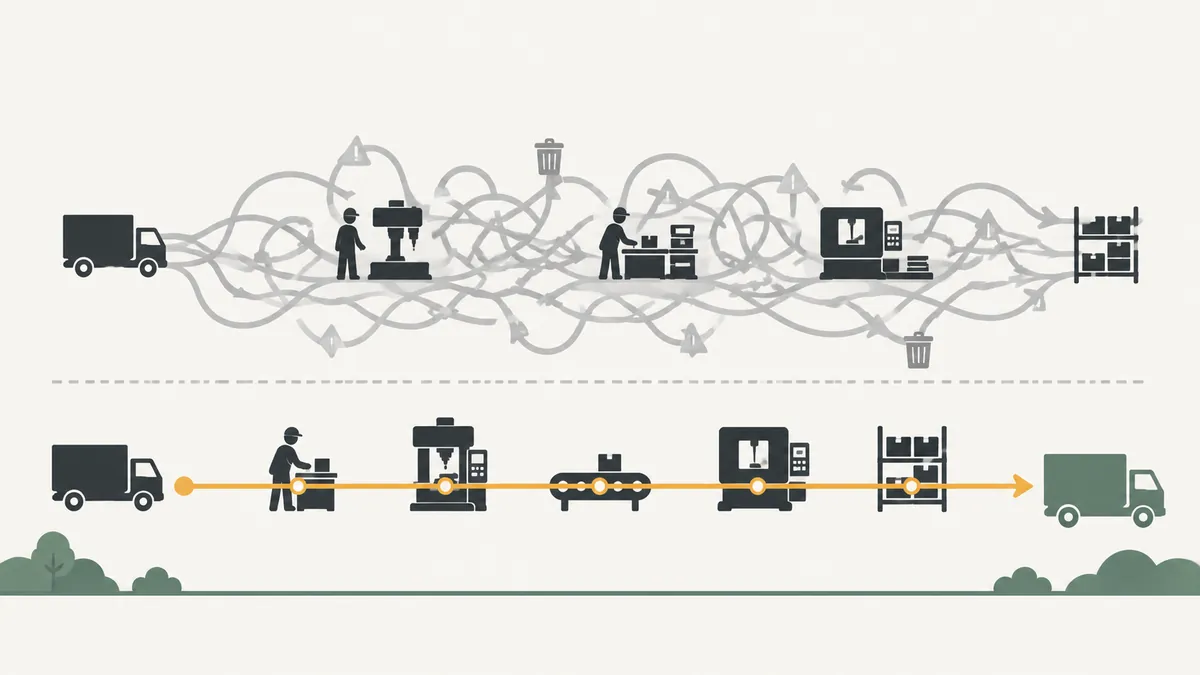
Lean manufacturing is a way of running production that delivers more value to the customer with less waste. Instead of adding resources, lean removes everything that consumes time, material and effort without giving the customer anything they would pay for.
Its practical base is the Toyota Production System, developed in Japan after World War II with major contributions from Taiichi Ohno. The word "lean" spread in the West from studies of the global auto industry, and James Womack and Daniel Jones organized it into principles in the book Lean Thinking.
The Lean Enterprise Institute describes lean thinking as a way of thinking and acting that continually improves the value delivered to customers while developing the people who do the work. Both halves matter, process and people. Lean without respect for people turns into plain cost cutting.
You can recognize a lean operation by five signs: little stock sitting between steps, visible flow, problems that surface immediately, standardized work and operators who suggest improvements. If inventory hides defects, parts wait in queues and rework is accepted as normal, there is a lot of lean left to apply.
Lean is also different from cost reduction. A budget cut is a one-time decision. Lean changes how work is done, and cost falls as a result of less waiting, fewer defects and less pointless motion.
The 5 Principles of Lean
The five principles work as a cycle. Each pass exposes a new problem to solve.
- Value: define what the customer recognizes as value and will pay for. The starting point is always the customer, never the process.
- Value stream: map every step from order to delivery and separate what adds value from waste. The classic tool is value stream mapping.
- Flow: make the product move without stops, queues or backtracking, in small batches.
- Pull: produce only what the downstream process consumes, at the pace of demand.
- Perfection: repeat the cycle without end, through continuous improvement involving everyone.
Each principle has tools behind it. Pull, for example, usually relies on kanban and supermarkets, and flow depends on small batches and quick changeovers.
One detail many teams skip: the first principle is defining value. Without it, a company can eliminate waste in an activity the customer never wanted. Value is the feature of a product or service the customer is willing to pay for, delivered when and at the price they expect.
Waste: The Target of Lean
Waste, or muda, is any activity that consumes resources without adding value for the customer. Ohno defined seven types in production. Many US sources add an eighth, unused talent, and remember the list with the acronym DOWNTIME. The grouping is a practical way to organize what you see, and authors differ on it.
| Waste | Shop floor example |
|---|---|
| Defects | Rework and scrap |
| Overproduction | Making more, or earlier, than the customer asks |
| Waiting | A part sitting in line for the next process |
| Non-utilized talent | Operator ideas that nobody collects |
| Transportation | Carts moving material between distant departments |
| Inventory | Pallets of semi-finished parts between steps |
| Motion | Operator walking to look for a tool |
| Extra processing | Finishing beyond what the specification requires |
Ohno considered overproduction the worst waste because it causes and hides the others: it builds inventory, requires transport, takes space and masks defects. Making only what was ordered is the center of pull logic.
Go deeper in the article on the 8 wastes of lean. Besides muda, lean also fights unevenness (mura) and overburden (muri).
Pillars and Tools of the Lean System
The Toyota system is usually drawn as a house. The two pillars are just in time (the right item, in the right amount, at the right time, at the pace of takt time) and jidoka (stopping at the first sign of abnormality so defects do not move on). The foundation is stability: standardized work, production leveling and continuous improvement.
| Goal | Tools |
|---|---|
| Organize the workplace | 5S, visual management |
| Improve machine availability | TPM, SMED, OEE |
| Make flow happen | Kanban, just in time, heijunka, takt time |
| Prevent defects | Jidoka, poka-yoke, andon |
| Solve problems | PDCA, 5 Whys, A3 report |
| Align strategy | Hoshin kanri |
No single tool makes a lean system. A company that installs kanban without stabilizing the process just moves the queue somewhere else. Continuous improvement is what keeps the other tools working.
Worked Example: How Much of Lead Time Adds Value?
Illustrative example, with made-up numbers for the calculation. A batch of sheet metal parts goes through four steps. The table shows the wait before each step and the processing time.
| Step | Wait before (h) | Processing (h) |
|---|---|---|
| Cutting | 9 | 0.5 |
| Bending | 11 | 0.5 |
| Welding | 8 | 0.5 |
| Assembly | 10 | 0.5 |
| Total | 38 | 2 |
Step 1. Lead time is the sum of everything: 38 + 2 = 40 hours.
Step 2. Value-added ratio (also called process cycle efficiency) = time that transforms the product ÷ lead time = 2 ÷ 40 = 5%. To keep it simple, we treat all processing as value added.
Step 3. The other 95% is waiting. That is where lean acts, through continuous flow, smaller batches and pull production.
Expected result. If flow cuts the waiting in half (38 ÷ 2 = 19 h), lead time drops to 19 + 2 = 21 hours, a reduction of 19 ÷ 40 = 47.5%, and the ratio rises to 2 ÷ 21 = 9.5%. Nobody worked faster: the gain came from eliminating the queue.
How to read the result: a very low value-added ratio is common in processes without flow, and it does not mean people work badly. It means the system leaves the product waiting. Recalculate after each improvement and use the number to prioritize, not to blame the operator.
Lean vs Traditional Mass Production
| Aspect | Traditional mass production | Lean |
|---|---|---|
| Starting point | Machine capacity | Customer value |
| Batches | Large, to spread out setup | Small, with quick changeover |
| Scheduling | Pushed by forecast | Pulled by consumption |
| Quality | Inspection at the end | Built in at the source, with jidoka |
| Role of people | Perform the task | Perform and improve the task |
Lean and Six Sigma complement each other: one attacks flow and waste, the other reduces variation. See the comparison in lean vs Six Sigma. The same principles also apply in offices and hospitals, which gave rise to lean office and lean healthcare.
Typical benefits of a well-run program include shorter lead time, less work in process, more stable quality, a tidier workplace and more engaged teams. Results vary widely from case to case, so measure your own starting point before promising numbers.
How to Implement Lean and Common Mistakes
- Pick one product family. Do not try the whole plant at once.
- Go to the gemba and map the current state with real times.
- Stabilize the basics: 5S, standardized work and one indicator per area.
- Attack the longest wait with a short PDCA cycle.
- Standardize, measure again and choose the next problem.
Common mistakes: copying tools without understanding the problem, using lean as an excuse for layoffs, leaving leaders off the shop floor and dropping the cycle after the first win. Another frequent error is tracking only cost and ignoring delivery time, which is what the customer feels first. Define a few indicators, such as lead time, first time quality and on time delivery, and review them daily at the workstation.
Next Step
Choose one product, time the wait between steps and calculate the value-added ratio, as in the example. That simple number shows where the queue is and justifies the first project. Record the result, share it with the team and repeat it after the first improvement. Then go deeper into the tool that attacks the longest wait: kanban if the problem is too many pushed orders, quick changeover if batches are large because of setup, 5S if operators lose time searching for material.
Frequently asked questions
What is lean manufacturing in simple terms?
It is a way of running production to deliver what the customer values with minimum waste, while constantly improving the process and developing people.
What are the 5 principles of lean?
Value, value stream, flow, pull and perfection, as described by Womack and Jones in Lean Thinking.
What is the difference between lean and the Toyota Production System?
The Toyota Production System is the practical origin. Lean generalizes its principles to other companies and industries.
What are the 8 wastes of lean?
Defects, overproduction, waiting, non-utilized talent, transportation, inventory, motion and extra processing.
Does lean work for small businesses?
Yes. 5S, visual management and PDCA need little investment and work at any size.
Is lean only for manufacturing?
No. The same principles are used in offices, healthcare, logistics and services.
How long does it take to see results from lean?
Targeted gains, such as shortening one queue, can show up in weeks. Changing the culture takes years of steady practice.
Sources
- Lean Enterprise Institute. Lean Thinking and Practice. Lean Lexicon. https://www.lean.org/lexicon-terms/lean-thinking-and-practice/
- Lean Enterprise Institute. Toyota Production System. Lean Lexicon. https://www.lean.org/lexicon-terms/toyota-production-system/
- Lean Enterprise Institute. Seven Wastes. Lean Lexicon. https://www.lean.org/lexicon-terms/seven-wastes/
- Womack, J. P.; Jones, D. T. Lean Thinking. New York: Simon & Schuster, 1996.
Want to lead lean change in practice?
Download the free "Lean for Leaders" e-book and learn how to sustain lean in daily operations.
Download the e-book
About the author
Lean Manufacturing & Behavioral Management Specialist
Over 20 years in the automotive and metalworking industries (GM and Dana), Lean Manufacturing practitioner since 2006. SENAI instructor and mentor in Brazil’s Brasil Mais Produtivo program, delivering consulting, training and audits for 50+ companies, combining quality, productivity and people development.