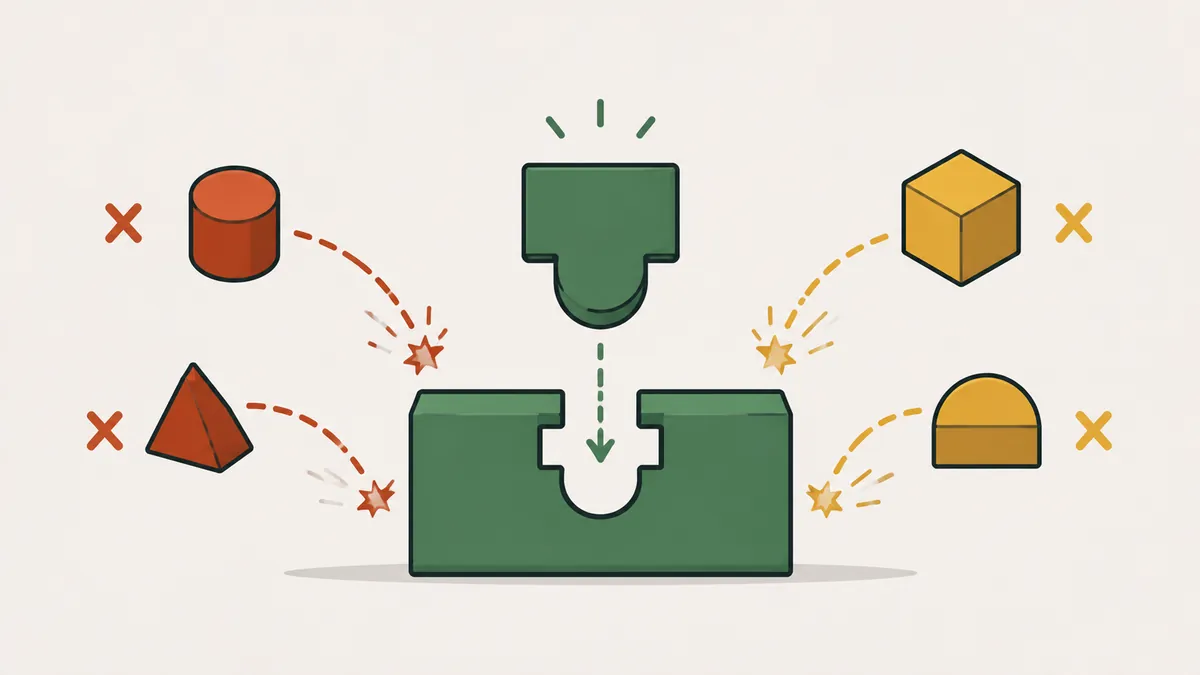
What is poka-yoke
Poka-yoke is a Japanese term that means error-proofing (or mistake-proofing). According to the Lean Enterprise Institute (LEI), these are simple, inexpensive devices that help operators avoid mistakes such as using the wrong part, leaving a part out or installing it backwards. Poka means an inadvertent error and yoke means prevention.
The concept was developed by Shigeo Shingo, an engineer who worked with Toyota, starting in the 1960s. The original name, baka-yoke, was changed because it sounded insulting to operators. The idea behind it is still current: people make mistakes, and the system should be designed so a mistake does not become a defect.
A mistake and a defect are different things. The error is the cause, a wrong action by a person or a machine. The defect is the result, the bad part that reaches the customer. Poka-yoke works in between: it prevents the error or detects it before it becomes a defect.
Why is inspection not enough? The LEI points to two limits of traditional inspection. Sampling inspection guarantees that defects get through, because the sample does not always contain the defects in the lot. 100% inspection at the end of the line is costly and finds the defect far from its source, which makes it hard to remove the cause. Poka-yoke flips the logic: instead of sorting out the bad part afterward, it keeps the bad part from being made.
Shingo described three kinds of inspection, and the difference shows where poka-yoke fits. Judgment inspection separates good from bad after the fact. Informative inspection uses defect data to correct the process. Source inspection checks the condition that causes the error before it happens, and that is where poka-yoke works.
Types of poka-yoke
There are two ways to classify them. The first is by function, meaning what the device does when it detects the error:
| Function | How it works | Example |
|---|---|---|
| Control (shutout) | Prevents the operation or stops the process when there is an error. This is the stronger type. | Press that only cycles when the part is in the correct position |
| Warning (alert) | Signals the error with light or sound, but depends on someone reacting. | Sensor that lights up when a screw is missing |
Whenever possible, prefer control. Warning fits when stopping the process would cause a larger loss.
The second is by detection method, as described by Shingo:
| Method | What it checks | Example |
|---|---|---|
| Contact | Shape, size or color of the part | Fixture with a guide pin: the part only fits in the right orientation |
| Fixed value (counting) | Whether the number of parts or movements is the expected one | Tray with 6 screws that must be empty at the end of assembly |
| Motion-step (sequence) | Whether all steps were done in order | Sensor that blocks the cycle if the previous step was not completed |
Everyday examples are familiar: a USB-C connector that fits both ways, a microwave that only runs with the door closed and an automatic car that only starts in park.
Levels of protection: strongest to weakest
Not every poka-yoke protects equally. A practical organization, which varies between authors, ranks solutions from strongest to weakest:
| Level | Idea | Example |
|---|---|---|
| Eliminate | Remove the step where the error is born | Design the part so a backwards assembly cannot exist |
| Prevent | Make the error physically impossible | Connector that only fits one way |
| Replace | Swap an error-prone process for a more reliable one | Automatic dosing instead of manual measuring |
| Facilitate | Make the right action the easiest one | Color coding and labels at the point of use |
| Detect | Identify the error right after it happens | Sensor that stops the line or sounds an alert |
| Mitigate | Reduce the effect of the error when it happens | Limiter that avoids damage to the part |
Start from the top of the table. Detect and mitigate are useful, but only after eliminate and prevent are exhausted.
Worked example: the screw that went missing
Illustrative example. A station assembles a cover with 6 screws, 2,000 assemblies per week. Through oversight, 40 assemblies per week left with a screw missing and went back for rework, at 15 minutes each. The solution: a tray with 6 screw holes and a sensor that only releases the assembly when the tray is empty (fixed value method, control type).
| Indicator | Before | After |
|---|---|---|
| Assemblies per week | 2,000 | 2,000 |
| Assemblies with a missing screw | 40 | 2 |
| Defect rate | 2.0% | 0.1% |
| Rework (15 min each) | 600 min (10 h) | 30 min (0.5 h) |
Defect rate: 40 ÷ 2,000 = 2.0% before and 2 ÷ 2,000 = 0.1% after. Rework: 40 × 15 = 600 minutes (10 hours) before and 2 × 15 = 30 minutes (0.5 hour) after. The station recovers 10 − 0.5 = 9.5 hours per week.
The reduction in defects is (40 − 2) ÷ 40 = 95%. The 2 remaining cases show that no device is perfect: a tray may be refilled wrongly or the device may be bypassed. That is why it must be checked every shift.
It is worth comparing cost. If the device took a few hours of maintenance time to build and gave back 9.5 hours per week, the investment pays back within a few weeks, without counting the cost of a defect reaching the customer.
Where to apply it: examples by type of error
Poka-yoke works for any repetitive, predictable error. These are the most common in production:
- Wrong or missing part: a tray with one hole per item and a presence sensor that blocks release of the assembly.
- Backwards part: a guide pin or an asymmetric hole in the fixture, so only the correct position fits.
- Wrong parameter: a machine that only starts the cycle if the selected program matches the product on the order.
- Forgotten step: an operation sequence where each step releases the next, like the torque tool that logs the tightening of every bolt.
- Similar connectors: different shapes and colors, so they cannot be swapped.
Outside the factory the logic is the same: the required field on a form, the address check at checkout and the missing attachment warning in email prevent or catch the error on the spot.
How to implement poka-yoke, step by step
- Pick the right error. Use quality data or complaints and a Pareto chart to find the defect that repeats most. FMEA helps prioritize the most severe failure modes.
- Go to the station and understand how the error happens, using the 5 Whys.
- Define the level of protection. Can the error be made impossible? If not, can it be made obvious on the spot?
- Build a cheap prototype and test it with the operators, including new ones.
- Standardize. Record the device in standardized work and check at the start of each shift that it works.
- Measure the result and compare it with the defect rate before.
Three questions help design the device: what exactly must the operator get right? What physical condition proves it was done right? How can that condition be turned into something the fixture, sensor or machine checks by itself? If the answer depends on human attention, it is not poka-yoke yet.
Poka-yoke, jidoka, FMEA and inspection
These terms show up together and get confused. Each has a role:
| Term | Role | Relation to poka-yoke |
|---|---|---|
| Poka-yoke | Prevents the error or detects it where it occurs | It is the device |
| Jidoka | Pillar of the Toyota Production System: the machine or operator stops the line when an abnormality is detected | Poka-yoke is one of the tools of jidoka |
| FMEA | Anticipates failures and ranks them by severity, occurrence and detection | Shows where a poka-yoke is most needed |
| Inspection | Finds the defect after it is made | Poka-yoke acts earlier, at the source |
In short: FMEA says where to look, poka-yoke protects the critical point and jidoka makes sure that, if something gets through, the process stops.
Benefits: less rework and scrap, less inspection, faster training for whoever joins the station and quality that does not depend on the operator's attention at the end of a shift. Limits: poka-yoke covers repetitive, predictable errors; it does not fix a product design error or rare, unpredictable failures, and it needs periodic verification to keep working.
Common mistakes
- Using training or a sign on the board as if they were poka-yoke. A reminder does not prevent an error.
- Building an expensive, complex device when a simple solution would do.
- Letting the operator bypass the device, removing the sensor or fixture because it is a nuisance. If that happens, the design is poor, because it slows the cycle or was made without listening to the operator.
- Not checking the device at the start of the shift. A broken sensor is worse than none, because it gives false security.
- Jumping to the solution without finding the cause of the error.
- Not involving the people who run the station in the design.
- Applying poka-yoke to everything: too many devices complicate the station. Focus on the errors with the highest severity and frequency.
Next step
Take the defect that repeats most in your process and count how many times it occurred last month. Go to the station, run the 5 Whys and ask whether the error can be made impossible. Build a cheap prototype this week, test it for one shift and compare the defect rate. If the result shows up, standardize it and replicate at the next station.
Before closing, check three points: the device is simple enough that the operator will not want to bypass it; someone is responsible for testing it at the start of the shift; and the result is recorded on the metrics board so the improvement is seen and sustained.
Frequently asked questions
What is poka-yoke?
It is an error-proofing device or method: simple and inexpensive, it prevents the error from happening or detects it before it becomes a defect.
What does poka-yoke mean?
It means error-proofing. Poka is an inadvertent error and yoke is prevention.
What are the types of poka-yoke?
By function, control and warning. By detection method, contact, fixed value (counting) and motion-step (sequence).
What is the difference between poka-yoke and jidoka?
Jidoka is the pillar of giving the process the ability to stop when it detects an abnormality. Poka-yoke is one of the tools used for that.
Does poka-yoke have to be expensive?
No. The LEI definition speaks of simple, inexpensive devices. A guide pin or a tray with holes already solves many cases.
What are examples of poka-yoke?
A fixture with a guide pin, a tray that must end up empty, a presence sensor, connectors with different shapes and an automatic car that only starts in park.
Who created poka-yoke?
Shigeo Shingo, an engineer who worked with Toyota and developed the concept starting in the 1960s.
What is the difference between an error and a defect?
The error is the wrong action, the cause. The defect is the bad part that results from it. Poka-yoke acts between the two.
Sources
- Lean Enterprise Institute. Poka Yoke. Lean Lexicon. https://www.lean.org/lexicon-terms/poka-yoke/
- Lean Enterprise Institute. Jidoka. Lean Lexicon. https://www.lean.org/lexicon-terms/jidoka/
- SHINGO, S. Zero Quality Control: Source Inspection and the Poka-Yoke System. Productivity Press, 1986.
- SHINGO, S. A Study of the Toyota Production System from an Industrial Engineering Viewpoint. Productivity Press.
Want the tools ready to use?
Download the free "Problem Solving Kit" e-book, with PDCA, A3, 5 Whys and Ishikawa.
Download the e-book
About the author
Lean Manufacturing & Behavioral Management Specialist
Over 20 years in the automotive and metalworking industries (GM and Dana), Lean Manufacturing practitioner since 2006. SENAI instructor and mentor in Brazil’s Brasil Mais Produtivo program, delivering consulting, training and audits for 50+ companies, combining quality, productivity and people development.