What Is Kaizen?
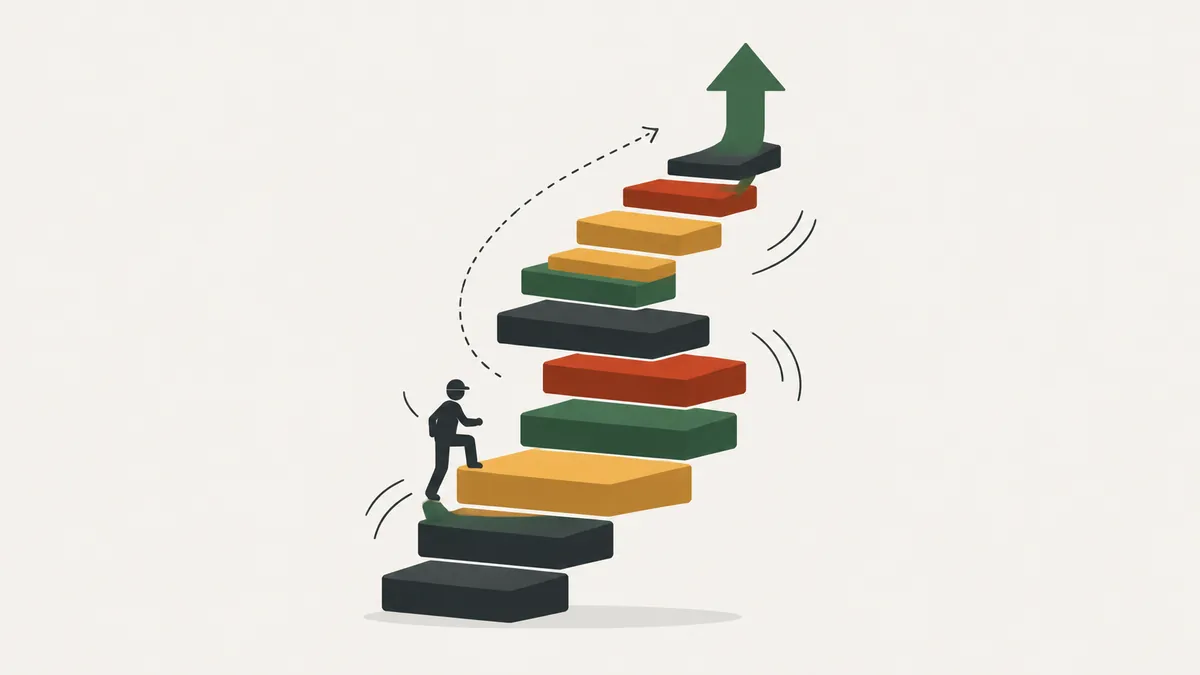
Kaizen is a Japanese word made of kai (change) and zen (for the better). In management it means continuous improvement: small, constant improvements in processes, with everyone taking part, from the operator to the executive team.
The idea is simple. An improvement of a few seconds does not look big, but ten of them, added up and sustained, change the result of a workstation. According to the Lean Enterprise Institute, Masaaki Imai introduced the philosophy to the world in 1986, in the book Kaizen: The Key to Japan's Competitive Success.
Kaizen is not a project with an end date. It is a routine of looking at the work, finding a waste and fixing it. That is why it sits at the heart of lean manufacturing, where it matches the principle of perfection.
Kaizen is not limited to the factory. It shows up in maintenance, the warehouse, quality, customer service and offices, wherever a repeated process has someone who performs it. It does not depend on technology either: a board, a stopwatch and attention are enough to start.
What makes it hard is not the technique but the discipline. Improving a little each day requires time set aside in the routine, leadership support and fast feedback on ideas. Without those three, the program becomes a campaign and ends within a few months.
Kaizen Principles
Authors organize the principles in different ways. This is a practical grouping of what repeats across the literature:
- Focus on the process, not on blame. When something fails, ask where the process allowed the error.
- Small, frequent improvements. Simple, low cost changes that do not depend on big investment.
- Everyone participates. The person who does the task knows the problem better than someone watching from a distance.
- Go and see. The facts are at the gemba, the place where work happens. See the gemba walk.
- Standardize what worked. Without a standard the gain is lost and the process slides back.
In practice, this requires the leader to go to the workstation, watch the work for several cycles and listen to the operator before proposing any solution. Many good improvements cost less than an hour of machine downtime.
These principles change the manager's question. Instead of "who made the mistake?", it becomes "what in the process let this happen?".
Daily Kaizen vs Kaizen Event
| Daily kaizen | Kaizen event | |
|---|---|---|
| Size | Small improvements at the workstation | Focused change in one process |
| Duration | Ongoing | Usually a few days to a week |
| Who | Operators and area leaders | Dedicated cross functional team |
| Example | Moving a tool closer to the operator | Redesigning a cell layout |
They complement each other. The event creates a jump; daily kaizen keeps the process from sliding back. In the US, a short event is often called a kaizen blitz. Imai also describes other classifications, such as management oriented, group oriented and individual kaizen.
PDCA as the Engine of Kaizen
Improvement happens through the PDCA cycle: plan the change, do it on a small scale, check the result and act, either standardizing what worked or starting again. Without the "check", a company piles up changes without knowing which ones improved anything.
When the cause of the problem is unknown, the cycle starts with root cause analysis such as the 5 Whys. For bigger problems, use an A3 report.
Here is PDCA applied to the first improvement in the example below. Plan: the operator notices losing 6 seconds per cycle bending down for screws, and proposes a tilted bin within arm's reach. Do: the bin is installed for a test shift. Check: the stopwatch shows a 54 second cycle. Act: the position becomes a written standard and the idea is copied to identical stations.
Once a standard exists, many companies rename the cycle SDCA (standardize, do, check, act). It keeps the gain stable until the next PDCA raises the level. Kaizen is the alternation between the two.
Worked Example: Three Cycle Time Improvements
Illustrative example, with made-up numbers for the calculation. An assembly station has a cycle time of 60 seconds and works 27,000 useful seconds per shift (7.5 hours). The team applies three small improvements in sequence.
| Improvement | Reduction | Cycle (s) | Units per shift |
|---|---|---|---|
| Starting point | - | 60 | 450 |
| 1. Screw bin within arm's reach | 6 s | 54 | 500 |
| 2. Part positioning fixture | 4 s | 50 | 540 |
| 3. Cart at the right height, no bending | 5 s | 45 | 600 |
Step 1. Units per shift = useful time ÷ cycle. At the start: 27,000 ÷ 60 = 450 units.
Step 2. Total cycle reduction: 6 + 4 + 5 = 15 s, or 15 ÷ 60 = 25%.
Step 3. Final output: 27,000 ÷ 45 = 600 units, 150 more per shift (150 ÷ 450 = 33.3%). Over 22 working days, that is 3,300 units.
Notice the difference: cutting 25% of the time yields 33.3% more units, because the time in the denominator shrinks. The gain only becomes a result if the station is the bottleneck and there is demand for the extra output. Otherwise the freed time should go into another improvement, not into inventory.
Also notice the cost: the three improvements were cheap and made by the team itself. That profile, low cost and high frequency, is what separates kaizen from an investment project.
Kaizen vs Innovation vs PDCA
| Aspect | Kaizen | Innovation (kakushin) |
|---|---|---|
| Size of change | Small and gradual | Large and radical |
| Pace | Continuous, never ending | One time, per project |
| Investment | Low | Usually high |
| Who takes part | Everyone | Specialists and a project team |
| Risk | Low | Higher |
One does not replace the other. Imai describes innovation as the leap and kaizen as the steady climb between leaps. PDCA is not a competitor: it is the method kaizen uses to improve.
How to Implement Kaizen and What Kills It
- Start from a visible problem. A workstation indicator, such as daily scrap or cycle time, shows where to act.
- Create a simple channel for ideas, like a board in the area with the name of whoever suggested.
- Respond quickly. An idea left unanswered for days teaches people that suggesting is pointless.
- Test small, on one shift or one machine, before spreading.
- Standardize with standardized work. The standard is the base for the next kaizen.
- Show the before and after at the workstation, with a photo and a number.
To know where to look for improvements, use the wastes as a lens: waiting, motion, transportation, rework, inventory, extra processing and overproduction. At each station ask where the operator walks, searches, waits or redoes work. The answers become the idea list.
To sustain the program, define one simple indicator per area, such as cycle time, scrap or number of ideas implemented per month. Measuring ideas implemented, not just ideas received, keeps the board from becoming a wall of forgotten suggestions.
Common mistakes: treating kaizen as a yearly blitz with no routine in between; rewarding only big savings, which discourages small improvements; not standardizing and watching the process slide back; and leaders who demand results but never go to the gemba.
Next Step
Pick one workstation, time the cycle 10 times and write down where the operator loses seconds: searching, walking, waiting. Make a single improvement this week, measure again and post the before and after on a board in plain sight. Repeat next week. In a month you will have the habit, which is worth more than any single event.
Frequently asked questions
What does kaizen mean?
It is a Japanese word meaning change for the better, used in management as a synonym for continuous improvement.
Who created kaizen?
Kaizen grew out of Japanese company practices after World War II. Masaaki Imai introduced it to the world in 1986, according to the Lean Enterprise Institute.
What is the difference between kaizen and a kaizen event?
Kaizen is everyday improvement. A kaizen event is a focused effort of a few days on one specific process.
What is the difference between kaizen and innovation?
Kaizen makes small, continuous changes. Innovation makes large, one time changes, usually with higher investment.
Are kaizen and PDCA the same thing?
No. Kaizen is the philosophy of always improving, and PDCA is the method cycle that organizes each improvement.
How long does a kaizen event last?
Usually a few days to a week, with a cross functional team dedicated to a single process.
Does kaizen work in small companies?
Yes. It needs little investment and depends more on routine and participation than on resources.
Sources
- Lean Enterprise Institute. Kaizen: A Resource Guide. Lean Lexicon. https://www.lean.org/lexicon-terms/kaizen/
- Lean Enterprise Institute. PDCA. Lean Lexicon. https://www.lean.org/lexicon-terms/pdca/
- Imai, M. Kaizen: The Key to Japan's Competitive Success. New York: Random House, 1986.
- Liker, J. K. The Toyota Way: 14 Management Principles from the World's Greatest Manufacturer. New York: McGraw-Hill, 2004.
Want the tools ready to use?
Download the free "Problem Solving Kit" e-book, with PDCA, A3, 5 Whys and Ishikawa.
Download the e-book
About the author
Lean Manufacturing & Behavioral Management Specialist
Over 20 years in the automotive and metalworking industries (GM and Dana), Lean Manufacturing practitioner since 2006. SENAI instructor and mentor in Brazil’s Brasil Mais Produtivo program, delivering consulting, training and audits for 50+ companies, combining quality, productivity and people development.