- What hoshin kanri is
- The problem it solves
- How strategy deployment works
- Worked example: lead time from 15 to 7 days
- Catchball: the conversation that makes the plan real
- The X-matrix: one page to see everything
- The monthly review with PDCA
- Hoshin kanri vs. OKR vs. balanced scorecard
- Common mistakes
- Next step
- Frequently asked questions
What hoshin kanri is
Hoshin kanri, also called strategy deployment or policy deployment, is a framework for building sustained high performance and producing results with the structured thinking of PDCA. In Japanese, hoshin means direction, or compass, and kanri means management. It originated in Japan, tied to total quality control, and is now part of the lean toolbox.
According to the Lean Enterprise Institute, the central point is vertical and horizontal alignment: from the president to the front line and across departments, so that every person understands how their work contributes to the company's objectives.
It is worth clarifying what it is not. It is not a system of individual targets used to pressure people, nor a five-year strategic plan kept in a drawer. It is an annual cycle of planning and execution, with frequent reviews, in which leadership sets the direction and every level says how it will contribute.
The problem it solves
In many companies, strategy lives in an annual slide deck while the shop floor works to a different logic: fighting the fires of the day. Each area chases its own goals, sometimes in conflict. Purchasing cuts cost with larger lots while production tries to cut inventory. Sales promises a short lead time while planning protects equipment efficiency.
Hoshin kanri connects the two worlds and picks a few priorities. It answers four questions: where are we going, what must change this year, who does what, and how will we know we are on track.
How strategy deployment works
| Level | Question | Example in this article |
|---|---|---|
| Direction (3 to 5 years) | What must change in the coming years? | Be the regional benchmark for delivery time |
| Annual objective | Which few objectives this year get us there? | Reduce lead time from 15 to 7 days |
| Area | What does each area do to get there? | Production: cut changeover time. Logistics: finished goods kanban |
| Team | Which metric do we track on the board? | Changeover time per machine, days of finished goods |
Each level turns the objective above it into something its team controls. An operator does not control plant lead time, but does control the changeover time at the station, and that is the number that goes on the board.
Two precautions make a difference. The first is to limit the quantity: few objectives per level, so the team's attention is not split. The second is to make sure every lower target supports an upper one. If an area has a target that supports no annual objective, either it is routine and belongs to day-to-day management, or it is a distraction.
Worked example: lead time from 15 to 7 days
Suppose a manufacturer sets as its annual objective cutting lead time from 15 to 7 days. The reduction is 8 days, or 53.3% (8 ÷ 15). The numbers below are illustrative.
The first step is to break the current lead time into its parts, so each area knows where to act.
| Lead time component | Today (days) | Target (days) | Reduction (days) | Initiative |
|---|---|---|---|---|
| Queue in production | 6 | 3 | 3 | SMED on the press: changeover from 60 to 30 minutes, with smaller lots |
| Processing | 5 | 3 | 2 | Continuous flow in the assembly cell |
| Finished goods waiting for shipping | 4 | 1 | 3 | Finished goods kanban and delivery scheduling |
| Total | 15 | 7 | 8 |
The reductions add up: 3 + 2 + 3 = 8 days. Each initiative has an owner, a metric and a deadline. That way, any project on the shop floor, such as SMED on the press or kanban for shipping, can be traced back to an executive objective. That traceability is what sets hoshin kanri apart from a list of unconnected projects.
Notice also that the overall target was split into parts that add up to exactly the total. That is a simple consistency test: if the area targets, added together, do not deliver the objective, the plan has a gap. In this example no single area solves lead time. If production delivers everything and shipping does not, customer lead time only falls from 15 to 10 days (3 + 3 + 4), because finished goods still sit for 4 days.
Catchball: the conversation that makes the plan real
Deployment is not an order handed down. It is a negotiation in which each level receives the objective, assesses what is possible, proposes how it can contribute and sends it back, like a ball passed from one side to the other. This back and forth is called catchball. It turns the target into a commitment by the people who will carry it out and, according to the LEI, builds capability through strategic delegation of responsibility.
In the example, leadership proposes cutting press changeover from 60 to 30 minutes. Production answers that the target is possible but requires tool carts and team training. Leadership approves the resources, and the target stays at 30 minutes, now with a real plan behind it. Without the conversation, the target would arrive as a loose number, with no resources and no owner.
The X-matrix: one page to see everything
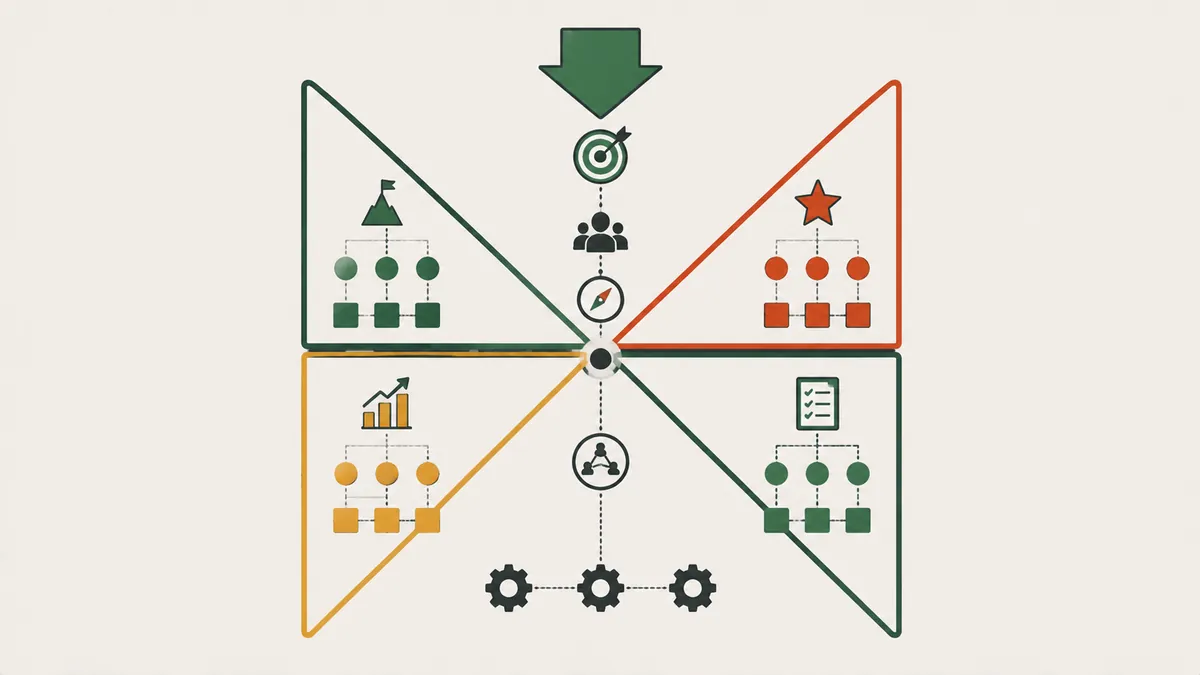
Many companies summarize the plan on a single sheet called the X-matrix. It puts four groups of information at the center, one on each side of an X, with the owners along the edges.
| Side of the matrix | What it holds | In the example |
|---|---|---|
| Long-term objectives | The 3 to 5 year direction | Benchmark in delivery time |
| Annual objectives | The few objectives of the year | Lead time from 15 to 7 days |
| Priority initiatives | The projects that deliver the objectives | SMED, continuous flow, finished goods kanban |
| Metrics and targets | What will be measured and the expected value | Changeover 30 min; finished goods at 1 day |
Where the sides cross, you mark the relationships between initiatives, objectives and metrics. If an initiative connects to no objective, it probably should not exist. If an objective has no initiative, it will not happen.
The monthly review with PDCA
Hoshin kanri fails quietly when the plan is written in January and reread in December. A short monthly review keeps it alive: one page per objective, actual versus target, and a brief PDCA note on what changes next month.
In the example, lead time falls linearly from 15 to 7 days over 12 months, or 8 ÷ 12 = 0.67 day per month. At the sixth-month review, the plan says 15 − 4 = 11 days. The actual measurement is 12 days. The gap is 1 day, or 9.1% above plan (1 ÷ 11).
A red item is not a reason for blame. It is the agenda for problem solving. The team opens an A3 on the queue in production, the component with the most delay, and takes the actions to the visual management board. That is the Check and Act of PDCA applied to strategy.
Hoshin kanri vs. OKR vs. balanced scorecard
These three methods often show up together in searches. The comparison below is a practical organization, since each company adapts the method.
| Aspect | Hoshin kanri | OKR | Balanced scorecard |
|---|---|---|---|
| Origin | Japan, total quality control | Management by objectives, popularized in tech companies | Kaplan and Norton, metrics in perspectives |
| Number of objectives | Few, usually 3 to 5 | Few objectives with key results | Many metrics across 4 perspectives |
| Dialogue between levels | Formal catchball | Varies by company | Varies by company |
| Review | Monthly, with PDCA, tied to the gemba | Usually quarterly | Periodic |
They are not mutually exclusive. What sets hoshin kanri apart is that it ties strategy to the shop-floor improvement method, with PDCA and the participation of every level.
Common mistakes
- Deploying ten objectives. The team cannot prioritize, and having too many priorities is the same as having none.
- Cascading targets without catchball, which creates unrealistic targets and disengagement.
- Not reviewing during the year and discovering the gap in December.
- Targets with no initiative and no owner. A number without a plan is only a wish.
- Treating the plan as bureaucracy, with a spreadsheet filled in and no conversation at the gemba.
Next step
For a small or midsize manufacturer, start with a simple cycle.
- Define at most three objectives for the year, with a metric and a target.
- For each objective, write on one A3 sheet the current situation, the target and the main initiatives.
- Run catchball with each area and adjust.
- Take the metrics to the teams' visual management board.
- Meet once a month: what moved forward, what got stuck and what changes.
The first time, accept that the plan will be imperfect. The value of hoshin kanri shows up in the second and third cycles, when the team knows catchball, can read the board and uses gaps as a chance to learn. Start small, with a pilot area, and expand later.
Frequently asked questions
What is hoshin kanri?
It is a strategy deployment framework, built on PDCA, that aligns objectives from the top to the front line.
What does hoshin kanri mean?
In Japanese, hoshin means direction or compass, and kanri means management. In English it is usually called strategy deployment or policy deployment.
What is catchball in hoshin kanri?
It is the back-and-forth process between levels to adjust targets, resources and commitments.
How many objectives should you deploy per year?
Few, usually three to five at the annual level. More than that dilutes focus.
What is the X-matrix?
It is a single sheet that relates long-term objectives, annual objectives, initiatives and metrics, with their owners.
What is the difference between hoshin kanri and OKR?
Both prioritize a few objectives. Hoshin kanri has formal catchball, a monthly PDCA review and a focus on shop-floor improvement.
Does hoshin kanri work for small companies?
Yes. With three objectives, one A3 per objective and a monthly meeting, it already works.
Sources
- Lean Enterprise Institute. Hoshin Kanri. Lean Lexicon. https://www.lean.org/lexicon-terms/hoshin-kanri/
- Lean Enterprise Institute. PDCA. Lean Lexicon. https://www.lean.org/lexicon-terms/pdca/
- AKAO, Y. Hoshin Kanri: Policy Deployment for Successful TQM. Cambridge: Productivity Press, 1991.
- JACKSON, T. L. Hoshin Kanri for the Lean Enterprise: Developing Competitive Capabilities and Managing Profit. New York: Productivity Press, 2006.
Want to see how this connects to daily improvement?
Read the complete Kaizen and continuous improvement guide.
Read the article
About the author
Lean Manufacturing & Behavioral Management Specialist
Over 20 years in the automotive and metalworking industries (GM and Dana), Lean Manufacturing practitioner since 2006. SENAI instructor and mentor in Brazil’s Brasil Mais Produtivo program, delivering consulting, training and audits for 50+ companies, combining quality, productivity and people development.