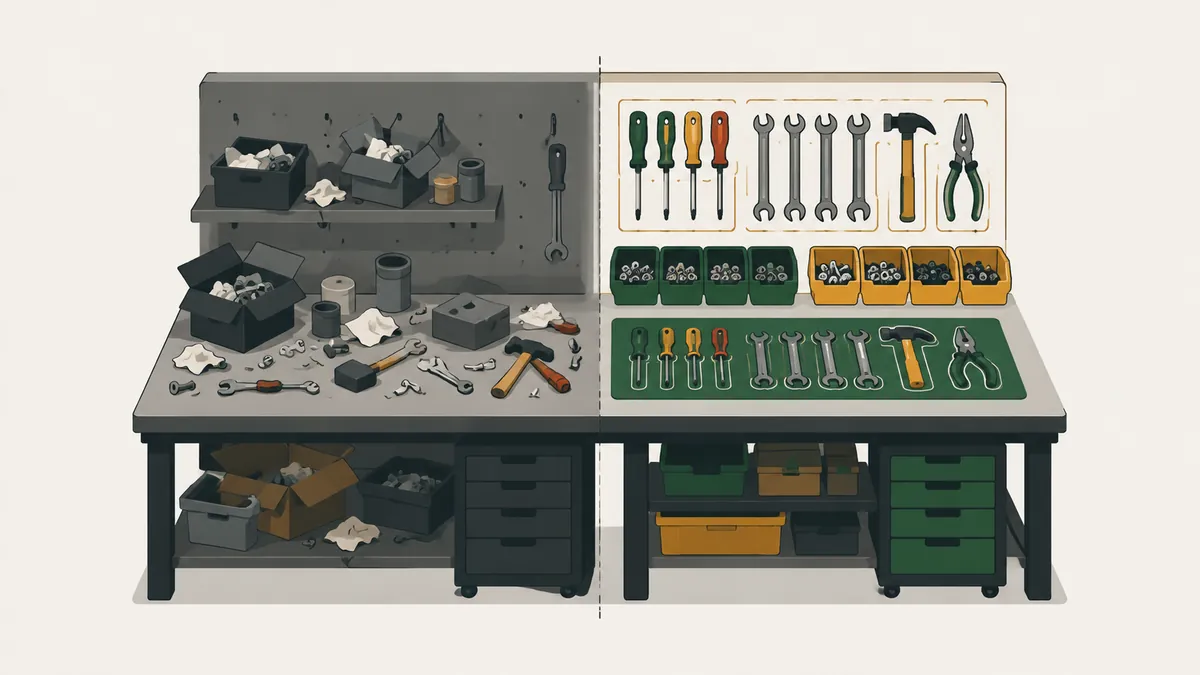
What 5S is
5S is a set of five workplace organization practices that support visual control and lean production. The Lean Enterprise Institute lists the Japanese terms: seiri, seiton, seiso, seiketsu and shitsuke, usually translated as Sort, Set in Order (also called Straighten), Shine, Standardize and Sustain. The practice grew out of Japanese industry and was spread in the West by authors such as Hiroyuki Hirano and Takashi Osada.
The goal is not a tidy area for visitors. It is to make any abnormality visible: the missing tool, the leak, the inventory above its limit, the document nobody owns. In a station where everything has a place and is clean, anyone can tell in seconds what is out of standard.
That is why 5S is the base of almost every lean program: without minimum order, visual management, TPM and standardized work do not hold.
The five S's, in order
| Pillar | Japanese | What to do | Example |
|---|---|---|---|
| Sort | Seiri | Separate what is needed from what is not and remove the rest | Broken tools, obsolete parts, old paperwork |
| Set in Order | Seiton | A place for everything and everything in its place | Shadow board for tools |
| Shine | Seiso | Clean and, while cleaning, inspect | Finding an oil leak while wiping the machine |
| Standardize | Seiketsu | Keep the first three with visible rules | Photo of how the station should look |
| Sustain | Shitsuke | Turn the first four into habit | Short, frequent audit |
Some practitioners add a sixth S, for safety, and the Lean Enterprise Institute notes that Toyota traditionally refers to just four. English names also vary from company to company. What matters is the sequence: there is no point standardizing what has not been sorted and set in order.
- Sort: for each item ask whether it is used, how often and by whom. With no planned use, the item does not belong at the station.
- Set in Order: store by frequency of use, give every item an address and use shadows, colors or labels so anyone can return it to the right place.
- Shine: cleaning is inspecting. Every leak, loose part or noise found becomes a recorded abnormality, and the source of the dirt should be eliminated, not just wiped.
- Standardize: turn the agreement into a visible rule: a station photo, colors by item type, marked limits and an owner for each area.
- Sustain: it cannot be decreed. It comes from the short audit, from a leader present at the station and from recognizing the people who hold the standard.
Step-by-step 5S implementation
- Pick a small pilot area, visible and with a willing team. One cell, not the whole plant.
- Take "before" photos from several angles.
- Sort with red tags. Anything nobody can confirm is used gets a dated tag and moves to a holding area. What is not claimed within the agreed period leaves the area.
- Set in order by use. What is used all the time stays within reach; what is used once a week can sit farther away.
- Mark floors, shelves and boards with clear visual identification.
- Shine while inspecting and write down every abnormality found.
- Standardize with a photo: how the station should look at the end of the shift.
- Audit with a short, frequent checklist done by the team itself.
A red tag should record the item, the date, who tagged it, the reason and the suggested destination: discard, relocate or keep. Set the holding period before you start, for example one week, and give one person the final say on what leaves the area. Without that owner, the red tag corner turns into a new warehouse.
The same logic applies outside the plant: stockrooms, labs, offices and digital folders also collect what nobody uses. See the application in Lean Office.
Numeric example: red tag and audit
Illustrative example. An assembly cell has 160 items at the station, including tools, fixtures, bins and documents. The team red-tags whatever nobody can justify.
| Step | Items | Share of total |
|---|---|---|
| Items reviewed at the station | 160 | 100.0% |
| Red-tagged | 40 | 25.0% |
| Discarded or sold | 28 | 17.5% |
| Relocated to another area | 8 | 5.0% |
| Returned to the station (use confirmed) | 4 | 2.5% |
| Items that stay at the station | 124 | 77.5% |
The math: 28 + 8 + 4 = 40 tagged. Items left at the station: 160 - 28 - 8 = 124, which is 22.5% fewer. Of those 124, the team now knows where each one lives.
Then comes the audit: 20 checks, 4 per pillar, each answered yes or no. The score is the number of passes divided by 20.
| Pillar | First audit | After 30 days |
|---|---|---|
| Sort | 4 of 4 | 4 of 4 |
| Set in Order | 3 of 4 | 4 of 4 |
| Shine | 3 of 4 | 4 of 4 |
| Standardize | 2 of 4 | 3 of 4 |
| Sustain | 1 of 4 | 2 of 4 |
| Total | 13 of 20 = 65% | 17 of 20 = 85% |
Notice the pattern: Sort and Set in Order rise fast because they depend on a one-time push. Standardize and Sustain move slowly because they depend on routine. That is why 5S usually dies in the last two pillars.
5S audit checklist
An audit that sustains 5S is short, objective and done by the team. Four checks per pillar are enough to start:
| Pillar | Yes or no checks |
|---|---|
| Sort | Is there an unused item at the station? Is there material for another product? Is any red tag past its date? Is any paperwork outdated? |
| Set in Order | Is every tool in its marked place? Is each address labeled? Is what is used most within reach? Are aisles clear? |
| Shine | Are floor and bench clean? Is there a new leak or dirt on the equipment? Is waste separated? Was the cleaning routine completed? |
| Standardize | Does the station match the standard photo? Are the visual rules legible? Is there an owner for each area? Do open abnormalities have an owner? |
| Sustain | Was the last audit done on time? Were the actions from the last score closed? Can the team explain the standard? Is the score on the board? |
The result goes on the area's visual management board. A low score triggers action, not blame.
On frequency, the team audits its own station every week in ten minutes, and the manager runs a cross audit once a month in a different area. The minimum acceptable score is the company's decision; what matters is that it is the same for everyone and that each failed check generates an action with an owner and a date.
5S, 6S, cleanups and TPM: the differences
| Concept | Focus | Difference from 5S |
|---|---|---|
| 6S | 5S plus safety | Adds a safety pillar; the base is the same |
| Cleanup day | Appearance of the area | No sorting, standard or audit; the effect lasts days |
| TPM | Equipment reliability | Uses 5S as the first step of autonomous maintenance |
| Kaizen | Continuous process improvement | 5S creates the order in which improvements show up |
In short: 5S organizes the environment, kaizen improves the process and TPM looks after the equipment. The three work best together, in that order.
Why 5S comes before other lean tools
Shine with inspection is the first step of autonomous maintenance in TPM, covered in autonomous maintenance in 7 steps. Tools in the right place cut changeover time in SMED. And searching for things is motion waste, one of the wastes of lean. Once the station has a standard photo, standardized work has a visible base.
What 5S delivers when sustained: less time searching for tools, lower accident risk from blocked floors and aisles, defects and leaks found earlier, freed-up space and an environment where deviation stands out. Measure these effects at your own station, before and after, instead of promising generic gains.
Mistakes that turn 5S into a cleanup
- Running one big push and never coming back to it.
- Skipping Sort and only tidying what was already there.
- Standardizing without the team, with rules nobody understands.
- Using the audit to punish instead of improve.
- Starting with the whole plant instead of a pilot.
The clearest sign that 5S became a cleanup is the station returning to its old state within weeks. When that happens, repeating the push does not help: review standardization, the audit and leadership presence, which is where sustaining usually fails.
Next step
- Pick a pilot cell and take photos of its current state.
- Set aside one morning for red tagging and define the holding period.
- Run the first 20 check audit and post the score on the board without judgment.
- Repeat the audit weekly for a month and compare the evolution by pillar.
If Standardize and Sustain lag behind, the problem is not the team: it is the routine that does not exist yet.
Frequently asked questions
What are the 5S?
Sort, Set in Order (Straighten), Shine, Standardize and Sustain, from the Japanese seiri, seiton, seiso, seiketsu and shitsuke.
What does 5S stand for?
It names five Japanese workplace organization practices whose names all begin with S when written in the Latin alphabet.
How do you implement 5S?
Start with a pilot area, take photos, red-tag unneeded items, set items in order by use, shine while inspecting, standardize with a photo and audit every week.
What is a red tag?
A dated tag placed on items nobody can confirm are used. They move to a holding area and leave the work area if no one claims them in time.
Is there a 6S?
Yes, some practitioners add a sixth S for safety. The Lean Enterprise Institute notes this variation.
How long does 5S take to implement?
The first three pillars can be done in a few days in a pilot area. What takes time is the habit, sustained by frequent audits.
Does 5S work in an office?
Yes. The same pillars apply to files, desks, cabinets and digital folders, with sorting based on how often things are used.
Sources
- Lean Enterprise Institute. 5S. Lean Lexicon. https://www.lean.org/lexicon-terms/five-s/
- Lean Enterprise Institute. Visual Management. Lean Lexicon. https://www.lean.org/lexicon-terms/visual-management/
- HIRANO, H. 5 Pillars of the Visual Workplace: The Sourcebook for 5S Implementation. Portland: Productivity Press.
- OSADA, T. The 5S's: Five Keys to a Total Quality Environment. Tokyo: Asian Productivity Organization.
Want the complete 5S audit checklist?
Download the free "5S in Practice" e-book, with an implementation manual and ready-made checklists.
Download the e-book
About the author
Lean Manufacturing & Behavioral Management Specialist
Over 20 years in the automotive and metalworking industries (GM and Dana), Lean Manufacturing practitioner since 2006. SENAI instructor and mentor in Brazil’s Brasil Mais Produtivo program, delivering consulting, training and audits for 50+ companies, combining quality, productivity and people development.