- What the Toyota Production System is
- Origin: four names and one system
- The TPS house: pillars and foundation
- The 14 principles of the Toyota Way, in 4 groups
- Worked example: a 14-principle self-assessment
- TPS, the Toyota Way, lean and Six Sigma
- Common mistakes when copying Toyota
- Next step
- Frequently asked questions
What the Toyota Production System is
The Toyota Production System (TPS) is the system Toyota Motor Corporation developed to deliver the best quality, the lowest cost and the shortest lead time by eliminating waste. It is the origin of what the West later called lean.
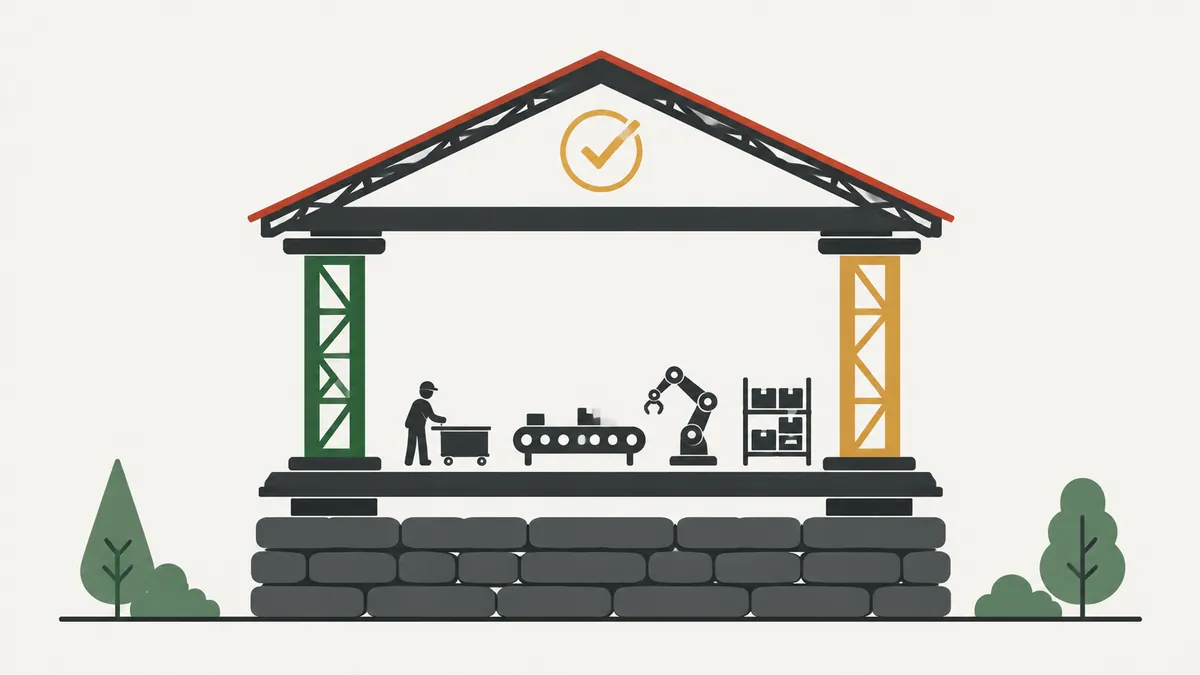
The Lean Enterprise Institute describes it as a house with two pillars, just-in-time and jidoka, held up by standardized work and kaizen.
Many people searching for the "14 principles of Toyota" are really asking about the Toyota Way, the book by Jeffrey Liker. TPS is the production system. The 14 principles are a wider reading that includes culture, people and philosophy. This article covers both.
In one sentence, the logic is this: make only what the customer asks for, at the pace the customer asks for it, with quality built into every step, and treat every problem as a chance to improve. TPS is not a list of tools. It is a management approach that ties tools, people and leadership routines together.
Origin: four names and one system
| Who | Contribution | When |
|---|---|---|
| Sakichi Toyoda | Loom that stops by itself when a thread breaks, the origin of jidoka | Early 20th century |
| Kiichiro Toyoda | Just-in-time concept, no excess inventory | 1930s |
| Taiichi Ohno | Developed the system starting in machining and spread it across Toyota | 1950s and 1960s |
| NUMMI | Toyota and General Motors joint venture in California, a milestone for spreading TPS outside Japan | 1984 |
According to the LEI, the spread to Toyota's suppliers happened in the 1960s and 1970s. Taiichi Ohno's book is the classic source on the logic of the system.
History shows that TPS did not arrive finished. It was assembled by trial and error over decades, from real problems in machining and assembly. Each tool appeared to solve a concrete difficulty, such as excess inventory or a defect passed to the next step. Copying the end result without that path is behind many failed implementations.
The TPS house: pillars and foundation
The house is a way to remember that the tools depend on each other.
- Roof: best quality, lowest cost, shortest lead time.
- Just-in-time pillar: takt time, continuous flow and a pull system with kanban.
- Jidoka pillar: stop when an abnormality is detected, with andon and poka-yoke.
- Foundation: stability, heijunka, standardized work and kaizen.
Each element answers a question. Takt time answers what pace the customer requires. Continuous flow answers how to move one piece at a time without queues. The pull system answers when to produce, linking the customer process to the supplier through signals such as kanban. Jidoka answers what to do when something leaves the standard: stop, signal and fix at the source. Heijunka levels volume and mix so the rest works without peaks.
If the foundation is weak, the pillars do not hold. That is why just-in-time without a stable process turns into material shortages, and jidoka without a standard turns into stoppages with no known cause.
The 14 principles of the Toyota Way, in 4 groups
Jeffrey Liker organized Toyota's practice into 14 principles in four groups, known as the 4 Ps: philosophy, process, people and partners, problem solving. The grouping is the author's practical organization.
| Group | Principles |
|---|---|
| 1. Long-term philosophy | 1. Base decisions on a long-term philosophy, even at the expense of short-term financial goals |
| 2. Process | 2. Create continuous flow to bring problems to the surface. 3. Use pull systems to avoid overproduction. 4. Level out the workload (heijunka). 5. Stop to fix problems and get quality right the first time. 6. Standardize tasks. 7. Use visual control. 8. Use only reliable, thoroughly tested technology |
| 3. People and partners | 9. Grow leaders who live the philosophy. 10. Develop exceptional people and teams. 11. Respect and challenge your partners and suppliers |
| 4. Problem solving | 12. Go and see for yourself (genchi genbutsu). 13. Decide slowly by consensus, then implement rapidly. 14. Learn through reflection and continuous improvement |
The process group has seven principles and is the one companies copy most. The other three groups have seven principles in total and are the ones that keep the system alive.
Philosophy. The first principle says decisions should look at the long term. In practice, that means accepting, for example, an investment in training or process stability even when the result is not yet visible in the monthly numbers. Without this commitment from management, the other principles become a campaign.
Process. These principles are closest to the shop floor. Continuous flow and pull production make problems visible, because with no inventory between steps any failure shows up at once. Stopping to fix, standardizing and visual control give a fast response to those problems. Leveling supports it all, since an uneven load breaks the flow.
People and partners. Leaders who know the work teach by example, and capable teams solve problems without waiting for orders. Suppliers are part of the same logic: they are challenged and supported to improve, not just pressed on price.
Problem solving. Go and see on site, find the root cause with PDCA, and decide carefully but implement fast. The last principle closes the loop: the company learns from each cycle and records what it learned.
Worked example: a 14-principle self-assessment
Illustrative example, with made-up scores to show the method. A plant rates each principle from 1 to 5 (1 = absent, 5 = practiced and sustained) in a gemba meeting with leaders and operators.
| Group | Principle scores | Sum | Average |
|---|---|---|---|
| 1. Philosophy | P1 = 4 | 4 | 4.0 |
| 2. Process (7 principles) | P2 = 4, P3 = 3, P4 = 2, P5 = 4, P6 = 4, P7 = 3, P8 = 4 | 24 | 3.4 |
| 3. People and partners | P9 = 2, P10 = 2, P11 = 2 | 6 | 2.0 |
| 4. Problem solving | P12 = 4, P13 = 3, P14 = 2 | 9 | 3.0 |
| Total | 14 principles | 43 of 70 | 61.4% |
Math: 4 + 24 + 6 + 9 = 43. Maximum score = 14 × 5 = 70. Score rate = 43 ÷ 70 = 61.4%. The process average is 24 ÷ 7 = 3.4.
Reading: the weakest group is people and partners, with an average of 2.0. Inside the process group, the lowest point is leveling (P4 = 2). The action with the best return is to grow leaders and develop teams before investing in more tools.
How to use the result: the total percentage (61.4%) is for comparing assessments over time, not for ranking plants. What matters is the gap between groups and the discussion the scores trigger. Two people can give different scores to the same principle, and that disagreement shows where a shared understanding is missing.
TPS, the Toyota Way, lean and Six Sigma
| Term | What it is | Focus |
|---|---|---|
| TPS | Toyota's production system, with the house and its tools | Flow and waste elimination |
| Toyota Way | Liker's 14 principles and 4 Ps | Culture, people and philosophy |
| Lean | Generalization of TPS to other companies and sectors | Customer value |
| Six Sigma | Statistical method for reducing variation | Defects and variation |
Lean and Six Sigma complement each other. See the differences in Lean vs Six Sigma.
A practical rule for choosing: if the problem is flow, waiting, inventory and lead time, the path is TPS and lean. If the problem is variation and defects in an already stable process, Six Sigma brings the statistical analysis. In many plants the two are used in sequence.
Common mistakes when copying Toyota
- Copying tools without the logic: installing kanban without leveling demand, or hanging boards that nobody responds to.
- Ignoring the people and problem-solving groups, and treating TPS as a bundle of techniques.
- Cutting inventory before machines and quality are stable.
- Handing the rollout to a project team while leaders never go to the gemba.
- Expecting quick results from a system built on habit and repetition.
What all these mistakes share is treating TPS as a project with an end date. At Toyota it is the management routine. The way to avoid the trap is to start small, in one area, with a leader present, and let the practice spread from results.
Next step
Run the self-assessment from the example in your plant. Bring leaders and operators together, score each principle from 1 to 5, add up by group and pick the group with the lowest average. Define one action, one owner and one date, and repeat the assessment next quarter, always starting at the gemba. A simple rule helps: at most one action per weak group, so the effort is not diluted.
Then learn what the system fights: the wastes of lean. For the broader method that grew out of TPS, see what lean manufacturing is.
Frequently asked questions
What is the Toyota Production System?
It is the system Toyota created to deliver the best quality, lowest cost and shortest lead time by eliminating waste. It has two pillars: just-in-time and jidoka.
Who created the Toyota Production System?
Development is credited to Taiichi Ohno, building on concepts from Sakichi and Kiichiro Toyoda.
What are the pillars of TPS?
Just-in-time and jidoka, resting on a foundation of stability, heijunka, standardized work and kaizen.
What are the 14 principles of Toyota?
They are the principles of the Toyota Way by Jeffrey Liker, in four groups: long-term philosophy, process, people and partners, and problem solving.
What is the difference between TPS and the Toyota Way?
TPS is the production system with its tools. The Toyota Way is the 14 principles, which include culture, leadership and people development.
Are TPS and lean the same thing?
Not exactly. Lean generalizes the principles of TPS to other companies and sectors.
How do you start applying TPS?
Start with stability: 5S and standardized work in one area. Then make problems visible, and only then reduce inventory and move toward pull production.
Sources
- Lean Enterprise Institute. Toyota Production System. Lean Lexicon. https://www.lean.org/lexicon-terms/toyota-production-system/
- Lean Enterprise Institute. Just-in-Time Production. Lean Lexicon. https://www.lean.org/lexicon-terms/just-in-time/
- LIKER, J. K. The Toyota Way. New York: McGraw-Hill, 2004.
- OHNO, T. Toyota Production System: Beyond Large-Scale Production. Portland: Productivity Press.
Want the tools ready to use?
Download the free "Problem Solving Kit" e-book, with PDCA, A3, 5 Whys and Ishikawa.
Download the e-book
About the author
Lean Manufacturing & Behavioral Management Specialist
Over 20 years in the automotive and metalworking industries (GM and Dana), Lean Manufacturing practitioner since 2006. SENAI instructor and mentor in Brazil’s Brasil Mais Produtivo program, delivering consulting, training and audits for 50+ companies, combining quality, productivity and people development.