What Is Jidoka?
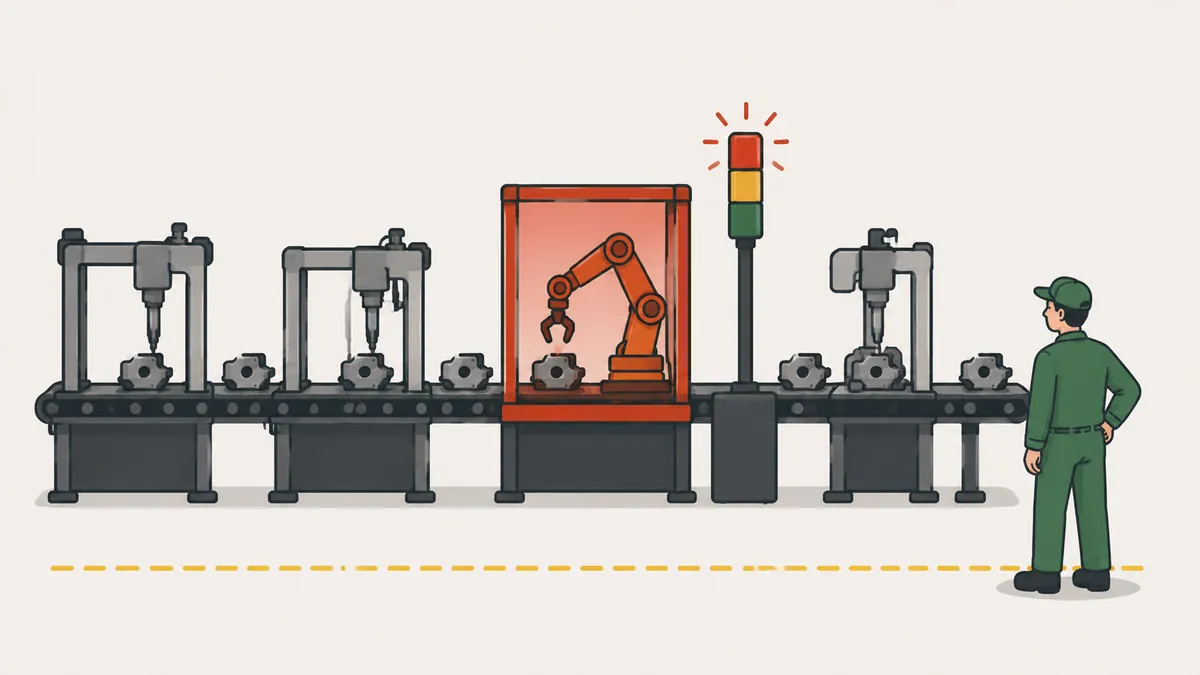
Jidoka means giving machines and operators the ability to detect an abnormal condition and stop work immediately. The defect does not move on to the next process, so quality is built into every step instead of being checked at the end.
It is one of the two pillars of the Toyota Production System, together with just-in-time. It is also called autonomation: automation with a human touch. The machine can tell a good part from a bad one on its own, and the person is free to look after more than one machine.
The word comes from the automatic looms of Sakichi Toyoda, which stopped by themselves when a thread broke, a widely documented fact. The core idea is to separate the work of people from the work of machines. Jidoka does not require expensive equipment: an operator who pulls a cord and stops the line after spotting a defect is also practicing jidoka.
In practice, jidoka swaps one question for another. Instead of asking how many bad parts came out today, the plant asks why the first bad part was not stopped.
Why Stopping the Line Raises Productivity
Stopping seems to hurt productivity. Jidoka argues the opposite. When work stops at the moment of the problem, the cause is still present and visible. That makes it possible to find and remove it instead of living with the defect and sorting parts at the end of the line.
| Without jidoka | With jidoka |
|---|---|
| The defect moves on to later processes | The defect stops where it was made |
| Inspection happens at the end of the line | Detection happens at the source |
| The cause is found days later | The cause is investigated on the spot |
| One operator watches one machine | One operator looks after several machines |
A line that never stops hides its problems. They come back every day under a different name and become part of the routine. Jidoka does the opposite: it makes every problem visible and sets a deadline to solve it.
The Four Steps of Jidoka
- Detect the abnormality, with a sensor, a gauge or the operator.
- Stop the work (the part, the machine or the line) so the defect does not advance.
- Fix the immediate condition so production can run again.
- Investigate the root cause and install a countermeasure so the problem does not return.
The first two steps prevent today's loss. The last two prevent tomorrow's. Teams that stop at step three fight the same fire every day. The investigation can use 5 Whys or an A3 report, depending on the size of the problem.
Worked Example: The Cost of Letting a Defect Travel
Illustrative example. A line has 4 stations and makes 1 part per minute. The cumulative cost of a part grows at each station because every step adds material and labor. The final inspection checks a lot of 120 parts. At station 2, a worn tool starts drilling the hole out of tolerance. Costs are shown in R$ (Brazilian reais); any currency works.
| Station | Operation | Cumulative cost per part |
|---|---|---|
| 1 | Cutting | R$ 4 |
| 2 | Drilling | R$ 9 |
| 3 | Assembly | R$ 15 |
| 4 | Finishing | R$ 22 |
| Scenario | Defective parts | Cumulative cost per part | Value lost |
|---|---|---|---|
| Without jidoka (defect found at final inspection) | 120 | R$ 22 | 120 × 22 = R$ 2,640 |
| With jidoka (sensor stops station 2) | 1 | R$ 9 | 1 × 9 = R$ 9 |
Without jidoka, all 120 parts go through cutting, drilling, assembly and finishing before anyone sees the error. With jidoka, the sensor flags the bad hole on the first part. The line stops, the tool is changed in 10 minutes, and the loss is one part worth R$ 9. In the example the part is scrapped in both cases; in real life some can be reworked.
The logic is simple: value lost = parts made until detection × cumulative cost at the point of detection. Without jidoka, that is 120 parts at R$ 22. With jidoka, it is 1 part at R$ 9. The loss falls from R$ 2,640 to R$ 9, about 293 times less. The later a defect is found, the more parts already exist and the more value has been added to them.
The 10 minutes of downtime cost 10 parts of capacity, and that belongs in the math too. Even so, the result is far better than finding the problem after 120 parts.
Jidoka Tools in Practice
- Andon: the light signal that calls the leader when a sensor or the operator detects a problem.
- Poka-yoke: a device that prevents the error or makes it impossible to miss.
- Sensors and gauges: check dimension, part presence, torque or position every cycle.
- Fixed-position stop: the line stops at a defined point of the cycle, not in the middle of an operation.
- Visual management: boards and signals that show station status, as in visual management boards.
Jidoka, Poka-Yoke and Final Inspection
| Practice | Moment | What it does |
|---|---|---|
| Poka-yoke | Before or during the operation | Prevents the error or detects it as it happens |
| Jidoka | When the abnormality appears | Stops the work and triggers the response |
| Final inspection | After the whole process | Separates good from bad without removing the cause |
The practices complement each other. Poka-yoke lowers the chance of error, jidoka makes sure any error that slips through is stopped on the spot, and final inspection stays as the last barrier, not the main one.
Where Jidoka Pays Off Most
Start where defects are expensive or dangerous. The best candidates are:
- Operations with a lot of added value before inspection, like station 2 in the example, followed by assembly and finishing.
- Processes that depend on a tool or setting that wears out.
- Safety or function characteristics, where a failure reaches the customer as a risk.
- Stations with repeated defects, found on a Pareto chart of scrap.
Not every defect needs a sensor. If the failure is rare and cheap, a check by the operator at the station may be enough. Use the cost in the example as a criterion: what is it worth to stop early? If the answer is a few dollars per part, keep detection cheap. If it is thousands per lot, a dedicated sensor and a deeper root cause analysis are justified.
How to Implement Jidoka Step by Step
- Pick a critical station with frequent defects or high cost, and start there.
- Define what is abnormal: a dimension out of tolerance, a time above cycle, a missing part.
- Choose the detection method: sensor, gauge or operator check.
- Give authority to stop. Operators must know they will not be punished for triggering the signal.
- Define who responds and how fast. A signal with no quick response loses credibility.
- Log every stop and attack the most frequent ones with a PDCA cycle.
A small company can start with a flag, a light or a cord. The principle matters, not the equipment.
The Role of Leadership
Jidoka depends less on technology and more on behavior. If an operator stops the line and gets scolded, they will not stop it again. If the leader never comes to the station, the signal becomes decoration. Three habits hold the system together:
- Thank people for every stop. The stop is the system working, not a personal failure.
- Go to the station right away and look at the part, the machine and the method, as in genchi genbutsu.
- Demand the root cause. A repeated stop for the same reason means a weak countermeasure.
Over time the number of stops falls because the most frequent causes were removed. That is the expected result: fewer lit signals, not more discipline to ignore them.
Common Mistakes
- Stopping the line and restarting without investigating the cause.
- Blaming the operator for the stop, which hides problems.
- Installing sensors without defining what is abnormal.
- A leader who does not respond to the signal.
- Confusing jidoka with more inspection at the end of the line.
- Trying to automate everything before fixing the manual process.
Go Deeper
To see how the signals work in detail, read the guide to andon. For the problem-solving side of step four, see the A3 problem solving method.
Next Step
Pick one station with a recurring defect today. Write in one line what is abnormal there, and decide who stops the operation and who responds. In one week, count how many stops happened and which cause was the most frequent. That log is the base of your first improvement.
Then take the cause that repeats the most and apply an A3 report or the 5 Whys. When it is solved, standardize the fix and move to the next station. This is how jidoka spreads across the plant without big investments, one station at a time.
Frequently asked questions
What is jidoka?
It is the ability of machines and people to detect an abnormality and stop work immediately, building quality into every process.
Are jidoka and autonomation the same thing?
Yes. Autonomation is another name for jidoka: automation with a human touch.
What are the two pillars of the Toyota Production System?
Just-in-time and jidoka. Just-in-time delivers the right item at the right time, and jidoka makes sure only good work moves on.
What is the difference between jidoka and poka-yoke?
Poka-yoke prevents or detects the error. Jidoka stops the work when an abnormality appears and triggers the response.
Does jidoka require automated machines?
No. An operator who stops the line with a cord or a button after seeing a defect is already practicing jidoka.
Does stopping the line not hurt productivity?
It does in the short run, but it avoids making whole lots with defects. Once the cause is fixed, stops become less frequent.
How are jidoka and andon related?
Andon is the tool that makes the stop visible and calls for help. It is one of the ways to practice jidoka.
Sources
- Lean Enterprise Institute. Jidoka. Lean Lexicon. https://www.lean.org/lexicon-terms/jidoka/
- Lean Enterprise Institute. Andon. Lean Lexicon. https://www.lean.org/lexicon-terms/andon/
- OHNO, T. Toyota Production System: Beyond Large-Scale Production. Portland: Productivity Press, 1988.
- LIKER, J. K. The Toyota Way: 14 Management Principles from the World's Greatest Manufacturer. New York: McGraw-Hill, 2004.
Want the tools ready to use?
Download the free "Problem Solving Kit" e-book, with PDCA, A3, 5 Whys and Ishikawa.
Download the e-book
About the author
Lean Manufacturing & Behavioral Management Specialist
Over 20 years in the automotive and metalworking industries (GM and Dana), Lean Manufacturing practitioner since 2006. SENAI instructor and mentor in Brazil’s Brasil Mais Produtivo program, delivering consulting, training and audits for 50+ companies, combining quality, productivity and people development.