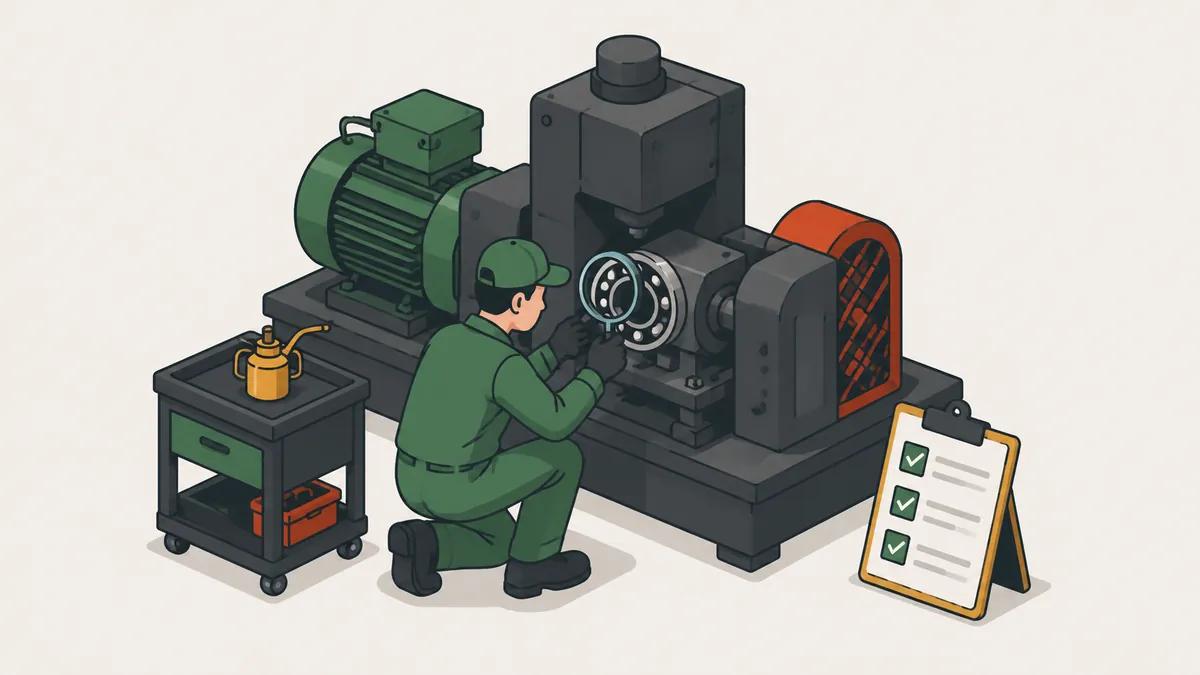
- What Is TPM (Total Productive Maintenance)?
- The Three Meanings of "Total"
- The Six Big Losses TPM Attacks
- The Pillars of TPM
- Autonomous Maintenance: The Heart of the Program
- Worked Example: Where Did the 400 Minutes Go?
- TPM vs Preventive vs Corrective Maintenance
- A Roadmap to Start and Why Programs Die
- Next Step
- Frequently asked questions
What Is TPM (Total Productive Maintenance)?
TPM, or total productive maintenance, is a set of practices that keeps every machine in the process always able to do what it is supposed to do. The goal is zero breakdowns, zero defects and zero accidents caused by equipment.
According to the Lean Enterprise Institute, the approach was pioneered at Denso, a Toyota Group company in Japan. Seiichi Nakajima, of the Japan Institute of Plant Maintenance (JIPM), is the name most associated with spreading it.
The difference from traditional preventive maintenance is who takes part. In preventive maintenance, the maintenance team alone is responsible. In TPM, operators also care for the equipment: they clean, lubricate, tighten and inspect every day, and maintenance focuses on what requires technical expertise.
TPM makes the most sense where equipment limits output: automated lines, bottlenecks, continuous processes and expensive machines. On a simple manual station the gain is smaller. It also connects to lean: without reliable machines, pull production and low inventory become a risk, because any stop interrupts the next customer.
Two terms come up constantly. Availability is the share of planned time in which the machine actually runs. Basic conditions are the set of items kept clean, lubricated and tight that hold the equipment in the state it was designed to work in.
The Three Meanings of "Total"
- Total participation: operators, line leaders, engineering, quality and maintenance, each with a role.
- Total productivity of equipment: attacking all six big losses, not only breakdowns.
- Total life cycle: caring for equipment from design and purchase through operation and replacement, carrying what was learned on old machines into new ones.
The Six Big Losses TPM Attacks
Breakdowns, setup and adjustments, minor stops, reduced speed, scrap and rework. They are the same losses measured by OEE. TPM is the program, and OEE is the scoreboard.
| Loss | Shop floor example | Typical response | OEE factor |
|---|---|---|---|
| Breakdowns | Motor burns out mid shift | Daily inspection, planned maintenance | Availability |
| Setup and adjustments | 90 minute tool change | SMED | Availability |
| Minor stops | Part jams in the feeder | Log and remove the cause | Performance |
| Reduced speed | Machine runs slower "to be safe" | Restore basic conditions | Performance |
| Scrap | Parts out of tolerance after warm up | Condition control, poka-yoke | Quality |
| Rework | Part redone because of a burr | Fix the source of the burr | Quality |
Speed losses and minor stops deserve special attention because they last seconds or minutes and nobody opens a work order for them. Added up over a shift, they can weigh more than a long, rare breakdown.
Almost all of these losses stay invisible in the production report. They only show up when someone logs the minutes of each stop and the actual speed against the ideal speed.
The Pillars of TPM
JIPM organizes the program into eight pillars. Some companies use fewer, and the split varies by author, so treat the list as a practical grouping.
| Pillar | What it does |
|---|---|
| Autonomous maintenance | Operators clean, lubricate and inspect the equipment |
| Planned maintenance | Maintenance handles scheduled work and failure analysis |
| Focused improvement | Teams attack specific equipment losses |
| Quality maintenance | Controls the equipment conditions that cause defects |
| Early equipment management | Brings maintenance learning into the design of new machines |
| Education and training | Builds the skills of operators and maintainers |
| Office TPM | Applies TPM logic in support areas |
| Safety, health and environment | Aims for zero accidents and zero environmental impact |
The pillars do not have to be launched together. Planned maintenance, for example, depends on data that autonomous maintenance produces: without daily inspection, the preventive plan runs on the calendar, not on the real condition of the machine.
In plants just starting out, the two pillars that usually open the way are autonomous maintenance and focused improvement.
Autonomous Maintenance: The Heart of the Program
Autonomous maintenance puts the simple, frequent tasks in the operator's hands: cleaning, lubricating, tightening and inspecting. It is not "passing work" to production. It uses the person who spends eight hours next to the machine to notice early the odd noise, the small leak, the loose bolt.
In practice, cleaning becomes inspection: while cleaning, the operator looks, touches and finds abnormalities. That is why 5S is usually the first step. The program follows a ladder of steps, described in the article on autonomous maintenance in 7 steps.
A well written cleaning and inspection standard fits on one sheet per machine. It shows a photo of the point to inspect, what to look for (oil level, leaks, noise, tightness, temperature), the acceptance criterion, how long it takes and how often. If the task takes more than 10 to 15 minutes per shift, the standard is probably too heavy and will be abandoned.
When the operator finds something he or she cannot fix, there is no improvising: the abnormality is tagged and maintenance handles it. This simple flow of tagging, logging and resolving is what keeps TPM from becoming just housekeeping.
Worked Example: Where Did the 400 Minutes Go?
Illustrative example, with made-up numbers for the calculation. A machine has 400 minutes of planned production in the shift. There were 24 minutes of breakdown and 16 of setup. The ideal cycle is 0.6 minute per part. The machine made 480 parts, and 24 of them were scrapped.
| Data | Value |
|---|---|
| Planned time | 400 min |
| Breakdown + setup | 24 + 16 = 40 min |
| Run time | 360 min |
| Ideal cycle | 0.6 min/part |
| Parts produced | 480 |
| Scrap | 24 |
| Good parts | 456 |
Availability = run time ÷ planned time = 360 ÷ 400 = 90%.
Performance = produced ÷ ideal output. Ideal output in 360 min is 360 ÷ 0.6 = 600 parts, so 480 ÷ 600 = 80%.
Quality = good parts ÷ produced = 456 ÷ 480 = 95%.
OEE = 0.90 × 0.80 × 0.95 = 0.684, or 68.4%. Check: 456 parts × 0.6 min = 273.6 min of truly productive time, and 273.6 ÷ 400 = 68.4%.
| Where the 400 minutes went | Minutes | Share |
|---|---|---|
| Stops (breakdown and setup) | 40 | 10% |
| Speed and minor stops (120 fewer parts × 0.6) | 72 | 18% |
| Scrap (24 parts × 0.6) | 14.4 | 3.6% |
| Productive time | 273.6 | 68.4% |
| Total | 400 | 100% |
Notice that the biggest single loss is not the breakdown but speed, exactly the one the production report almost never shows. If TPM cuts breakdowns in half (24 to 12 min), run time rises to 372 min, availability reaches 372 ÷ 400 = 93% and OEE reaches 0.93 × 0.80 × 0.95 = 70.7%, a gain of 2.3 percentage points.
TPM vs Preventive vs Corrective Maintenance
| Aspect | Corrective | Preventive | TPM |
|---|---|---|---|
| When it acts | After the breakdown | At fixed intervals | Every day, and at the cause of losses |
| Who does it | Maintenance | Maintenance | Operations and maintenance |
| Focus | Get running again | Avoid predictable failures | Eliminate the six big losses |
| Typical metric | Repair time | Plan compliance | OEE, MTBF and MTTR |
TPM does not eliminate specialized maintenance. It frees maintenance from simple tasks so it can work on failure analysis and improvements. MTBF and MTTR help track the outcome: if TPM works, MTBF (mean time between failures) rises and MTTR (mean time to repair) falls. For the manager, the gain is better capacity prediction and less reliance on overtime to recover lost output.
A Roadmap to Start and Why Programs Die
- Pick one pilot machine, ideally the one that stops most and has a dedicated operator.
- Measure the starting point with OEE per shift for two to four weeks.
- Do an initial clean with operators and maintenance together, tagging every abnormality.
- Create the cleaning and inspection standard with photos, time and frequency.
- Fix the abnormalities with owners and deadlines on a visual management board.
- Compare OEE before and after, and only then move to the next machine.
Programs die when they start on every machine at once, with no capacity to fix the abnormalities found; when autonomous maintenance becomes a task list without operator training; and when nothing is measured. Without OEE, TPM turns into "housekeeping" and loses management support within months.
Next Step
On the machine that stops most, log every stop for one week with its reason and duration. Add them up by category and build a table like the one in the example. That snapshot of losses gives you TPM's first priority and a concrete argument for asking operators for cleaning and inspection time. Then define the cleaning and inspection standard for the station and track OEE per shift.
Frequently asked questions
What is TPM?
It is total productive maintenance: a set of practices in which operations and maintenance care for equipment together to eliminate breakdowns, defects and accidents.
What are the six big losses in TPM?
Breakdowns, setup and adjustments, minor stops, reduced speed, scrap and rework.
What are the pillars of TPM?
JIPM describes eight: autonomous maintenance, planned maintenance, focused improvement, quality maintenance, early equipment management, education and training, office TPM, and safety, health and environment.
What is the difference between TPM and preventive maintenance?
Preventive maintenance relies on the maintenance team. TPM involves operators in routine care and attacks all six losses, not only breakdowns.
Which metric goes with TPM?
OEE, which multiplies availability, performance and quality of the equipment.
Where should TPM start?
With one pilot machine, OEE measurement and an initial clean done by operations and maintenance together.
What is autonomous maintenance?
It is the pillar in which operators take over cleaning, lubricating, tightening and inspecting their own equipment.
Sources
- Lean Enterprise Institute. Total Productive Maintenance. Lean Lexicon. https://www.lean.org/lexicon-terms/total-productive-maintenance/
- Lean Enterprise Institute. 5S. Lean Lexicon. https://www.lean.org/lexicon-terms/five-s/
- Nakajima, S. Introduction to TPM: Total Productive Maintenance. Cambridge, MA: Productivity Press, 1988.
Want to measure what really matters?
Download the free metrics e-book and track the losses in your operation.
Download the e-book
About the author
Lean Manufacturing & Behavioral Management Specialist
Over 20 years in the automotive and metalworking industries (GM and Dana), Lean Manufacturing practitioner since 2006. SENAI instructor and mentor in Brazil’s Brasil Mais Produtivo program, delivering consulting, training and audits for 50+ companies, combining quality, productivity and people development.