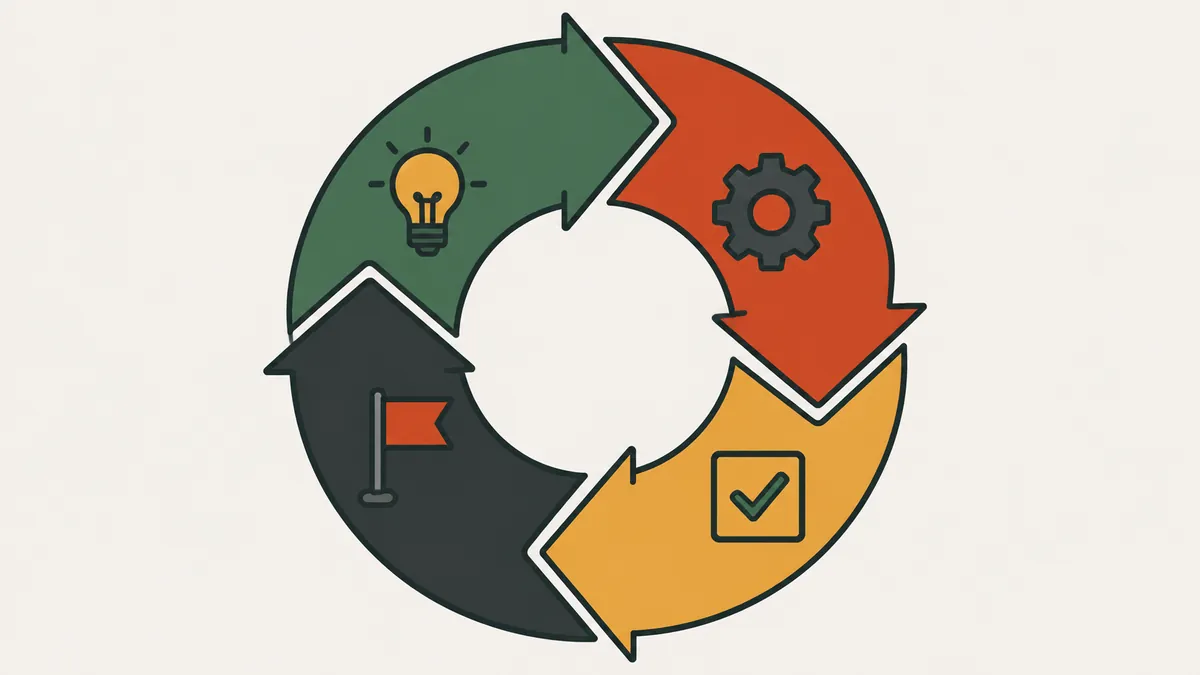
What the PDCA cycle is
PDCA is an improvement cycle based on the scientific method: propose a change to the process, implement it, measure the result and act on what you learn. The acronym stands for Plan, Do, Check, Act.
The cycle traces back to Walter Shewhart's work on quality control in the 1930s. W. Edwards Deming introduced it to Japan in the 1950s, which is why it is also called the Deming cycle. Deming himself preferred the variation PDSA, where the "S" stands for study, to stress that the step exists to learn from the result.
The Lean Enterprise Institute describes PDCA as the basis of continuous improvement. When the team gets a measurable gain, it standardizes the new method and starts another cycle, now from a higher level.
The four steps of PDCA
| Step | Question | What to do | Common tools |
|---|---|---|---|
| Plan | What are the problem, the goal and the cause? | Define the problem, set a numeric goal, analyze the cause and build the plan | Pareto, fishbone, 5 Whys, 5W2H |
| Do | Does the plan work at small scale? | Train, implement the change and record what happened | Pilot, check sheet |
| Check | Did the result reach the goal? | Compare the result with the goal and with the earlier situation | Charts, metrics, control group |
| Act | What do we do with what we learned? | Standardize if it worked, or correct and start again | Standardized work, training |
Plan is the longest step and the one that most decides the outcome. Describe the problem with data, set a goal with a number and a date, find the root cause and define what will be tested, by whom and when.
Do carries out the plan, preferably at reduced scale: one machine, one shift, one line. Write down everything that happens, including what departed from the plan. The people who run the change must be trained in it.
Check compares what happened with what was expected. Use the same metrics as the baseline and, when possible, a control group: a part of the process that did not get the change. That way you know whether the gain came from the action or from something else.
Act closes the cycle. If the goal was reached, the change becomes the standard, training is redone and the new method is audited. If not, the team studies why and starts another cycle with a new hypothesis.
Worked example: scrap on press 3
Illustrative example, with invented numbers to teach the reasoning. Press 3 makes 18,000 parts a month, 6,000 on each of three shifts. The scrap rate is 4%.
- Plan: 4% of 18,000 = 720 scrapped parts a month. Goal: 2% in 60 days, that is, at most 360 parts. A 5 Whys analysis points to variation in the position of the sheet.
- Do: install positioning stops, a poka-yoke, and test them for two weeks on shift 1 only.
- Check: shift 1 dropped to 1.8% (108 parts out of 6,000). Shifts 2 and 3, without the change, stayed at 4% (240 parts each).
- Act: standardize the stop on all three shifts and add the check to the start-of-shift checklist.
| Situation | Shift 1 | Shift 2 | Shift 3 | Total (parts) | Scrap rate |
|---|---|---|---|---|---|
| Before | 240 | 240 | 240 | 720 | 4.0% |
| During the pilot (shift 1 only) | 108 | 240 | 240 | 588 | 3.3% |
| After standardizing | 108 | 108 | 108 | 324 | 1.8% |
The control group showed that the stop caused the improvement: the shifts without it did not change. With standardization, scrap goes from 720 to 324 parts a month, a 55% reduction and below the goal limit of 360 parts. The next cycle goes after the second largest cause of scrap.
How to do the Plan step well
Most cycles that fail have a weak Plan. Five habits help:
- A problem with data: "4% scrap on press 3" is a problem; "poor quality" is not.
- A goal with a number and a date: "2% in 60 days," measured by the same metric as the problem.
- A verified root cause: use 5 Whys or a fishbone diagram and confirm at the place, not in the meeting room.
- A countermeasure that hits the cause: whenever possible a poka-yoke, which prevents the error, instead of a warning.
- A clear action plan: what, who, when, where, why, how and how much, in the format of the 5W2H.
When you standardize in the Act step, update the standardized work. Without that, the improvement depends on the memory of whoever was present and disappears within weeks.
How to do the Check and Act steps well
Check is the most skipped step and the one that best protects against self-deception. Ask three questions.
- Did we reach the goal? Compare the result with the number in the Plan, using the same metric and the same measurement period.
- Was it our action? Look at the control group or the history. If scrap also fell where nothing changed, the gain came from somewhere else.
- What did we learn? Record what worked, what did not and what surprised the team.
There are three possible exits in Act. If it worked, standardize and extend it to other areas. If it worked in part, adjust the action and repeat the cycle. If it did not work, go back to Plan, because the hypothesis was wrong. Failing in a small pilot is cheap and part of the method.
PDCA, SDCA, PDSA, DMAIC and A3: what is the difference
Many problem-solving methods are PDCA with more detail. The comparison below is a practical organization; authors classify them in different ways.
| Method | What it is for | Relation to PDCA |
|---|---|---|
| PDCA | Improving a result | The base cycle, with four steps |
| SDCA | Holding the standard | S stands for Standardize: run the standard, check and act on deviations |
| PDSA | Learning from tests | C becomes S for Study, with a focus on the hypothesis |
| DMAIC | Reducing variation with statistics | Same logic, with more data analysis (Six Sigma) |
| A3 report | Telling the PDCA on one sheet | Organizes the reasoning, see A3 |
SDCA and PDCA alternate. SDCA holds the current level; when an improvement appears, PDCA raises it and the standard is updated. That is the idea behind kaizen: improve a little, lock in the gain and improve again.
When and how often to use PDCA
Use PDCA on any problem whose solution is not known: scrap, downtime, delays, rework, customer complaints. It is not needed for obvious fixes, such as replacing a burned-out bulb.
Prefer short cycles. A two-week cycle teaches more than a six-month project with no check. When a cycle ends, the next starts from a higher level, like a spiral. For complex problems, with many causes and several areas, the A3 report helps keep everyone aligned on one sheet.
Day to day, PDCA shows up in short meetings in front of the visual management board: what we planned, what was done, what the numbers show and what the next action is. When this ritual is daily, small cycles add up and results appear without big projects.
Mistakes that make PDCA spin in place
- Skipping Plan and rushing to execute solutions without knowing the cause.
- Skipping Check and declaring victory without measuring.
- Skipping Act: the improvement never becomes the standard and fades in weeks.
- A vague goal, with no number and no date.
- Cycles that are too long, which slow down learning.
- Changing several things at once and not knowing what worked.
Next step
Pick a problem in your area that has a number: scrap, downtime or delays. Write the goal with a deadline, run the 5 Whys at the place and plan a small pilot on one shift or one machine. Measure against a control group. If it works, standardize; if not, adjust the hypothesis and spin the cycle again.
Frequently asked questions
What does PDCA stand for?
Plan, Do, Check, Act. It is a continuous improvement cycle based on the scientific method.
What are the steps of PDCA?
Plan sets the problem, goal and plan. Do carries it out, preferably at small scale. Check compares the result with the goal. Act standardizes or restarts the cycle.
Who created PDCA?
The basis comes from Walter Shewhart in the 1930s. Deming spread it in Japan in the 1950s, which is why it is called the Deming cycle.
What is the difference between PDCA and PDSA?
In PDSA, the C for check becomes S for study, which stresses learning from the result.
What is the difference between PDCA and SDCA?
PDCA improves a result. SDCA holds the standard: S stands for Standardize, and the cycle runs the standard, checks and acts on deviations.
Is PDCA the same as DMAIC?
They share the same logic. DMAIC has five phases and leans on statistics, so it suits problems with variation and unclear causes.
How do you set the goal in PDCA?
With a metric, a value and a date, measured the same way as the problem. In the example, scrap from 4% to 2% in 60 days.
When does PDCA end?
It does not. Once the gain is standardized, a new cycle starts from a higher level.
Sources
- Lean Enterprise Institute. Plan, Do, Check, Act (PDCA). Lean Lexicon. https://www.lean.org/lexicon-terms/pdca/
- DEMING, W. E. Out of the Crisis. Cambridge: MIT Press, 1986.
- SHEWHART, W. A. Statistical Method from the Viewpoint of Quality Control. Washington: Graduate School of the Department of Agriculture, 1939.
- DEMING, W. E. The New Economics for Industry, Government, Education. Cambridge: MIT Press, 1993.
Want the tools ready to use?
Download the free "Problem Solving Kit" e-book, with PDCA, A3, 5 Whys and Ishikawa.
Download the e-book
About the author
Lean Manufacturing & Behavioral Management Specialist
Over 20 years in the automotive and metalworking industries (GM and Dana), Lean Manufacturing practitioner since 2006. SENAI instructor and mentor in Brazil’s Brasil Mais Produtivo program, delivering consulting, training and audits for 50+ companies, combining quality, productivity and people development.