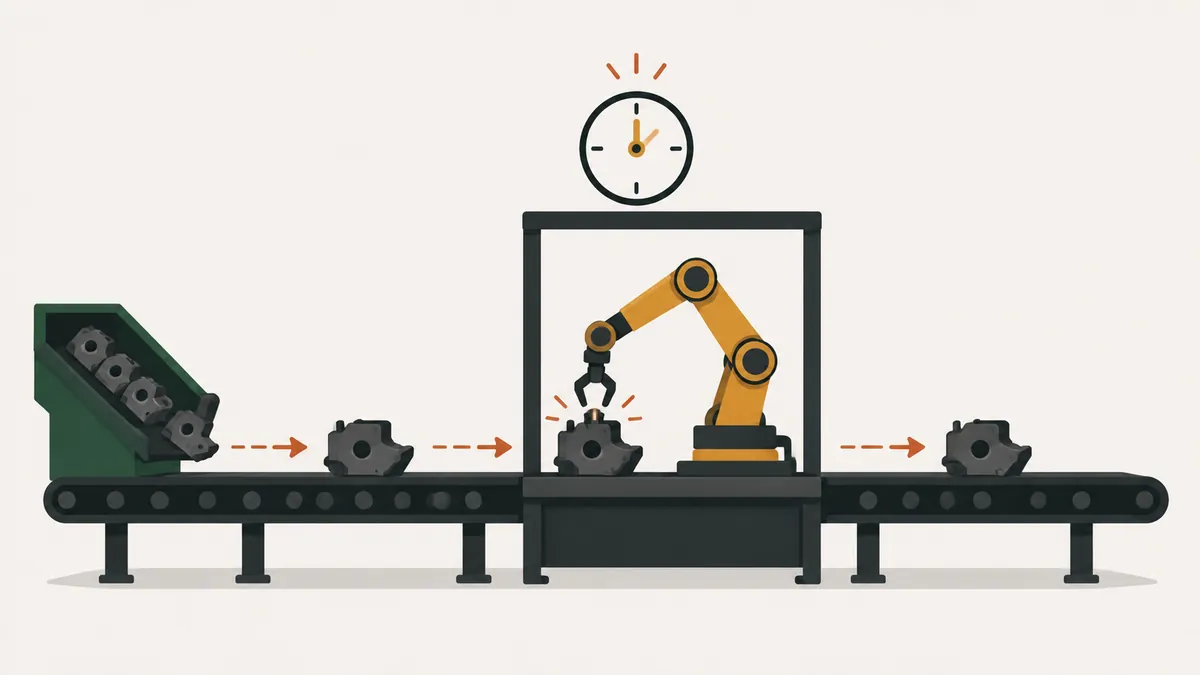
What just-in-time (JIT) is
Just-in-time (JIT) is a production system that makes and delivers just what is needed, just when it is needed and just in the amount needed. According to the Lean Enterprise Institute, JIT and jidoka are the two pillars of the Toyota Production System.
The goal is the total elimination of waste, to reach the best possible quality at the lowest cost and with the shortest production and delivery times. Low inventory is a visible consequence of that effort, not the goal itself.
In practice, JIT applies to three things at once: what is made (only what was ordered), how much is made (only the quantity ordered) and when it is made (only at the pace of demand). Every excess in one of these three dimensions turns into inventory, queues or waiting.
Where JIT comes from
The LEI credits the idea of JIT to Kiichiro Toyoda, founder of Toyota Motor Corporation, in the 1930s. Taiichi Ohno, then manager of the machining shop at the main plant, reported that the first practical steps toward JIT took place in 1949 and 1950.
So JIT is not an isolated purchasing or logistics technique. It was born inside the plant as a way to cut waiting between processes, and was only later extended to suppliers.
The three elements of JIT
JIT rests on leveling, or heijunka, and has three operating elements.
| Element | What it is | Tool |
|---|---|---|
| Pull system | The customer process signals what it needs, and only then does the supplier produce | Kanban |
| Takt time | Production pace equal to the pace of demand | Takt time calculation |
| Continuous flow | Making one piece at a time, moving straight from one step to the next | Production cells |
The three work together. Takt sets the pace. Continuous flow keeps parts moving at that pace. The pull system covers the stretches where continuous flow is not possible, for example when two steps have very different cycle times or sit far apart. A supermarket between them holds a defined quantity of parts, and consumption triggers replenishment.
Worked example: takt time and inventory
Illustrative example. A line runs a 480-minute shift, with a 30-minute meal break and two 10-minute breaks. Customer demand is 430 pieces per day.
Step 1, available time: 480 − 30 − 20 = 430 minutes, or 430 × 60 = 25,800 seconds.
Step 2, takt time: 25,800 ÷ 430 = 60 seconds per piece.
Step 3, compare with the cycle time of each step:
| Step | Cycle time | Against takt (60 s) | Capacity per day |
|---|---|---|---|
| Cutting | 45 s | 15 s below | 573 pieces |
| Welding | 58 s | 2 s below | 444 pieces |
| Assembly | 62 s | 2 s above | 416 pieces |
| Packing | 40 s | 20 s below | 645 pieces |
Capacity per day = 25,800 ÷ cycle time, rounded down: cutting 573, welding 444, assembly 416, packing 645. Assembly does not meet takt: it is short by 430 − 416 = 14 pieces per day. To close the gap it has to drop from 62 s to 60 s, that is, 2 s (3.2%).
Step 4, inventory: the plant holds 2,150 pieces between steps. Coverage = 2,150 ÷ 430 = 5 days. The target is 2 days, or 860 pieces. The total reduction is 1,290 pieces, made gradually and only after the assembly bottleneck is solved. Until then, the stock that remains is what protects the customer.
Reading the result: the line has slack in most steps, but the pace of the whole line is set by the slowest one. Welding, at 58 s, is 2 s from takt and any small loss puts it above. Leveling the cycles around 55 s to 58 s is better than speeding up one isolated step, which only pushes the problem to the next one.
JIT, just-in-case and MRP
| Criterion | Just-in-time | Just-in-case |
|---|---|---|
| Logic | Produces when the customer consumes | Produces and stocks in case of shortage |
| Inventory | Minimum needed to keep flow | High, as protection |
| Problems | Show up fast and demand a fix | Stay hidden behind inventory |
| Requirement | Stable process and built-in quality | Lower, but with cost and space |
JIT pulls production from consumption. MRP schedules production from the forecast and the master schedule. Many plants use both: MRP for purchasing and long-range planning, and JIT with kanban for high-runner items on the shop floor.
JIT works best when demand is reasonably stable, products are repetitive and suppliers are close or reliable. In make-to-order operations with very uneven demand, the principles remain useful (remove waiting and excess), but applying kanban directly needs adaptation.
JIT is not zero inventory
A common mistake is to treat JIT as "taking out all the inventory". Without stability, cutting inventory only exposes the plant to stoppages. JIT demands discipline, as the LEI points out: stable processes, quick changeovers with SMED, reliable machines with TPM and built-in quality.
Inventory falls as a consequence, as the problems it was hiding get solved. There is also a supply risk: with minimal stock, a supplier failure stops the line quickly. The answer is not to abandon JIT but to plan: defined safety stock for critical items, clear replenishment signals, suppliers with frequent smaller deliveries and, when the risk justifies it, more than one source.
Implementation roadmap and common mistakes
- Map the value stream of one product family (VSM).
- Calculate takt time and compare it with the cycle time of each step.
- Stabilize the basics: 5S, standardized work and machine availability.
- Create continuous flow where steps are close together and have similar cycles.
- Where flow is not possible, use a supermarket with kanban.
- Reduce inventory gradually and deal with each problem that appears.
The order matters. Whoever starts with the last step, cutting inventory, finds the problems the hard way: with the line stopped. Whoever starts with stability earns the right to reduce inventory without fear.
Common implementation mistakes:
- Cutting inventory before machines and quality are stable.
- Treating JIT as a purchasing target without changing the internal process.
- Pushing JIT onto the supplier without giving it a stable demand signal.
- Rolling out kanban without leveling demand, which creates peaks and shortages.
- Measuring success only by falling inventory, not by lead time and customer service.
Benefits of JIT and how to measure each one
The gains show up in indicators you can measure. Track each one before and after the change.
- Shorter lead time: less queuing between steps. Measure the time from raw material in to product out.
- Less work in process: less tied-up capital and less floor space. Measure coverage in days, as in the example.
- Faster quality feedback: without big batches between steps, a defect is found quickly. Measure rework and scrap.
- More flexibility: smaller batches allow mix changes at lower cost.
- Visible problems: with no inventory to hide failures, every stoppage becomes an improvement topic.
Every benefit has a trade-off. Less inventory means less slack for failures, and smaller batches mean more changeovers. That is why JIT goes hand in hand with SMED, TPM and standardization.
Next step
Calculate the takt time of a real line and put the cycle time of each step beside it, as in the example table. The step that sits above takt is the first target. Then measure inventory coverage in days and set a gradual reduction goal.
To understand the other pillar of the Toyota system, read about jidoka, built-in quality. For the whole system, see the Toyota Production System.
Frequently asked questions
What does just-in-time mean?
Making and delivering only what is needed, when it is needed and in the amount needed.
What are the elements of JIT?
Pull system, takt time and continuous flow, with production leveling as the foundation.
Who created just-in-time?
The idea is credited to Kiichiro Toyoda in the 1930s and was put into practice by Taiichi Ohno starting in 1949.
Is just-in-time the same as zero inventory?
No. The aim is the minimum inventory needed to keep flow, reduced step by step as problems are solved.
What is the difference between just-in-time and just-in-case?
In JIT, consumption pulls production. In just-in-case, protective inventory is built in case of shortage, which hides problems.
How are JIT and kanban related?
Kanban is the signaling tool of the pull system: consumption releases the card that authorizes replenishment.
What are the risks of just-in-time?
With little inventory, a supplier or machine failure stops the line faster. That is why JIT needs stability, safety stock on critical items and supply planning.
Sources
- Lean Enterprise Institute. Just-in-Time Production. Lean Lexicon. https://www.lean.org/lexicon-terms/just-in-time/
- Lean Enterprise Institute. Takt Time. Lean Lexicon. https://www.lean.org/lexicon-terms/takt-time/
- OHNO, T. Toyota Production System: Beyond Large-Scale Production. Portland: Productivity Press.
- MONDEN, Y. Toyota Production System: An Integrated Approach to Just-in-Time. Boca Raton: CRC Press.
Want real pull production?
Download the free pull production e-book, with kanban, supermarkets and leveling.
Download the e-book
About the author
Lean Manufacturing & Behavioral Management Specialist
Over 20 years in the automotive and metalworking industries (GM and Dana), Lean Manufacturing practitioner since 2006. SENAI instructor and mentor in Brazil’s Brasil Mais Produtivo program, delivering consulting, training and audits for 50+ companies, combining quality, productivity and people development.