- What genchi genbutsu means
- Why reports are not enough
- Genchi genbutsu vs. gemba walk
- A 6-step go-and-see routine
- When to go and see
- Worked example: a 3.0% scrap rate hiding two processes
- What to look at when you go
- Genchi genbutsu beyond the plant and in leadership decisions
- Common mistakes
- Next step
- Frequently asked questions
What genchi genbutsu means
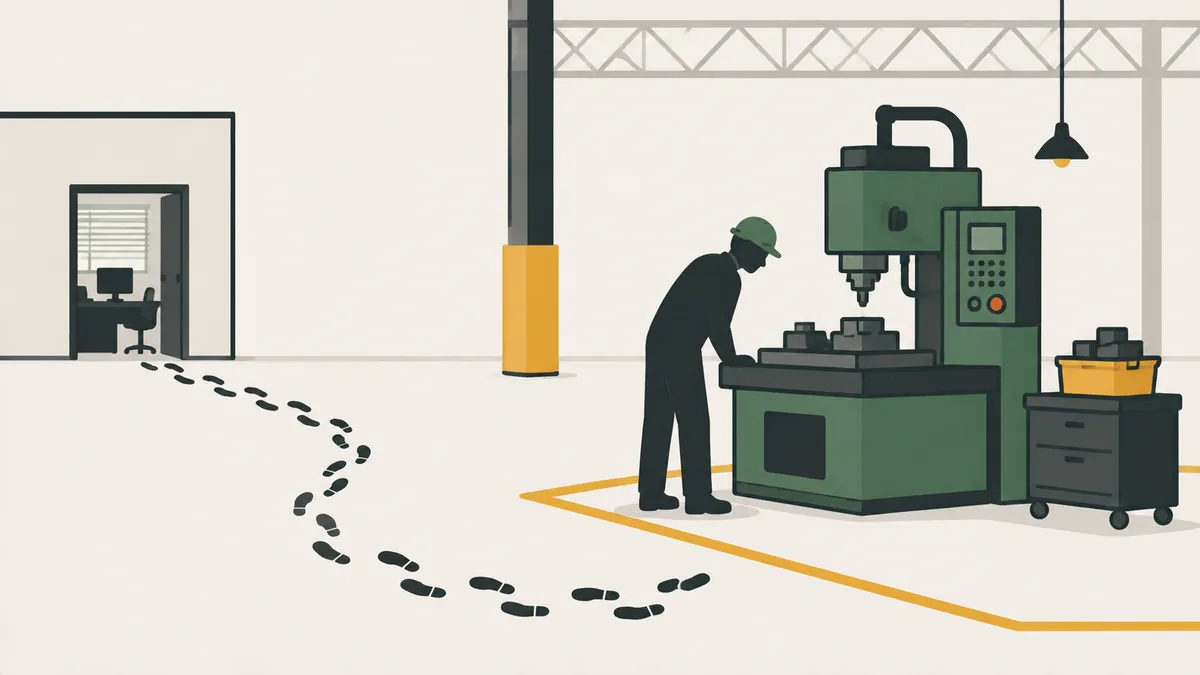
Genchi genbutsu is a Toyota practice for understanding a situation thoroughly by confirming information and data through personal observation at the source. The literal translation is "actual place, actual thing." In everyday use it is "go and see."
In practice, someone investigating a problem goes to the shop floor, watches the process and talks to the people who do the work, instead of relying only on computer data or secondhand accounts. The practice applies to operators, managers and executives alike. It shows up among the 14 principles of The Toyota Way described by Jeffrey Liker, as the habit of seeing for yourself to understand the situation before deciding. A widely told story is the Ohno circle: Taiichi Ohno would draw a circle on the floor and ask someone to stand inside it and watch the process until they saw what was really going on.
Why reports are not enough
A report tells you what happened, rarely how or why. It summarizes, filters and arrives late. A scrap rate in a spreadsheet does not show the worn fixture, the unclear drawing or the part that only fails on the night shift.
| The report shows | Observation on site reveals |
|---|---|
| A weekly average | Which shift, station and moment the problem happens |
| The defect code | How the part actually fails and how it compares with a good one |
| What the system logged | What the person actually did, and why |
| A number | A situation that leads to better questions |
None of this means throwing out the data. Numbers tell you where to look; observation tells you what to do. A scrap report, for example, points to the line and the week, and the visit shows the shift, the station and the motion that produce the loss. Without the numbers, the visit is random. Without the visit, the analysis is a guess.
Decisions made far from the process tend to be generic, such as "reinforce training" or "add inspection," and to treat the symptom. Each cause calls for a different fix, and only looking at the part, the machine and the method shows which one is real.
Genchi genbutsu vs. gemba walk
| Aspect | Genchi genbutsu | Gemba walk |
|---|---|---|
| Focus | Understanding a specific problem or decision | A leadership routine at the workplace |
| When | Whenever there is a problem or a decision to make | On a planned schedule |
| Result | Facts confirmed at the source | Following the standard and supporting the team |
Both start from the same idea: the place where value is created is where the truth is. The gemba walk is the routine form of the principle. Genchi genbutsu is the attitude that drives action in each decision. They reinforce each other: the routine builds the habit, and the habit sends people to the floor when a problem appears.
A 6-step go-and-see routine
- Bring a question, not a conclusion. Example: "Why does the second shift scrap more?"
- Watch one full cycle before talking. Write down what you see, not what you think. If you can, watch more than one shift.
- Touch the part and look at the defect. Compare it with a good part and with standardized work.
- Ask the people doing the work, respectfully: "What gets in your way here?" Ask them to show you, not just tell you.
- Check the data. Does what the system records match what you are seeing?
- Return with the facts for root cause analysis, using 5 whys or an A3 report.
The routine is not a rigid checklist. It exists to head off the most common habits of people who visit a workstation: talking before looking, concluding before measuring and fixing before understanding. Recording what you saw, with date, shift and photo, lets someone else reach the same conclusion and lets the team check whether the countermeasure worked.
When to go and see
The principle always applies, but some triggers make the visit mandatory.
- A metric off target for more than one period.
- A customer complaint or a defect that keeps coming back.
- A long stoppage or a string of short ones.
- Before investing in equipment, changing a layout or altering a standard.
- An improvement idea that nobody on site has validated.
Set a defined amount of time on site, such as an hour, and bring only what you need: the question, a notebook, a phone camera if the area allows it. Avoid bringing a large group, which intimidates people and interferes with the work. Agree in advance with the area leader and explain the purpose so the visit is understood as support.
Worked example: a 3.0% scrap rate hiding two processes
Illustrative example. The weekly report for a stamping line says 4,000 parts were produced and 120 were scrapped, or 3.0% (120 ÷ 4,000). The office reaction would be to add inspection. The supervisor goes to the line on both shifts instead and sorts the scrap by shift.
| Shift | Parts produced | Scrap | Scrap rate |
|---|---|---|---|
| 1st shift | 2,200 | 22 | 1.0% |
| 2nd shift | 1,800 | 98 | 5.4% |
| Week | 4,000 | 120 | 3.0% |
The 3.0% average hid two processes. On the 2nd shift, the supervisor sorts the 98 scrapped parts right at the station.
| Cause of 2nd-shift scrap | Parts | % of the shift's scrap |
|---|---|---|
| Burrs from press setup | 70 | 71.4% |
| Handling scratches | 18 | 18.4% |
| Other causes | 10 | 10.2% |
| Total | 98 | 100.0% |
Watching the cycle, the supervisor sees that the die clearance is set differently from the standard, because a new operator never received training on that adjustment. The countermeasure is a visual instruction at the station and hands-on training.
Impact: if the 2nd shift reached the 1st shift's rate (1.0%), its scrap would be 1,800 × 1.0% = 18 parts. The week's total becomes 22 + 18 = 40 parts, or 1.0% (40 ÷ 4,000), versus 120 today. That is 80 fewer parts per week. More inspection would not have touched this cause.
What to look at when you go
- The actual work, compared with the standard.
- Where material waits and for how long.
- What the operator has to search for, wait for or adjust.
- What the visual management board shows, checked against what you see.
- Differences between shifts, products and days of the week.
Ask open questions and listen. The goal is to understand, not to inspect people. If the visit turns into policing, people start hiding problems and the practice loses its point.
Genchi genbutsu beyond the plant and in leadership decisions
The idea works anywhere work happens. In an office, the actual place is where the document or request is processed. In a hospital, it is the bedside, the hallway and the lab draw room. In an engineering project, it is the site where the equipment will be installed.
It applies to executives too. Before approving an investment or changing a process, go see the operation and talk with the people who run it. That presence gives leadership a base of facts and shows the team that the problem matters. The practice ties into the principle of deciding on the basis of facts, described in the 14 principles of the Toyota Production System.
Common mistakes
- Going to the site only to confirm what has already been decided.
- Turning the visit into policing, which makes people hide problems.
- Going once and generalizing. Some conditions only show up on another shift or with another product.
- Deciding from the report alone and treating the visit as a formality.
- Coming back with no record: without notes, photos or measurements, the observation turns back into opinion.
Almost all of these mistakes share one origin: the visit is made to prove something, not to learn. When the leader arrives with an open question and a willingness to listen, the team answers with information. When the leader arrives with the conclusion ready, the team answers with silence.
Next step
Pick one metric that worries your area, such as scrap, downtime or late orders. Before the next meeting about it, go to the site, on at least two shifts, with a written question. Split the data by shift, station or product and bring photos and measurements. Then take the facts into a root cause analysis and track the result on the same metric to confirm the countermeasure worked.
Repeat the cycle. Over time, going to the site stops being the exception and becomes the normal way of deciding in your area, and the weekly gemba walk gains substance because every visit starts from a real question.
Frequently asked questions
What does genchi genbutsu mean?
Literally, actual place, actual thing. In practice it means going to the site yourself to see what is happening and confirm the facts before deciding.
Is genchi genbutsu the same as a gemba walk?
They are related but not identical. Genchi genbutsu is confirming facts at the source when facing a problem or decision. A gemba walk is a leadership routine at the workplace.
How do you practice genchi genbutsu day to day?
Bring a question, watch a full cycle, look at the actual part, talk to the people doing the work and return with recorded facts for the analysis.
What is the Ohno circle?
A well-known observation exercise attributed to Taiichi Ohno, in which a person stands inside a chalk circle on the floor and watches the process. Genchi genbutsu is the broader principle of seeing at the source.
Should executives practice genchi genbutsu?
Yes. The practice applies to operators, managers and executives, because decisions need facts confirmed at the source.
Does genchi genbutsu apply outside manufacturing?
Yes. In offices, hospitals and projects, the actual place is wherever the work is done.
What tool should I use after going to see?
The 5 whys or an A3 report help turn what you observed into a root cause and an action plan.
Sources
- Lean Enterprise Institute. Gemba. Lean Lexicon. https://www.lean.org/lexicon-terms/gemba/
- Lean Enterprise Institute. Toyota Production System. Lean Lexicon. https://www.lean.org/lexicon-terms/toyota-production-system/
- LIKER, J. The Toyota Way: 14 Management Principles from the World's Greatest Manufacturer. McGraw-Hill.
- WOMACK, J. Gemba Walks. Cambridge, MA: Lean Enterprise Institute.
Want the tools ready to use?
Download the free "Problem Solving Kit" e-book, with PDCA, A3, 5 Whys and Ishikawa.
Download the e-book
About the author
Lean Manufacturing & Behavioral Management Specialist
Over 20 years in the automotive and metalworking industries (GM and Dana), Lean Manufacturing practitioner since 2006. SENAI instructor and mentor in Brazil’s Brasil Mais Produtivo program, delivering consulting, training and audits for 50+ companies, combining quality, productivity and people development.