- What standardized work is
- The three elements of standardized work
- Worked example: a 66-second takt
- The standardized work forms
- How to build standardized work, step by step
- Standardized work vs. work instruction vs. SOP
- The standard is the starting point for kaizen
- Benefits of standardized work
- Common mistakes
- Next step
- Frequently asked questions
What standardized work is
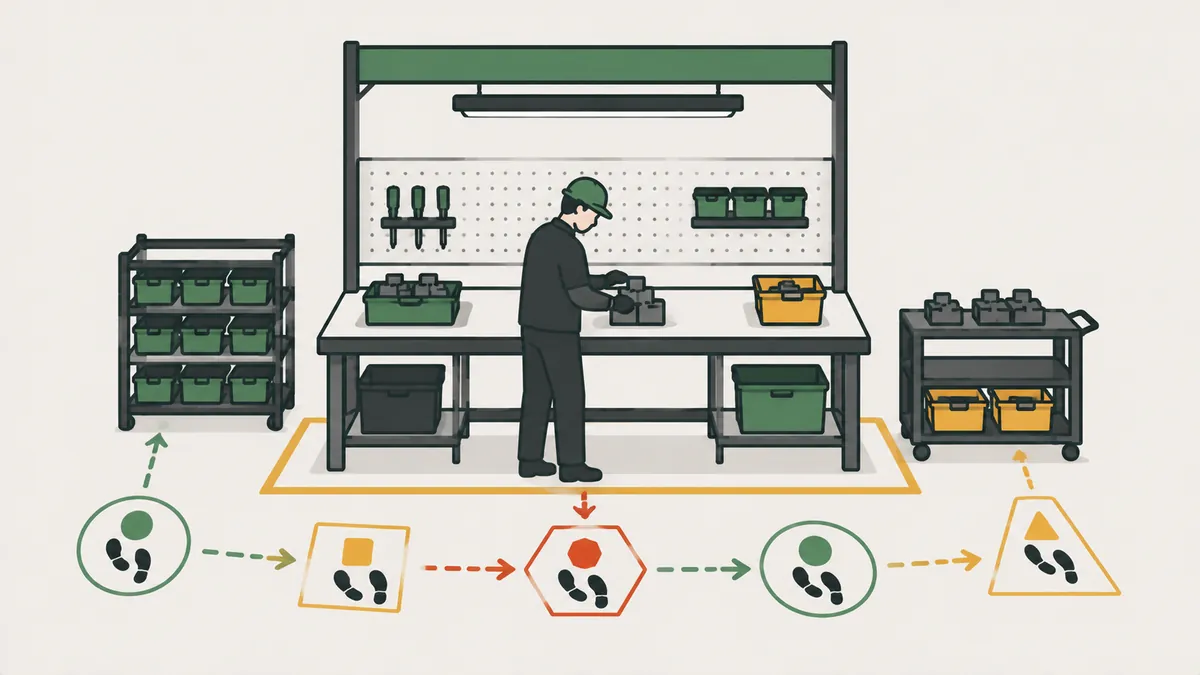
Standardized work, also called standard work, means establishing precise procedures for each operator's work in a production process. According to the Lean Enterprise Institute, it rests on three elements: takt time, work sequence and standard inventory in process.
In other words, the standard answers three questions: at what rate must we produce, in what order does the operator do the tasks, and how many parts must be at the station for the work to flow without stopping. It is the best known way to do the work today, written so that any trained person can repeat it on any shift.
The word "standard" is misleading. In the Toyota Production System, a standard is not a law handed down from the office. It comes from the real work, is written with the people who do the task and exists to be beaten. That is why standardized work is often called the foundation of kaizen: stabilize first, then improve. A process that changes from one operator to the next, or one shift to the next, cannot be measured or learned from.
The three elements of standardized work
| Element | What it defines | In this article's example |
|---|---|---|
| Takt time | The rate at which the product must be made to meet demand | One part every 66 seconds |
| Work sequence | The exact order of the operator's tasks within takt | 6 elements, from picking up the part to labeling and storing it |
| Standard inventory | The parts needed at the station, including those in machines, to run without interruption | 2 parts: 1 in the fixture and 1 waiting for the check |
Without all three, the document is just an instruction. Takt gives the time reference, the sequence gives the method and standard inventory gives the station its stability.
Worked example: a 66-second takt
First, calculate takt. The shift is 8 hours (480 minutes), with a 30-minute meal break and a 10-minute scheduled break. Available time is 480 − 40 = 440 minutes, or 26,400 seconds. Demand is 400 parts per shift.
Takt = 26,400 ÷ 400 = 66 seconds per part.
Now time the operator's real work several times, splitting each element into manual time and walking time. The values below are illustrative.
| No. | Work element | Manual (s) | Walk (s) | Total (s) |
|---|---|---|---|---|
| 1 | Pick the part from the bin | 5 | 2 | 7 |
| 2 | Position and clamp in the fixture | 14 | 0 | 14 |
| 3 | Tighten with the power tool | 4 | 0 | 4 |
| 4 | Remove and check the key point with a gauge | 11 | 0 | 11 |
| 5 | Assemble the subcomponent | 10 | 3 | 13 |
| 6 | Label and place in the output bin | 6 | 5 | 11 |
| Total cycle | 50 | 10 | 60 |
The operator's cycle is 60 seconds, below the 66-second takt. The margin is 6 seconds, or 9.1% of takt. The station produces 26,400 ÷ 60 = 440 parts per shift, 40 more than the demand of 400. If the cycle went above 66 seconds, the station could not keep up with the customer and the line would need rebalancing.
Read the table with three precautions. First, record the shortest time the operator can safely repeat, not the average of a good day. Second, separate manual time from walking: walking is almost always the first waste to go. Third, leave a margin between cycle time and takt, because small stops, bin changes and normal variation exist. A cycle equal to takt has no room for anything unexpected.
The standardized work forms
The Lean Enterprise Institute cites three basic forms for documenting the standard, used by engineers and supervisors.
| Form | What it is for |
|---|---|
| Process capacity table | Shows the capacity of each machine or station, including changeover time, and helps find the limiting one |
| Standardized work combination table | Combines manual work, walking and automatic time for each element on a timeline, compared with takt |
| Standardized work chart | Draws the station layout, the operator's path, quality and safety points and the standard inventory |
The forms should fit on one page and be posted at the station, not stored in an office file. The idea is that the operator, the team leader and anyone visiting the gemba read the same document.
How to build standardized work, step by step
- Tidy the station first. Do not standardize waste. Start with 5S so no one loses time looking for tools.
- Calculate takt for the process, as in the example above.
- Observe the real work of an experienced operator, at the station, not in the office.
- Time each element several times and record the shortest repeatable time. The technique is explained in time study.
- Define the best sequence with the operators themselves, removing unnecessary motion.
- Fill in the forms and compare the cycle with takt.
- Post it at the station, visually, with photos of the key points.
- Train and audit on every shift. If the standard is not followed, find out why before blaming the operator.
One detail decides whether the rollout works: involve the operators from step 3. People who help define the sequence understand the reason for each motion and hold their coworkers to it. People handed a finished standard tend to ignore it as soon as the supervisor leaves the station.
Standardized work vs. work instruction vs. SOP
People often mix up the three documents. The difference lies in what each one controls.
| Document | What it controls | Includes takt and standard inventory? |
|---|---|---|
| Standardized work | The station's pace, sequence and inventory, designed to be improved | Yes |
| Work instruction | How to perform one specific task, step by step | Usually not |
| SOP (standard operating procedure) | The rule of a process, who does what and when | No |
They complement each other. A company can have all three, but only standardized work ties the task to the time of demand and to continuous improvement.
In practice, standardized work often points to a work instruction when a task needs detail, such as the torque of a bolt or the tightening sequence. The station standard shows the whole, and the instruction goes deep on the critical point. You do not have to choose one or the other. You only need to keep the more detailed document from hiding the station's pace and inventory.
The standard is the starting point for kaizen
The Lean Enterprise Institute stresses that standardized work, once established and displayed at the workstation, is the object of continuous improvement through kaizen. Without a standard there is no way to tell whether a change helped, because there is no reference for comparison. Nor is there any way to see what is abnormal, which jidoka depends on.
In the example, the team noticed that the operator walked 5 seconds to the output bin. They moved the bin within arm's reach. Walking in element 6 dropped from 5 to 0 seconds, and the cycle went from 60 to 55 seconds. The cycle now takes 55 ÷ 66 = 83.3% of takt, and the station makes 26,400 ÷ 55 = 480 parts per shift. The 55 seconds become the new standard, and the cycle starts again.
Benefits of standardized work
- Documents the current process for all shifts.
- Reduces variability between operators and between shifts.
- Makes it easier to train new operators.
- Reduces injuries and excess strain by removing unnecessary motion.
- Provides the baseline for improvement activities.
There is a less visible gain too. When everyone knows how the work should be done, any deviation shows up right away: a part out of place, a longer cycle, a skipped step. Managers stop looking for someone to blame and start looking for causes, with the help of tools such as the 5 whys.
Common mistakes
- Writing the standard in the office, without observing the station.
- Confusing it with a work instruction, leaving out takt and standard inventory.
- Standardizing waste, such as searching for tools, instead of removing it first.
- Freezing the standard. If it never changes, kaizen has stopped.
- Imposing the standard without the operators. The people who do the work know where the problems are.
Next step
Pick a station with variation between shifts and do the following this week.
- Calculate the station's takt.
- Time the real work over three cycles and split it into elements.
- Build the combination table with manual and walking time.
- Compare the cycle with takt and cut walking first.
- Post the standard at the station and schedule a review 30 days out.
Frequently asked questions
What are the elements of standardized work?
Takt time, work sequence and standard inventory in process.
What is standard work in lean?
It is another name for standardized work: precise procedures for each operator's work, based on takt, sequence and standard inventory.
What is the difference between standardized work and a work instruction?
An instruction describes how to do one task. Standardized work also defines takt and standard inventory, and serves as the base for improvement.
How do you calculate takt time for standardized work?
Divide available time by customer demand. In the example, 26,400 seconds divided by 400 parts gives 66 seconds.
Does standardized work make operators rigid?
It should not. The standard is the best known way today and should be improved with input from the people who do the work.
How are standardized work and kaizen related?
The standard is the baseline for comparison. Each successful improvement becomes the new standard.
What is a standardized work combination table?
A form that compares manual work, walking and automatic time against takt on a timeline.
Sources
- Lean Enterprise Institute. Standardized Work. Lean Lexicon. https://www.lean.org/lexicon-terms/standardized-work/
- Lean Enterprise Institute. Takt Time. Lean Lexicon. https://www.lean.org/lexicon-terms/takt-time/
- OHNO, T. Toyota Production System: Beyond Large-Scale Production. Portland: Productivity Press, 1988.
- LIKER, J. K. The Toyota Way: 14 Management Principles from the World's Greatest Manufacturer. New York: McGraw-Hill, 2004.
Want to understand the "metronome" behind the standard?
Read how to calculate your line's takt time.
Read the article
About the author
Lean Manufacturing & Behavioral Management Specialist
Over 20 years in the automotive and metalworking industries (GM and Dana), Lean Manufacturing practitioner since 2006. SENAI instructor and mentor in Brazil’s Brasil Mais Produtivo program, delivering consulting, training and audits for 50+ companies, combining quality, productivity and people development.