- What lean healthcare is
- What flows and what counts as value
- Typical wastes in healthcare services
- Example: a 120-minute outpatient visit
- Metrics to track the flow
- How to apply it: step by step
- Where lean is usually applied
- What requires care when implementing
- Common mistakes
- Next step
- Frequently asked questions
What lean healthcare is
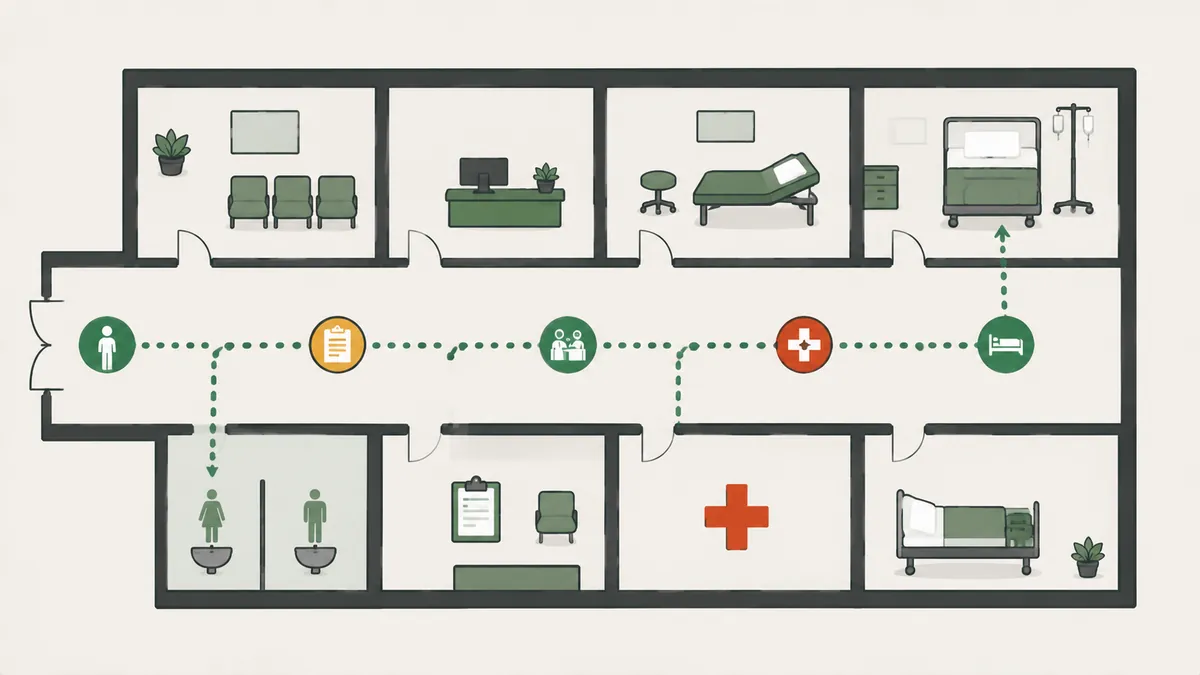
Lean healthcare applies lean management principles to hospitals, clinics, laboratories and other health services. Instead of parts, what flows is the patient, samples, medications, supplies and information.
The Institute for Healthcare Improvement (IHI) published the white paper Going Lean in Health Care, which argues that principles used in manufacturing for decades can be applied to the delivery of health services. The central idea is to remove waste so that every step adds value for the patient. Identifying which steps add value and which do not is where the journey starts.
This article covers process management, not clinical guidance. Lean organizes the flow around care. It does not replace protocols or the judgment of clinical staff.
What flows and what counts as value
In a factory, the customer buys the product. In healthcare, value is defined from the patient's side: being treated safely, at the right time, understanding what is happening. Everything the patient waits for without need, repeats or redoes is waste from their point of view.
The gemba changes too. The Lean Enterprise Institute cites the operating room as an example of a hospital gemba. To understand the flow, you have to go to the emergency department, the lab and the pharmacy and follow the real path from arrival to discharge. Each step can be mapped with the logic of value stream mapping.
The five lean principles help organize the thinking: specify value from the patient's view, identify the value stream for each type of visit, make the flow move without waits, let the patient and demand pull the work, and pursue continuous improvement with the team itself. One healthcare-specific point: demand variability is high. Unscheduled arrivals and cases of different complexity call for planned slack, not a schedule booked at 100%.
Typical wastes in healthcare services
| Waste | Management example |
|---|---|
| Waiting | Patient waiting for care, a bed, a test or discharge |
| Motion | Staff walking to get supplies that should be at the point of use |
| Transportation | Samples and charts traveling long routes |
| Inventory | Supplies expiring in decentralized storerooms |
| Extra processing | The same information recorded on several forms |
| Defects | Rework caused by communication gaps between shifts |
| Overproduction | Reports and forms filled in that nobody uses |
| Non-utilized talent | Clinical staff doing administrative tasks |
Names and counts vary among authors. This is a practical way to organize them. The full list of lean wastes helps you spot each one. Deciding which test is needed is a clinical decision, of course, and stays with the clinician.
Example: a 120-minute outpatient visit
Illustrative flow-management example, unrelated to any real service. Follow a patient through an outpatient visit and record, at each step, the wait time and the care time (time with staff):
| Step | Wait (min) | Care (min) |
|---|---|---|
| Registration | 20 | 5 |
| Triage | 15 | 5 |
| Consultation | 35 | 15 |
| Test result | 20 | 5 |
| Total | 90 | 30 |
Total time = 90 + 30 = 120 minutes. Care share = 30 ÷ 120 = 25.0%. Waiting is 90 ÷ 120 = 75.0% of the time the patient spends in the service.
Two process changes, discussed with the team: pre-registration by phone or online cuts the registration wait from 20 to 5 minutes, and drawing the sample already at triage cuts the wait for the result from 20 to 5 minutes. Care time stays at the same 30 minutes.
| Metric | Before | After |
|---|---|---|
| Total wait | 90 min | 60 min |
| Care | 30 min | 30 min |
| Total time | 120 min | 90 min |
| Care share | 25.0% | 33.3% |
New share = 30 ÷ 90 = 33.3%. Total time fell 25.0% (30 ÷ 120) and waiting fell 33.3% (30 ÷ 90). Not one minute of care was shortened. The improvement came from the waits.
How to read this result
The biggest wait in the example is before the consultation (35 minutes), and it did not change. That is intentional: it depends on the schedule and on staff availability, and any change there requires a capacity analysis with the clinical team. The gain came from waits that depended on paperwork and task sequence, which are the easiest to attack. Once those changes are consolidated, the team can look at the biggest remaining wait with data in hand.
Metrics to track the flow
Start with few metrics, measured the same way every week and posted on a board the team can see.
| Metric | What it shows | How to measure |
|---|---|---|
| Total patient time | The end-to-end experience | Departure time minus arrival time |
| Wait per step | Where the queue forms | Start time minus arrival time at the step |
| Care share | How much of the time is care | Care time ÷ total time |
| Repeated data entry | Information rework | How many forms repeat the same data |
| Items out of place | Staff motion | Count in the 5S audit of the point of use |
Always use aggregated data without patient identification on management boards.
How to apply it: step by step
- Choose one flow with a clear problem, such as the emergency department, outpatient visits, lab collection or hospital discharge.
- Form a team with the people who do the work, including clinical staff, with leadership sponsorship.
- Follow real patients at the gemba and record the wait and care time of each step, as in the example.
- Map the current state and highlight the waits and repeated data entry.
- Propose changes with the team and test them on a small scale, in short PDCA cycles.
- Standardize what worked and track the metrics every week.
The work starts on the floor of the service. A map drawn in a meeting room, without seeing the real flow, almost always gets the waits wrong, because people remember what should happen rather than what does. Bring a clipboard and watch the clock on the wall to note real times. Ask the team what gets in the way of their day and what they would change if they could. Many of the best ideas already exist in the heads of the people doing the work and only need space and support to be tested.
Where lean is usually applied
- Emergency department: shorten the waits between triage, care and tests.
- Pharmacy and storeroom: replenishment by kanban and organization with 5S, so staff do not hunt for supplies.
- Operating room: room turnover using quick changeover logic, separating what can be done before and after the procedure.
- Shift handoff: standardizing the information passed on.
- Beds and daily huddles: visual management of bed status and open issues.
- Laboratory: organize the collection route and sample receiving to cut travel and waits before analysis.
- Discharge process: anticipate administrative items, such as paperwork and instructions, so leaving does not depend on a chain of queues at the last minute.
In every case, start where the wait is longest and the decision involved is about management, not clinical care.
What requires care when implementing
The IHI highlights two points: you need to build a culture receptive to lean, with commitment from top leadership, and the whole team must take part in redesigning processes. In healthcare, this means involving clinical staff from the start, not presenting a finished design.
Any change that affects care must go through the institution's protocols and responsible clinical leads. Patient safety comes before any time target. Reducing a wait cannot mean skipping a check. Also avoid using lean to chase individual productivity: the target is the flow, not the person.
Another caution is privacy. When following patients at the gemba, follow the institution's rules and applicable data protection law, ask for permission when needed and record only what the analysis requires. Step times are enough; you do not need to identify the person.
Common mistakes
- Copying factory tools without adapting them to the care setting.
- Changing things without listening to the people who deliver care.
- Measuring only care time and ignoring waiting, which is what the patient feels.
- Chasing a time target at the expense of safety.
- Running an isolated project and dropping follow-up afterward.
- Hiding the data from the team. Without seeing the numbers, nobody knows whether the change worked.
Next step
Choose one flow and follow five real patients or users, with permission and respecting privacy. At each step, note the wait and the care time. Add up the times and calculate the care share (care ÷ total time). Present the result to the team and let them choose the wait that bothers them most. Test one change at a time and measure again the following week.
Frequently asked questions
What is lean healthcare?
It is the application of lean principles in hospitals, clinics and laboratories. It focuses on flow and on removing waste from care-related processes.
Does lean work in hospitals?
Yes. The principles have been adapted to healthcare, with a focus on patient flow and on waste in management and support processes.
What flows in lean healthcare?
Patients, samples, medications, supplies and information instead of parts.
Does lean interfere with clinical care?
It should not. It organizes flows and management processes. Clinical decisions stay with clinical staff and the institution's protocols.
What are the most common wastes in healthcare?
Patient waiting, staff motion, rework in documentation and supplies expiring in storage are the most cited.
Where should lean healthcare start?
With one flow that has a clear problem, following real patients at the gemba and measuring the wait and care time of each step.
How do you measure results?
With total patient time, wait per step and care share, which is care time divided by total time.
Is lean healthcare only for large hospitals?
No. It works for clinics, labs and health centers of any size, because it starts from observing a real flow.
Sources
- GRABAN, M. Lean Hospitals: Improving Quality, Patient Safety, and Employee Engagement. Boca Raton: CRC Press.
- Institute for Healthcare Improvement. Going Lean in Health Care. IHI Innovation Series white paper. Cambridge, MA: IHI.
- Lean Enterprise Institute. Value Stream Mapping. Lean Lexicon. https://www.lean.org/lexicon-terms/value-stream-mapping/
- Lean Enterprise Institute. Gemba. Lean Lexicon. https://www.lean.org/lexicon-terms/gemba/
Want the tools ready to use?
Download the free "Problem Solving Kit" e-book, with PDCA, A3, 5 Whys and Ishikawa.
Download the e-book
About the author
Lean Manufacturing & Behavioral Management Specialist
Over 20 years in the automotive and metalworking industries (GM and Dana), Lean Manufacturing practitioner since 2006. SENAI instructor and mentor in Brazil’s Brasil Mais Produtivo program, delivering consulting, training and audits for 50+ companies, combining quality, productivity and people development.