The short answer
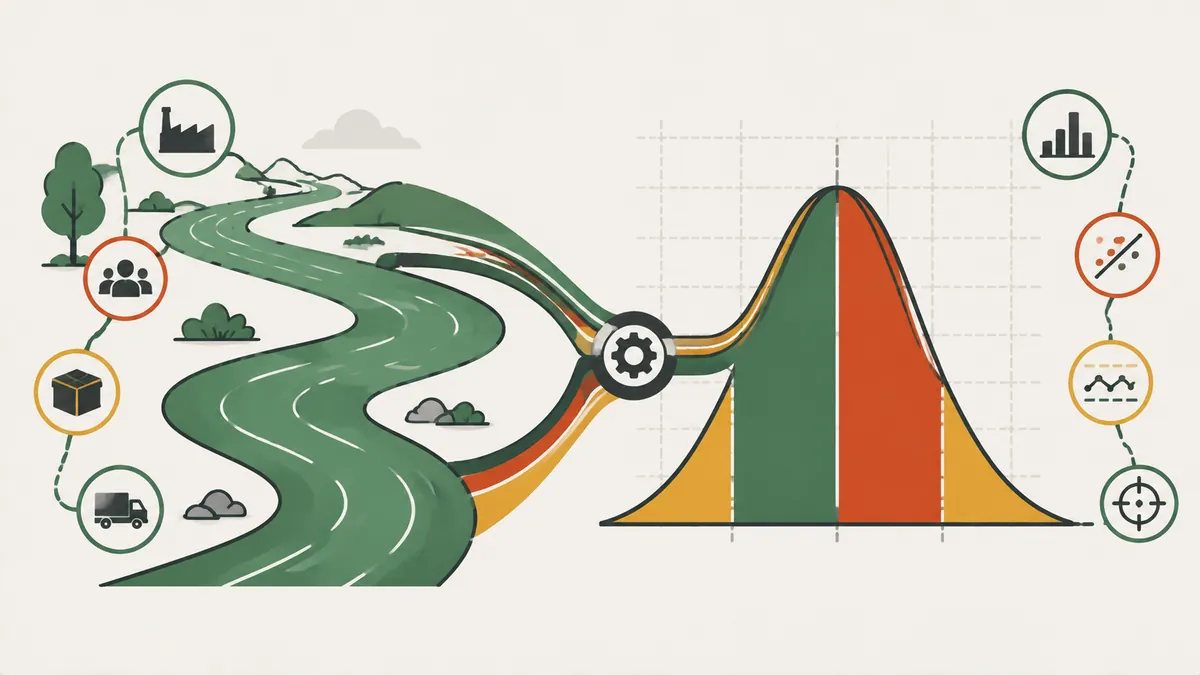
Lean focuses on flow and waste: making value move to the customer faster with fewer resources. Six Sigma focuses on variation: reducing defects through a structured, data-driven method. They answer different questions and work well together.
Sources: Lean Enterprise Institute, Lean Thinking and Practice and Six Sigma.
Side by side
| Lean | Six Sigma | |
|---|---|---|
| Main target | Waste and lead time | Variation and defects |
| Typical method | PDCA, kaizen | DMAIC |
| Typical tools | VSM, 5S, kanban, SMED | Statistical process control, design of experiments, regression |
| Who improves | Everyone, in small daily steps | Trained specialists leading projects |
When to use each
- Lean first when the problem is queues, long lead times, inventory or wasted motion.
- Six Sigma when a defect persists and its causes are hidden in variation that only data can reveal.
Many companies start with lean to stabilize and simplify the process, then use Six Sigma on the defects that remain.
Common mistakes
- Running statistical projects on processes that are not yet stable or standardized.
- Turning either method into a belt-counting program instead of solving problems.
Choosing for a real problem
A practical way to decide is to look at the problem itself. If parts wait days between steps, the issue is flow, and lean tools such as value stream mapping and kanban fit best. If a dimension varies from part to part for no obvious reason, the issue is variation, and a DMAIC project with data analysis is more appropriate. Many companies use both, under the name Lean Six Sigma.
Where most companies should start
For small and mid-sized plants, starting with basic lean practices usually brings faster results with less training: 5S, standardized work, a simple OEE measurement and PDCA. Statistical tools become more useful once the process is stable enough for the data to mean something.
Frequently asked questions
Is Lean Six Sigma a separate method?
It is a combination: lean for flow and waste, Six Sigma for variation.
Which one should a small company start with?
Usually lean, because its basic tools need little investment.
Is Six Sigma only for manufacturing?
No. It is also used in services, wherever defects and variation can be measured.
Sources
- Lean Enterprise Institute. Lean Thinking and Practice. Lean Lexicon. https://www.lean.org/lexicon-terms/lean-thinking-and-practice/
- Lean Enterprise Institute. Six Sigma. Lean Lexicon. https://www.lean.org/lexicon-terms/six-sigma/
Want to see the two methodologies combined?
Download the free "Problem Solving Kit" e-book, with PDCA, A3, 5 Whys and Ishikawa.
Download the e-book
About the author
Lean Manufacturing & Behavioral Management Specialist
Over 20 years in the automotive and metalworking industries (GM and Dana), Lean Manufacturing practitioner since 2006. SENAI instructor and mentor in Brazil’s Brasil Mais Produtivo program, delivering consulting, training and audits for 50+ companies, combining quality, productivity and people development.