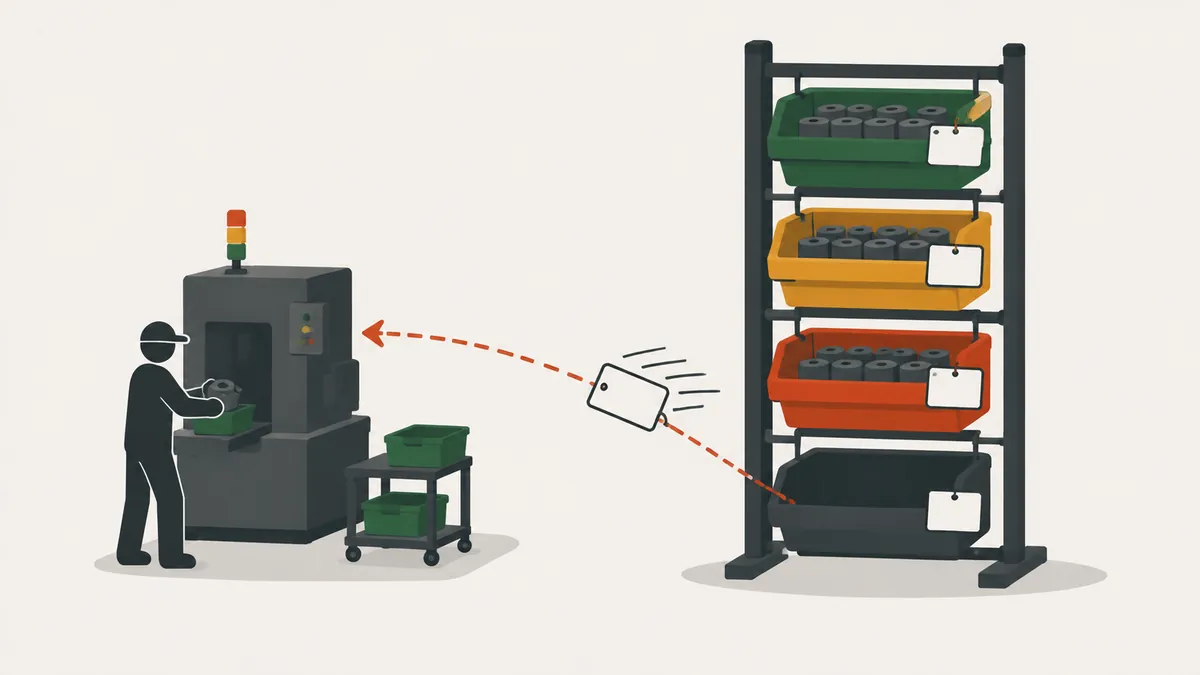
What a kanban is
A kanban is a signaling device that authorizes and gives instructions for the production or withdrawal of items in a pull system. The term is Japanese for sign or signboard. Cards are the best-known example, but the Lean Enterprise Institute notes that a kanban can also be a metal plate, a colored ball, an electronic signal or any device that carries the right information and prevents wrong instructions.
The system was developed at Toyota, and Taiichi Ohno described it as the means of operating just-in-time. The idea is simple: the downstream process withdraws what it consumed, and the upstream process makes only what was withdrawn. Nothing is made or moved without a kanban.
The main goal is to eliminate overproduction, the waste of making more, earlier or faster than the customer asks. Because the number of cards caps the inventory in the loop, kanban also makes problems visible: when a part runs short, the cause shows up and can be fixed.
A note on the term: the factory kanban covered here replenishes parts. The kanban board used by software and office teams borrowed the name and the idea of limiting work in progress, but it is a different application.
How the kanban loop works
The basic loop has six steps. The supermarket is a small, organized inventory with fixed addresses, between the two processes.
- The customer station uses the last item in a full container.
- The withdrawal card that was in the container is released and goes to the supermarket.
- The material handler takes a full container from the supermarket and brings it to the customer with the card.
- The production card from the withdrawn container goes back to the supplier station and joins the scheduling board.
- The supplier makes one container for each card on the board, in the order they arrived.
- The finished container, with its production card, goes back to the supermarket and the loop starts again.
The result is pull production: real consumption sets the supplier's pace, instead of a schedule pushing parts through the plant. To see the whole system kanban belongs to, read Just-in-Time.
Production kanban vs withdrawal kanban
| Production kanban | Withdrawal kanban | |
|---|---|---|
| Function | Authorizes the supplier process to produce | Authorizes moving parts to the customer process |
| When it is issued | When the customer takes parts from the supermarket | When the customer uses up a container |
| Example | The stamping press gets the card and makes a lot of 50 parts | The material handler takes a bin from the supermarket to assembly |
The card shows the part name and number, the supplier or process that feeds it, the quantity per container, the storage address and the consuming process. It may carry a barcode for tracking. There are variations too: the supplier kanban, for outside parts; the signal kanban, where a mark on the container replaces the card; and the electronic kanban, which sends the signal through a system. The principle is the same.
The kanban rules
For the system to work, the Toyota Production System literature describes usage rules. There are short versions with four rules and longer ones with six; this is a practical organization:
- The customer process withdraws from the supplier process only what the card indicates.
- The supplier process makes only the quantity and sequence withdrawn.
- No part is made or moved without a kanban.
- A kanban always travels with the physical part.
- A defective part never goes to the next process.
- Reducing the number of cards makes the system more sensitive to problems.
How to calculate the number of kanban cards, with example
N = D × LT × (1 + α) ÷ C
N is the number of cards, D the demand per period, LT the replenishment time in the same unit, α the safety factor and C the quantity per container. Illustrative example:
| Data | Value |
|---|---|
| Demand (D) | 400 parts per day |
| Replenishment time (LT) | 0.5 day |
| Safety factor (α) | 10% |
| Parts per container (C) | 50 |
N = 400 × 0.5 × 1.1 ÷ 50 = 220 ÷ 50 = 4.4, rounded up to 5 cards. Maximum inventory in the loop: 5 × 50 = 250 parts, or 0.625 day of demand.
In an 8 hour day, the line uses one container every 60 minutes. During a half-day replenishment it uses 4 containers (200 parts). The remaining 0.4 card is the safety, 20 parts. See what happens when you change the number:
| Cards | Parts in the loop | Demand during replenishment, with safety | Result |
|---|---|---|---|
| 4 | 200 | 220 | 20 parts short; the line stops |
| 5 | 250 | 220 | 30 parts of cushion |
With 4 cards the loop covers exactly 0.5 day of demand, with no cushion at all. Any delay stops the line. That is why lean cuts cards gradually, and only after attacking the cause of the problem the inventory was hiding. For the full calculation walk-through, see kanban card calculation.
When kanban works, kanban vs MRP and the kanban board
Kanban works best with reasonably stable demand, repetitive items, controlled variety and a supplier with a known replenishment time. With very uneven demand, study heijunka first. With long changeovers, SMED should come first, to allow smaller lots.
| Kanban | MRP | |
|---|---|---|
| Logic | Pull: replenish what was consumed | Plan from the forecast and push orders |
| Trigger | Card or consumption signal | Master schedule and bill of materials |
| Best for | High-turnover items and stable demand | Expensive, made-to-order or long lead time items |
Many plants use both: MRP for long-horizon purchasing and kanban for high-turnover items on the shop floor. The kanban board used in software and office work limits work in progress, but it does not replenish parts.
How to roll it out without stopping the line
- Start with a family of parts with regular consumption, one customer and one supplier clearly defined.
- Build the supermarket with fixed addresses and visual identification, supported by 5S.
- Calculate cards with some cushion at first and reduce gradually.
- Train the rules: no card, no production; withdraw only what the card asks for.
- Track shortages and excesses on a visual management board.
- Review the card count when demand, replenishment time or container size changes. Every problem revealed becomes a kaizen cycle.
Common mistakes
- Calculating the cards once and never reviewing.
- Running kanban on an unstable process with long changeovers and frequent breakdowns.
- Producing without a card to use idle capacity.
- Using a high safety factor to hide instability.
- Losing cards without control and mixing time units in the calculation.
- Sending a defective part to the supermarket.
Next step
- Pick one regular-turnover item with a clear customer and supplier.
- Measure daily demand and the real replenishment time.
- Calculate N with the formula and round up.
- Build the supermarket, print the cards and run for two weeks.
- If the line never runs short, remove one card and watch what appears.
Frequently asked questions
What is kanban?
A signal, in the form of a card, plate or electronic message, that authorizes making or moving items in a pull production system.
What does kanban mean?
It is a Japanese word that means sign or signboard.
How does a kanban system work?
The customer uses a container, the card goes to the supermarket and the supplier, and the supplier makes only what was withdrawn, refilling the supermarket.
What is the difference between production kanban and withdrawal kanban?
The production kanban authorizes the supplier to make parts; the withdrawal kanban authorizes moving the parts to the customer.
How do you calculate the number of kanban cards?
Use N = D × LT × (1 + α) ÷ C and round up. In the example, 400 × 0.5 × 1.1 ÷ 50 = 4.4, so 5 cards.
Are kanban and just-in-time the same thing?
No. Just-in-time is the production system; kanban is one of the tools that make the pull system work.
Is factory kanban the same as a kanban board?
No. Factory kanban replenishes consumed parts. A kanban board limits work in progress in software and office work.
When should you not use kanban?
With very uneven demand, made-to-order items or unstable processes with long changeovers and frequent breakdowns, kanban tends to fail.
Sources
- Lean Enterprise Institute. Kanban. Lean Lexicon. https://www.lean.org/lexicon-terms/kanban/
- Lean Enterprise Institute. Supermarket. Lean Lexicon. https://www.lean.org/lexicon-terms/supermarket/
- MONDEN, Y. Toyota Production System: An Integrated Approach to Just-in-Time. Boca Raton: CRC Press.
- OHNO, T. Toyota Production System: Beyond Large-Scale Production. Portland: Productivity Press.
Want real pull production?
Download the free pull production e-book, with kanban, supermarkets and leveling.
Download the e-book
About the author
Lean Manufacturing & Behavioral Management Specialist
Over 20 years in the automotive and metalworking industries (GM and Dana), Lean Manufacturing practitioner since 2006. SENAI instructor and mentor in Brazil’s Brasil Mais Produtivo program, delivering consulting, training and audits for 50+ companies, combining quality, productivity and people development.