What Is Andon?
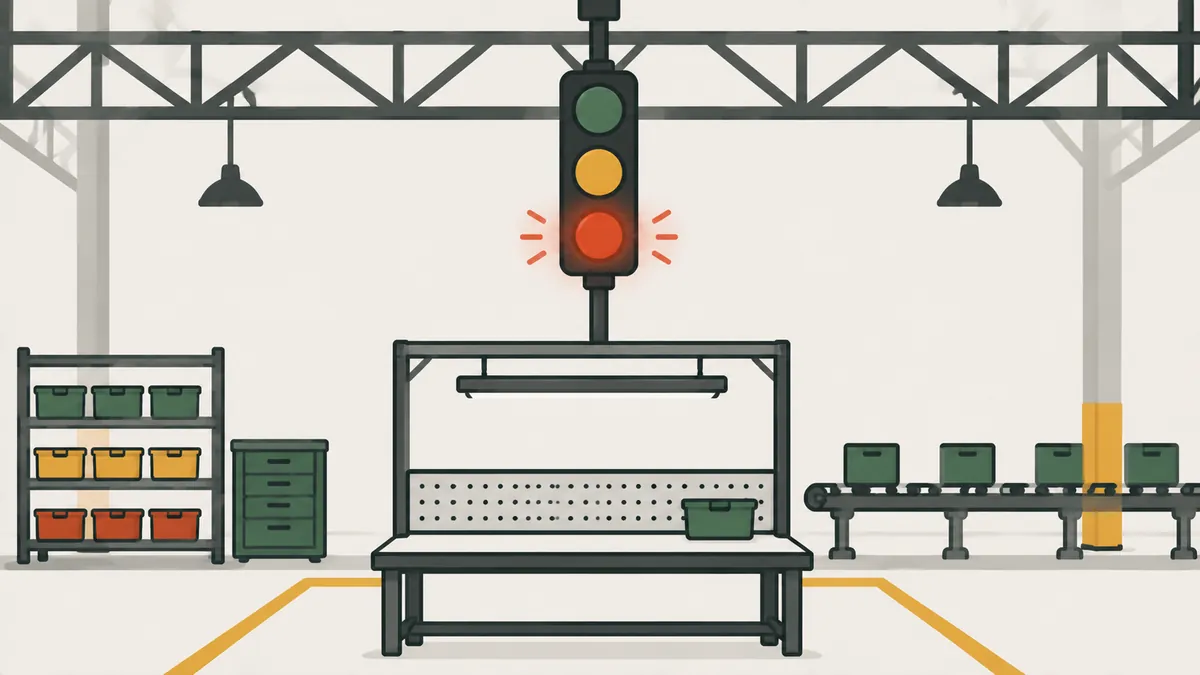
Andon is a visual management tool that shows, at a glance, the status of operations in an area and signals whenever an abnormality occurs. The Japanese word means "lamp".
In practice, it is how a workstation asks for help. Instead of hiding the problem or waiting for someone to notice, the operator or the machine turns on a signal and the leader goes to the spot. Andon is one of the tools of jidoka: it makes the stop visible and the help immediate.
The system comes from the Toyota Production System. The idea is simple: a problem can only be solved if it is seen, and it will only be seen quickly if it announces itself.
It helps to separate three things that often get mixed up. The andon is the signal. The response is what the leader does after seeing it. The record is what the company learns afterwards. A fancy board with no response and no record is just decoration. A simple colored card with a quick response and a note about the cause is already a working andon system.
What an Andon Shows
- Production status: which machines and stations are running.
- Abnormalities: machine down, quality problem, tool failure, operator delay, material shortage.
- Required actions: such as a scheduled tool change.
- Planned versus actual: how many parts should be out by now and how many are.
What the Andon Light Colors Mean
Colors vary between companies, so define yours and train everyone. The most common convention is:
| Color | Usual meaning | Expected action |
|---|---|---|
| Green | Normal operation | None |
| Yellow | Call for help or attention | The leader goes to the station |
| Red | Line or machine stopped | Fix it before releasing |
| Blue | Material shortage (common use) | Logistics replenishes the item |
How an Andon System Works
The classic format is an overhead board with numbers that match stations or machines. The number lights up when a sensor detects the problem or when the operator pulls a cord or presses a button. The light calls for a fast response from the team leader. Colored lights above the machines, green for normal and red for a problem, are another common form.
- The operator or a sensor detects the abnormality.
- The signal is triggered: the yellow light comes on and the board shows the station.
- The leader responds and goes to the station.
- If the problem is solved within the cycle time, the light goes off and production continues.
- If not, the line stops (red light) until it is fixed.
- The call is recorded, with the reason and the time spent.
On many Toyota-inspired lines, the first pull of the cord calls for help without stopping the line, and the stop only happens if the problem is not fixed by a defined point in the cycle. This design detail varies. What is essential is that the operator has the right and the means to trigger it.
Fixed-position stopping is also common: the line stops only at the end of the cycle or at a defined point, so the part is not left half done. This avoids new defects caused by the stop itself and makes restarting easier. On lines with many stations, the board shows the station number, and the leader knows where to go without searching.
Worked Example: A Shift With 12 Calls
Illustrative example. A line works a 480-minute shift with a takt time of 60 seconds. The plan is 1 part per minute, or 480 parts. The andon logged 12 calls, all with the line stopped until the fix.
| Cause | Calls | Average time per call (min) | Total downtime (min) | % of downtime |
|---|---|---|---|---|
| Material shortage | 5 | 4 | 5 × 4 = 20 | 38.5% |
| Machine or tool failure | 2 | 9 | 2 × 9 = 18 | 34.6% |
| Quality problem | 4 | 3 | 4 × 3 = 12 | 23.1% |
| Other | 1 | 2 | 1 × 2 = 2 | 3.8% |
| Total | 12 | 52 | 100.0% |
Total downtime: 20 + 18 + 12 + 2 = 52 minutes. Productive time was 480 − 52 = 428 minutes, and the line made 428 parts against 480 planned. Shift availability is:
428 ÷ 480 = 89.2%
This is the availability factor used in OEE. The andon data shows where the loss is: material shortage (20 minutes) and machine failure (18 minutes) add up to 38 of the 52 minutes, or 73.1% of downtime. Machine failure has the longest time per call, 9 minutes. The first attack goes to material shortage, which happens most often.
To read the result, look at two measures per cause: frequency (how many times) and duration (how many minutes each time). A frequent, short cause calls for a routine fix, like scheduled replenishment. A rare, long cause calls for root cause analysis and, often, preventive maintenance. In the example, material shortage is frequent and machine failure is long, so each needs a different response.
Without the record, the leader would remember only the last problem. With it, the conversation changes from "today was a bad day" to "material and machines explain 73.1% of the downtime".
Types of Andon Systems
| Type | How it works | When it makes sense |
|---|---|---|
| Manual | Flag, light with a switch or a cord | Early rollout and small companies |
| Semi-automatic | A button or cord turns on the light and board; sensors at critical points | Assembly lines with many stations |
| Electronic | Digital board that logs time and cause, tied to the production system | Operations with many lines that need analysis |
Start simple. A light or a flag with a fast leader response already does the job. Technology only helps if the habit of responding already exists. A digital board that logs time and cause automatically is valuable, because it removes manual notes and shows trends. But without leaders who respond, it only records the neglect more precisely.
How to Set Up an Andon
- Define what is abnormal at each station, with a clear standard: dimension, time, missing part.
- Choose the signals and colors and write down what each one means.
- Define who responds, how fast and what they do on arrival. A common starting target is to respond within 1 minute.
- Train operators and leaders and simulate a call before it counts.
- Record every call, with reason, start time and end time.
- Review the records every week and attack the most frequent causes with a PDCA cycle.
The Risk: Nobody Pulls the Cord
An andon only works if triggering it is safe. If the person who triggers it is blamed for the stop, the system dies within weeks and problems are hidden again. Leadership must thank people for every call and hold them accountable for the response, not for the call.
A good health sign is the opposite of what many expect: at first, the number of calls goes up, because problems that were hidden now appear. As causes are analyzed and fixed, it falls. If the number drops to zero right at the start, be suspicious. People have probably stopped calling.
Andon data also feeds the area's visual management boards and the daily production meetings.
Andon, Jidoka and Visual Management
| Concept | Role |
|---|---|
| Jidoka | Principle: detect the abnormality and stop the work |
| Andon | Tool: signals the problem and calls for help |
| Poka-yoke | Device that prevents the error or detects it |
| Visual management | Set of resources that makes operating status visible; andon is one of them |
Poka-yoke can trigger the andon automatically when it detects an error. The two complement each other.
Common Mistakes
- Installing the board without defining what is abnormal at each station.
- Blaming the operator for the call.
- A leader who is slow to respond or does not go to the station.
- Not recording the reason and time of each call.
- Colors with no agreed meaning, or different between areas.
- Muting the alarm so it does not bother anyone, instead of fixing the cause.
Next Step
Pick one line and start with a log sheet. For one week, write down every time an operator needs help: time, reason and minutes stopped. Add it up by cause, like in the example table, and turn the biggest item into an improvement project. Then install the simplest possible signal and agree on the leader's response.
Frequently asked questions
What does andon mean?
It is the Japanese word for lamp. In a factory, it is the visual signal that shows the status of an area and calls for help when there is a problem.
Who triggers the andon?
The operator, by pulling a cord or pressing a button, or the machine itself through a sensor.
What are the andon light colors?
The most common convention is green for normal, yellow for a call for help and red for a stop. Each company defines its own and must train everyone.
Does an andon need an electronic system?
No. A light or a flag with a fast leader response already does the job.
How are andon and jidoka related?
Jidoka is the principle of detecting and stopping. Andon is the tool that makes the stop visible and calls for help.
What is the andon log for?
It shows which causes stop the line most and how much time they cost, so improvements can be prioritized with data.
Does the andon always stop the line?
Not necessarily. In many systems the first call asks for help, and the line only stops if the problem is not solved in time.
Sources
- Lean Enterprise Institute. Andon. Lean Lexicon. https://www.lean.org/lexicon-terms/andon/
- Lean Enterprise Institute. Jidoka. Lean Lexicon. https://www.lean.org/lexicon-terms/jidoka/
- Lean Enterprise Institute. Visual Management. Lean Lexicon. https://www.lean.org/lexicon-terms/visual-management/
- LIKER, J. K. The Toyota Way: 14 Management Principles from the World's Greatest Manufacturer. New York: McGraw-Hill, 2004.
Want to measure what really matters?
Download the free metrics e-book and track the losses in your operation.
Download the e-book
About the author
Lean Manufacturing & Behavioral Management Specialist
Over 20 years in the automotive and metalworking industries (GM and Dana), Lean Manufacturing practitioner since 2006. SENAI instructor and mentor in Brazil’s Brasil Mais Produtivo program, delivering consulting, training and audits for 50+ companies, combining quality, productivity and people development.