- What gemba is and what a gemba walk is
- What it is for and what it is not
- The walk routine, step by step
- Worked example: a 60-minute walk
- How to deal with the team's mistrust
- Questions that work on a gemba walk
- How often to do it
- Gemba outside the factory
- When the walk turns into an inspection
- Next step
- Frequently asked questions
What gemba is and what a gemba walk is
Gemba is the Japanese term for "the actual place," where the work that creates value happens. In manufacturing, it is the shop floor. In other fields it can be a restaurant kitchen, a hospital operating room, a construction site or a software codebase. The Lean Enterprise Institute (LEI) ties gemba to the principle of genchi genbutsu, "go and see."
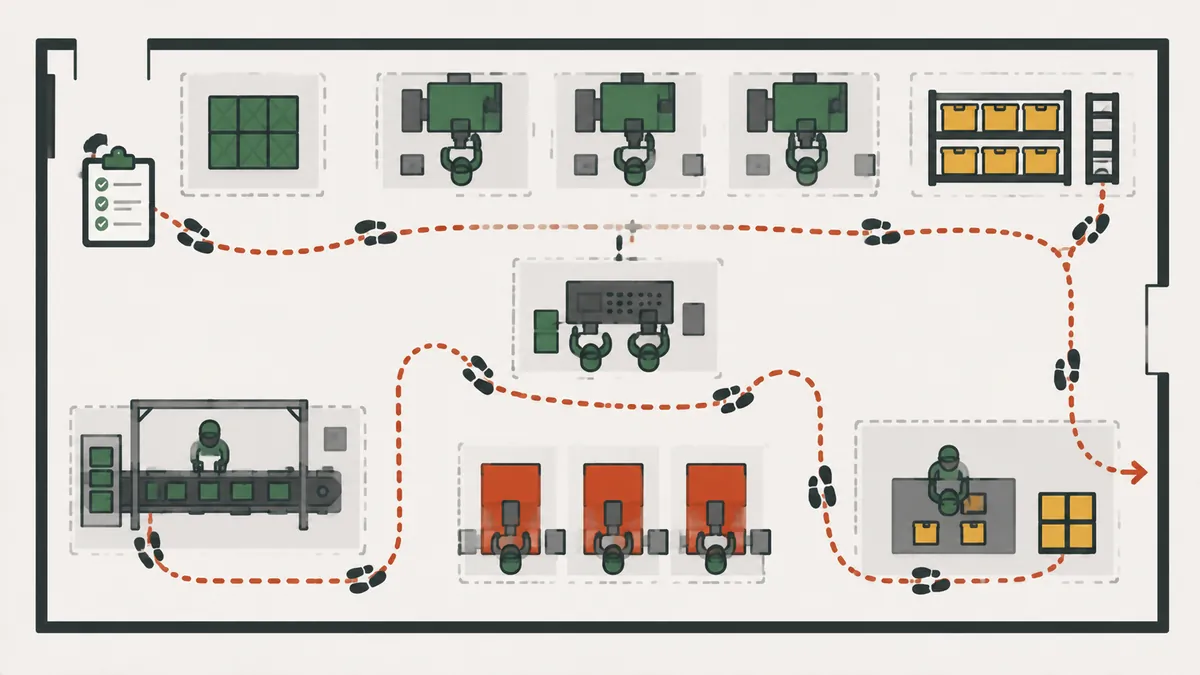
A gemba walk is the management practice in which a leader goes to where the work is done to understand the real situation through direct observation and questions, before deciding or acting. It is not an inspection and it is not a social visit. It is a disciplined way to learn from the process and support the people who run it.
The story goes that Taiichi Ohno drew a chalk circle on the floor and asked an engineer to stand in it, watching, until he could see the waste. The tale is widely repeated as a symbol of the principle: to understand work, you have to look at the work, patiently.
What it is for and what it is not
The goal is for the leader to see the gap between the standard and reality, understand what gets in the way of the work and help the team solve it. The expected result is learning and action, not a report.
| Practice | Goal | Focus |
|---|---|---|
| Gemba walk | Understand the real situation and support people | The process and the flow |
| Audit | Verify compliance with a standard or requirement | Meeting the requirement |
| Inspection | Approve or reject a product or station | The result |
| Meeting room review | Discuss data and decide | Reports and metrics |
These practices complement each other. The difference is that the gemba walk starts from direct observation and respect for people. When a leader shows up only to demand results, people learn to hide problems, and the walk loses its point.
The walk routine, step by step
- Define the purpose. One theme per walk, such as safety, flow, quality or adherence to standardized work.
- Let the area know. Explain that the visit is to understand the process, not to evaluate people.
- Follow the product flow, from input to output, not the org chart.
- Observe before asking. Stand at a station for a few minutes and watch complete cycles. Compare what you see with the standard and with the area's visual management.
- Ask with respect, about the process and not about the person.
- Record facts, not impressions: times, quantities, photos and what was said.
- Close the loop. What you saw becomes an action with an owner and a date, and on the next walk you come back to see the result.
A good gemba notebook has three columns: what I saw, what I asked and what we agreed. This keeps the walk from dissolving into loose conversation.
Two habits improve the quality of the record. First, write down what you saw with numbers whenever possible: how many cycles, how many seconds, how many parts waiting. Second, separate fact from interpretation. "The operator walks too much" is interpretation. "He left the station to fetch screws in two of the five timed cycles" is a fact, and it is something the team can work with.
Worked example: a 60-minute walk
Illustrative example, with exercise data and not from a real company. The production manager takes a 60-minute walk on the assembly line, with the theme of flow and adherence to the standard.
| Step | Time | What happens |
|---|---|---|
| Preparation | 5 min | Define the theme and review the standard of the 4 stations |
| Observation | 4 stations × 10 min = 40 min | Watch complete cycles and talk with the operator |
| Notes and agreements | 15 min | Write down facts and set actions with the team |
| Total | 5 + 40 + 15 = 60 min |
At station 3, the standard is 60 seconds per unit. The manager times 5 consecutive cycles: 62, 71, 64, 75 and 63 seconds. The sum is 335 and the average is 335 ÷ 5 = 67 seconds. The gap is 67 − 60 = 7 seconds per unit, or 7 ÷ 60 = 11.7% above standard. At 400 units per shift, that is 400 × 7 = 2,800 seconds, about 47 minutes per shift.
The cause was not the operator: the screw bin sits 3 meters (about 10 feet) from the station, and in the 71- and 75-second cycles he had to go fetch it. The manager does not fix it on the spot and does not correct the person. He agrees on two actions with the area leader.
| Action | Owner | Due |
|---|---|---|
| Move the screw bin next to station 3 | Area leader | 3 days |
| Review the standardized work of station 3 and record the new cycle | Process engineering | 1 week |
On the next walk, the manager returns to station 3, times it again and checks whether the average moved toward 60 seconds. Without that return, the walk is just a visit. If the cause is unclear, the finding can feed a 5 Whys analysis.
How to deal with the team's mistrust
On the first walks, operators often feel they are being evaluated. The natural reaction is to show only what is going well or to stop talking. A few precautions reduce this effect.
- Explain the purpose beforehand: you are there to understand the process and remove obstacles.
- Thank people for every problem they point out. Whoever is criticized for speaking stops speaking.
- Keep your agreements. One action delivered on time is worth more than any speech.
- Ask the operator to show how the work is done, and listen to the end.
- Keep the same routine and the same frequency, so the walk becomes part of the rhythm and not an event.
Trust is built over weeks. The sign that the practice works is simple: people start bringing problems to the leader before the leader asks.
Questions that work on a gemba walk
Open questions invite explanations. Yes or no questions tend to close the conversation. Useful examples:
- What is the standard for this task? Is it being followed? If not, why?
- What got in the way of your work today?
- How do you know the part is good?
- What happens when a problem appears here? Who helps, and how fast?
- What is the most frequent problem at this station?
- If you could change one thing here, what would it be?
Avoid questions that sound like accusations, such as "why didn't you do it this way?" Swap them for "what made it hard to do it this way?" The right question shows the leader is there to help.
How often to do it
There is no single number. What matters is a predictable rhythm set by leadership and a return on what was seen. As a practical reference, each level tends to walk at a different cadence:
| Level | Reference cadence | Focus |
|---|---|---|
| Team leader and supervisor | Every day, about 15 to 20 minutes | Safety, station standard and the day's problems |
| Manager | Every week, 30 to 60 minutes | Flow, metrics and open actions |
| Executive team | Every month, 60 to 90 minutes | Support, barriers and learning |
Each company adjusts these times to its size. If the walk becomes a calendar ritual with no follow-up, it is better to do it less often and close the actions.
Gemba outside the factory
The concept applies anywhere work happens. The table lists examples taken from the LEI and from common use.
| Field | Gemba | What to observe |
|---|---|---|
| Manufacturing | The shop floor | Flow, standard, waiting and motion |
| Hospital | Operating room and wards | Shift handoffs, waiting, patient safety |
| Hospitality | Kitchen and dining room | Service time, rework and wasted supplies |
| Construction | The job site | Task sequence, material stock, safety |
| Office and software | The desk and the code | Request queues, rework, missing information |
The application shows up in lean office and lean healthcare. The walk is also the entry point to seeing the wastes of lean in the real flow.
When the walk turns into an inspection
- Going to the gemba to demand results instead of understanding the process.
- Solving the problem on the spot, over the head of the area leader, instead of helping him solve it.
- Criticizing in public, which teaches people to hide problems.
- Walking fast through the whole plant without watching one full cycle.
- Standing in the aisle, looking from afar.
- Having no set frequency and never coming back to check the agreements.
- Writing down impressions instead of facts.
Next step
Put a 30-minute walk on your calendar for this week, with one theme and one chosen station. Bring a notebook with three columns (what I saw, what I asked, what we agreed), watch at least five cycles and close one action with an owner and a date. The following week, go back to the same station and check the result.
Frequently asked questions
What does gemba mean?
In Japanese, the actual place: where the work that creates value happens, such as the shop floor.
What is a gemba walk?
It is a walk in which a leader goes to where the work is done to understand the real situation through direct observation and questions before acting.
What is the difference between a gemba walk and an audit?
A gemba walk aims to understand the process and support people. An audit verifies compliance with a standard or requirement.
How do you do a gemba walk?
Define a theme, follow the product flow, watch complete cycles, ask with respect, record facts and close actions with an owner and a date.
How often should you do a gemba walk?
At a regular rhythm set by leadership, for example daily for supervisors and weekly for managers, always returning to see the results of the actions.
What questions should you ask on a gemba walk?
Open questions about the process, such as what the standard for the task is, what got in the way today and how people know the part is good.
Does a gemba walk work in offices and hospitals?
Yes. The gemba is the place where the work happens in any field, and the practice applies to offices, hospitals, construction and services.
Sources
- Lean Enterprise Institute. Gemba. Lean Lexicon. https://www.lean.org/lexicon-terms/gemba/
- Lean Enterprise Institute. Standardized Work. Lean Lexicon. https://www.lean.org/lexicon-terms/standardized-work/
- WOMACK, J. P. Gemba Walks. Cambridge: Lean Enterprise Institute.
Want the tools ready to use?
Download the free "Problem Solving Kit" e-book, with PDCA, A3, 5 Whys and Ishikawa.
Download the e-book
About the author
Lean Manufacturing & Behavioral Management Specialist
Over 20 years in the automotive and metalworking industries (GM and Dana), Lean Manufacturing practitioner since 2006. SENAI instructor and mentor in Brazil’s Brasil Mais Produtivo program, delivering consulting, training and audits for 50+ companies, combining quality, productivity and people development.