What heijunka is
Heijunka is leveling the type and quantity of production over a fixed period of time. The Lean Enterprise Institute explains that it lets production meet customer demand efficiently while avoiding batching, resulting in minimum inventories, capital costs, manpower and lead time across the value stream. The Japanese word means, roughly, "leveling".
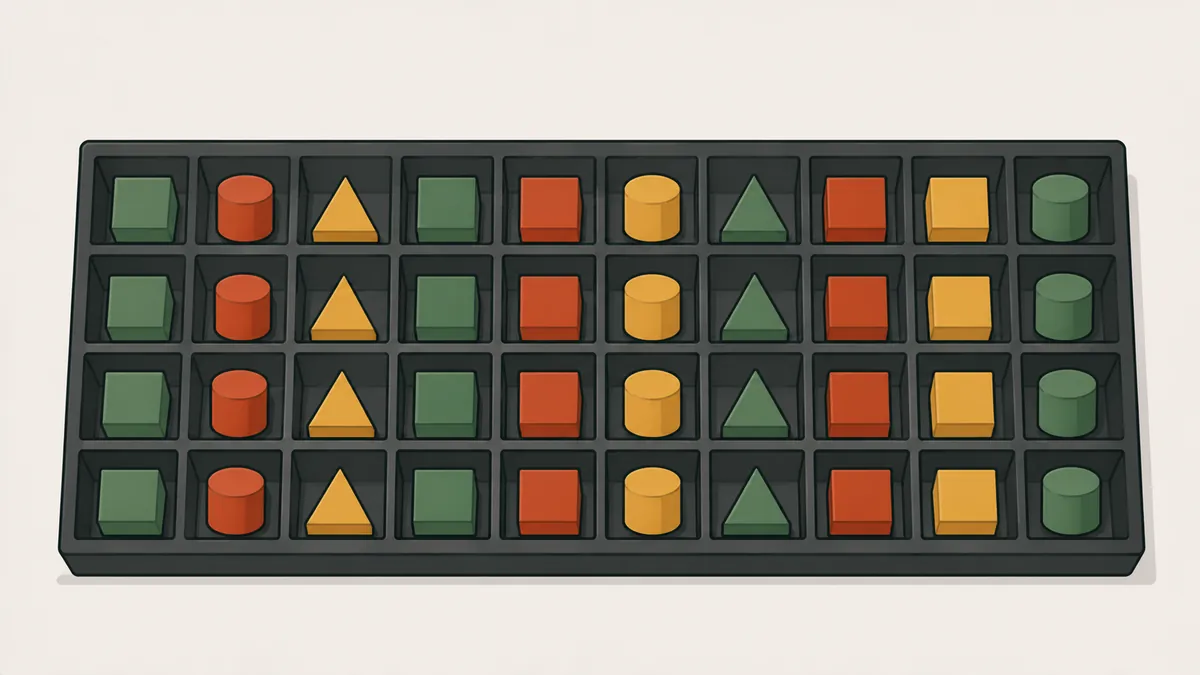
There are two kinds of leveling. Volume leveling spreads the total quantity in equal parts across the period, instead of following the peaks in orders. Mix leveling spreads the models in short, repeated sequences, instead of making each model in one long block.
Heijunka is the foundation of just-in-time. Without it, kanban receives uneven orders and needs inventory to absorb the peaks.
A simple mix-leveling example: instead of making all of model A on Monday, all of B on Tuesday and all of C on Wednesday, production alternates the models in short sequences, such as A, B, A, C, repeated through the day. Every customer gets a little of each model every day, and the stock of each stays small.
Leveling by volume: the LEI example
A manufacturer receives 500 orders per week, but with large day-to-day variation.
| Day | Orders | Leveled production |
|---|---|---|
| Monday | 200 | 100 |
| Tuesday | 100 | 100 |
| Wednesday | 50 | 100 |
| Thursday | 100 | 100 |
| Friday | 50 | 100 |
| Total | 500 | 500 |
To level, the manufacturer keeps a small finished goods inventory near shipping, which absorbs the Monday peak, and makes 100 units a day all week. Following the orders day by day would require capacity for 200 units and leave the plant idle on Wednesday and Friday.
Worked example: leveling the mix of A, B and C
Illustrative example. A line makes three products with weekly demand of 250 A, 125 B and 125 C, or 500 pieces in 5 days. The shift is 480 minutes.
Step 1, daily demand: 500 ÷ 5 = 100 pieces per day, made up of 50 A, 25 B and 25 C.
Step 2, compare the two weekly plans:
| Day | Unleveled | Leveled |
|---|---|---|
| Monday | 125 A | 50 A, 25 B, 25 C |
| Tuesday | 125 A | 50 A, 25 B, 25 C |
| Wednesday | 125 B | 50 A, 25 B, 25 C |
| Thursday | 125 C | 50 A, 25 B, 25 C |
| Friday | 0 | 50 A, 25 B, 25 C |
| Maximum daily load | 125 | 100 |
| Changeovers per week | 3 | 75 |
Unleveled, the daily peak is 125 pieces, 25% above the 100 of the leveled plan, and Friday has no load. Leveled, the load is the same every day, but changeovers go from 3 to 75 per week. That is the price of leveling, and it is why leveling goes hand in hand with shorter changeover times.
Note the logic of the sequence. Since A is half of demand (50 of 100), it takes half of each cycle. B and C split the other half. If a fourth model joins, the rule is the same: each model takes, in every cycle, the same share it has in daily demand.
Step 3, leveled cycle: the day is split into 5 cycles of 20 pieces, each with 10 A, 5 B and 5 C. Each cycle has 3 changeovers (A to B, B to C, C to A), which makes 15 changeovers per day.
Step 4, changeover time: after SMED, each changeover takes 2 minutes. In one day: 15 × 2 = 30 minutes. Net time = 480 − 30 = 450 minutes. Net pace = 450 ÷ 100 = 4.5 minutes per piece.
Step 5, cycle length: A takes 10 × 4.5 = 45 min. B and C take 5 × 4.5 = 22.5 min each. With 3 changeovers of 2 min (6 min), the cycle lasts 45 + 22.5 + 22.5 + 6 = 96 minutes. Five cycles: 5 × 96 = 480 minutes, the whole shift.
Step 6, feasibility test: if each changeover still took 20 minutes, the 15 changeovers would use 300 minutes. That would leave 180 minutes, which produce 180 ÷ 4.5 = 40 pieces, far below the 100 required. Mix leveling is only feasible with quick changeovers.
The heijunka box and pitch
The heijunka box is a board with columns for time intervals and rows for each product. Kanban cards are placed in the leveled sequence, and the material handler takes the cards for each interval to the process. The box turns the leveled plan into a visible rhythm tied to takt time.
The interval on the box is the pitch: takt time multiplied by the quantity in one container. In the example, if the container for A holds 10 pieces, the pitch for A is 4.5 × 10 = 45 minutes. At each pitch, the process finishes one container and withdraws the next card. If a card was not withdrawn on time, the delay is visible right away.
In practice, the box does three jobs. It shows the plan for the day without a report. It gives the material handler a fixed withdrawal routine. And it exposes deviations: a card left over at the end of the interval shows the process missed its pace, and the cause should be investigated right there, at the gemba.
What must be ready before leveling
- Quick changeovers: without SMED, small and frequent mixes do not fit in the shift, as step 6 showed.
- Stable processes: reliable machines with TPM and standardized work.
- Known takt time: the pace comes from demand, and demand must be analyzed over several weeks.
- Finished goods inventory: a small stock near shipping absorbs customer variation.
Why level: benefits and the link to muda, mura and muri
Leveling attacks mura, unevenness, one of the three losses in muda, mura and muri. An uneven load forces you to have capacity for the peak (muri, overburden) and leaves the plant idle in the valleys (muda).
- Less inventory: smaller batches of each product.
- Stable workload for people: fewer days of overtime followed by days of idle time.
- More stable suppliers: the raw material order becomes regular.
- Faster response: every product is made every day, and the customer gets a little of each model often.
- Foundation for JIT: the LEI places heijunka as the foundation of just-in-time.
One point of caution: real demand is never perfectly flat. That is why heijunka uses a fixed leveling period, usually a week or a shift, and revises the average when demand shifts to a new level. Small variations are absorbed by finished goods inventory. Large changes call for a new takt time calculation and a new sequence design.
Common mistakes
- Leveling the mix without cutting changeover time, which eats the line's capacity.
- Leveling from a single month of demand, without analyzing the real variation.
- Using the box as a wall display, with nobody withdrawing cards on time.
- Waiting for customer demand to level out. What gets leveled is production; finished goods inventory bridges the gap.
- Trying to level every product at once instead of starting with one family.
How to start
- Pick one product family and pull its demand over several weeks.
- Calculate the daily average of each model, as in step 1 of the example.
- Cut changeover time with SMED until the desired sequence fits.
- Build a daily sequence that repeats the mix and adjust it each period.
- Use a simple box, with the cards in sequence, and review deviations daily.
Next step
Take one product family in your plant and fill in the table from the example: weekly demand, daily average, number of changeovers in the current plan and the leveled plan, and today's changeover time. If the changeovers do not fit in the shift, the first project is SMED, not the box.
To understand the system that makes pull production work, read the complete guide to kanban.
Frequently asked questions
What does heijunka mean?
Leveling. It means spreading production by type and quantity evenly over a period of time.
What is the difference between volume leveling and mix leveling?
Volume leveling spreads the total quantity in equal parts per day. Mix leveling alternates the models in short, repeated sequences instead of making each in one long block.
Does heijunka increase inventory?
It needs a small finished goods stock to absorb variation, but it lowers total inventory in the flow because it removes large batches.
How are heijunka and SMED related?
Leveling the mix means switching products many times a day, which is only feasible with quick changeovers.
What is a heijunka box?
A board with columns for time intervals and rows by product, where kanban cards sit in the leveled sequence and are withdrawn at each interval.
What is pitch in heijunka?
It is the interval for withdrawing cards, calculated as takt time times the quantity in one container.
How are heijunka and kanban related?
Heijunka sets the rhythm and sequence of orders, and kanban passes those orders to the processes. Without leveling, kanban receives peaks and needs more cards.
Sources
- Lean Enterprise Institute. Heijunka. Lean Lexicon. https://www.lean.org/lexicon-terms/heijunka/
- Lean Enterprise Institute. Just-in-Time Production. Lean Lexicon. https://www.lean.org/lexicon-terms/just-in-time/
- Lean Enterprise Institute. Takt Time. Lean Lexicon. https://www.lean.org/lexicon-terms/takt-time/
- ROTHER, M.; SHOOK, J. Learning to See. Cambridge: Lean Enterprise Institute.
Want real pull production?
Download the free pull production e-book, with kanban, supermarkets and leveling.
Download the e-book
About the author
Lean Manufacturing & Behavioral Management Specialist
Over 20 years in the automotive and metalworking industries (GM and Dana), Lean Manufacturing practitioner since 2006. SENAI instructor and mentor in Brazil’s Brasil Mais Produtivo program, delivering consulting, training and audits for 50+ companies, combining quality, productivity and people development.