What is SMED
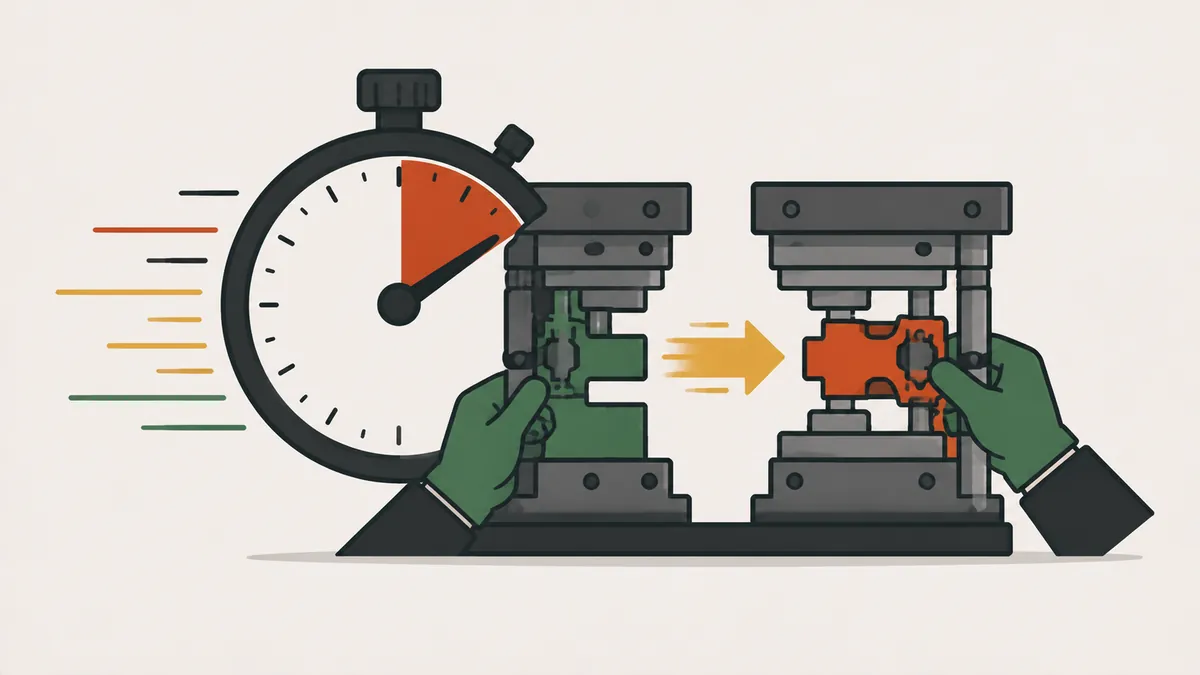
SMED (Single Minute Exchange of Die) is the method developed by Shigeo Shingo to cut the time it takes to change over a machine: the time between the last good part of one product and the first good part of the next. "Single minute" means single-digit minutes, changeovers under 10 minutes, which is the method's end goal.
The Lean Enterprise Institute defines changeover as the process of switching a machine or line from one product to another. On the shop floor the same idea goes by setup, die change, tool change, mold change and quick changeover.
Shingo drew the method from work in Japanese plants, including Toyota, and published it in the book A Revolution in Manufacturing: The SMED System. The central idea is simple: most of a changeover does not need to happen with the machine stopped.
One important detail: changeover time does not end when the machine starts running again. It runs until the first good part, so it includes adjustments and trial parts. Measuring only up to restart hides part of the loss.
Why setup matters so much
Long setups push plants toward big batches: if a changeover takes two hours, nobody wants to change over twice a shift. Big batches create inventory, which is among the wastes of lean, lengthen lead time and slow the response to the customer.
Shorter setups are what make small batches possible, enabling heijunka and just in time. In OEE, setup shows up as an availability loss: every minute of changeover is a minute the machine is not producing.
When is SMED worth it? Usually when the machine is a bottleneck, when there are many changeovers per shift, when batches are large because of setup or when product variety is growing. If a machine changes over once a week and does not limit the flow, other improvements pay more.
Internal and external setup
The central idea of SMED is to separate what can only be done with the machine stopped from what can be done while it runs.
| Type | Definition | Examples |
|---|---|---|
| Internal setup | Can only be done with the machine stopped | Unclamping and clamping the die, swapping the die, adjusting the height |
| External setup | Can be done while the machine is producing | Fetching the next die, preheating, gathering bolts and fixtures, reading the production order |
In many plants, a large part of changeover time is spent looking for tools, waiting for the forklift or fetching the drawing, all with the machine needlessly stopped. Just separating internal from external usually brings a big reduction, with almost no investment.
The steps of the method
Shingo organized SMED into stages. They start by observing and move from the cheapest to the most expensive:
| Stage | What to do | Example |
|---|---|---|
| 0. Starting point | Film a real changeover and list every activity with its time | Everything is done with the machine stopped |
| 1. Separate internal and external | Classify each activity and move the external work to before the stop | Fetch tools and bolts before stopping the machine |
| 2. Convert internal to external | Rethink what looked internal and prepare it off the machine | Preheat the die, preassemble clamps |
| 3. Streamline what remains | Shorten the internal work: quick clamps, guides, no trial and error adjustments | One-touch clamping, guide pins, standardized heights |
After stage 3 the cycle starts again: film again, measure the new time and look for the next reduction. The new method goes into standardized work, and every shift is trained on it.
In practice, stage 1 is the one that surprises most, because it reveals the time lost with the machine stopped for no reason: looking for the wrench, waiting for the forklift, fetching the drawing. In stage 2, the question is "does this really have to be done with the machine stopped?" Preheating the die in an oven next to the press, for example, takes out of the stop a time that looked unavoidable. In stage 3, the focus moves to the motion of unclamping, positioning and clamping itself, and that is where engineering techniques come in.
Worked example: from 60 to 20 minutes
Illustrative example. A press makes 3 changeovers per 480-minute shift, and each one takes 60 minutes with the machine stopped. The team applied the SMED stages:
| Stage | What changed | Machine stopped |
|---|---|---|
| 0. Starting point | Everything is done with the machine stopped | 60 min |
| 1. Separate internal and external | 15 min of external activities (fetching tools, gathering bolts, reading the order) move to before the stop | 45 min |
| 2. Convert internal to external | 10 min: preheat the die and preassemble the clamps off the machine | 35 min |
| 3. Streamline what remains | 15 min: quick clamps, guide pins and no more trial and error adjustments | 20 min |
Reduction per changeover: (60 − 20) ÷ 60 = 66.7%. Gain per shift: before, 3 × 60 = 180 minutes stopped for setup; after, 3 × 20 = 60 minutes. The press gives back 180 − 60 = 120 minutes per shift to production.
| Before | After | |
|---|---|---|
| Time per changeover | 60 min | 20 min |
| Machine stopped for setup per shift | 180 min | 60 min |
| Availability (setup as the only stop) | 62.5% | 87.5% |
Availability is (480 − 180) ÷ 480 = 62.5% before and (480 − 60) ÷ 480 = 87.5% after. The 20 minutes are still above the single-digit goal: the result is an excellent first cycle, not the end of the work.
Notice that the largest share of the gain came from the first two stages: 25 of the 40 minutes saved, without buying anything. That pattern repeats in many cases and is the reason to always start by separating internal from external.
The gain can be used in two ways: produce more in the same shift, or keep the output and change over more often with smaller batches. Lean aims for the second. With the same 180 minutes of setup, the press can now do 180 ÷ 20 = 9 changeovers. If demand is 900 parts per shift, batches fall from 300 to 900 ÷ 9 = 100 parts, and inventory between processes falls in proportion.
Techniques to simplify the changeover
- Quick clamping: replace bolts with clamps, wedges and quarter-turn locks.
- Guide pins and stops: the tool positions itself, with no fine adjustment.
- Standardized heights and dimensions: different tools use the same fasteners and wrenches.
- Changeover cart: everything the changeover needs on one cart prepared the day before.
- Parallel operations: two people work at the same time on different sides of the machine.
- Eliminating adjustments: marks, scales and presets that lead to the right setting the first time.
Start with the techniques from stages 1 and 2, which cost almost nothing, and leave stage 3 for later. Buying expensive equipment before separating internal and external work is the most common mistake.
How to apply it in practice
- Pick the right machine. Start with the bottleneck or the machine with the most downtime from changeovers.
- Form a team of operators, maintenance and whoever schedules production.
- Film a full changeover and time each activity, as in a time study.
- Watch the video with the team and classify every activity as internal or external.
- Apply stages 1 to 3, one at a time, and measure the time after each change.
- Standardize and train every shift, with a checklist and a changeover cart.
- Use the gain to cut the batch size, not just to produce more.
To track the result, use a few indicators and post them on the machine board:
| Indicator | What it shows |
|---|---|
| Changeover time | From the last good part to the first good part of the next product |
| Changeovers per shift | How much variety the machine serves |
| Share of external activities | How much of the setup has already moved outside the stop |
| Average batch size | Whether the gain became smaller inventory or just more volume |
| Availability | The effect on the machine's OEE |
Common mistakes
- Buying expensive equipment before separating internal and external work, which costs almost nothing.
- Improving the changeover without changing the batch size, wasting the gain.
- Not standardizing: each shift goes back to its own way within a few weeks.
- Measuring only the machine stop and forgetting the adjustments up to the first good part.
- Running the project without the operators, who know the waste in the changeover.
- Stopping at the first result. The goal is single-digit minutes, and the method is a cycle.
- Leaving the changeover cart disorganized. Without 5S at the changeover point, the search for tools comes back.
Next step
Pick the machine with the most stops from changeovers and film the next changeover from start to finish. With the team, split the activities into internal and external and add up the time of each group. That number almost always shows why the first stage pays off so much. Set the goal, apply one change at a time and record the new time. When the gain is stable, cut the batch size and use the freed time to level production, mixing products across the shift instead of making each one in a single block.
A simple rule for the first cycle: do not wait for the perfect project. One filmed changeover, a list of activities and three cheap changes usually cut the time visibly within a week. The rest of the method is repeating that cycle with discipline and recording each gain in the standard.
Frequently asked questions
What is SMED?
Single Minute Exchange of Die: a method to cut the time to change over a machine, ideally to under 10 minutes.
What does SMED stand for?
Single Minute Exchange of Die. It means changing over in single-digit minutes, that is, in under 10 minutes.
Who created SMED?
Shigeo Shingo, an engineer who worked with Toyota and described the method in the book A Revolution in Manufacturing: The SMED System.
What is the difference between internal and external setup?
Internal setup can only be done with the machine stopped. External setup can be done while the machine is producing, such as fetching tools or preheating the die.
What is the first step of SMED?
Filming a real changeover and listing every activity with its time, then separating internal from external setup.
What are the stages of SMED?
Observe the starting point, separate internal and external, convert internal to external and streamline what remains, then repeat the cycle.
How does SMED affect OEE?
Setup is an availability loss. Cutting the changeover raises availability, as from 62.5% to 87.5% in the map example.
How are SMED and batch size related?
Short changeovers make smaller batches viable, which reduces inventory and lead time.
Sources
- SHINGO, S. A Revolution in Manufacturing: The SMED System. Productivity Press, 1985.
- SHINGO, S. A Study of the Toyota Production System from an Industrial Engineering Viewpoint. Productivity Press.
- Lean Enterprise Institute. Just-in-Time. Lean Lexicon. https://www.lean.org/lexicon-terms/just-in-time/
- Lean Enterprise Institute. What are the 7 Wastes in Lean? Lean Lexicon. https://www.lean.org/lexicon-terms/seven-wastes/
Want real pull production?
Download the free pull production e-book, with kanban, supermarkets and leveling.
Download the e-book
About the author
Lean Manufacturing & Behavioral Management Specialist
Over 20 years in the automotive and metalworking industries (GM and Dana), Lean Manufacturing practitioner since 2006. SENAI instructor and mentor in Brazil’s Brasil Mais Produtivo program, delivering consulting, training and audits for 50+ companies, combining quality, productivity and people development.