
Quick answer: Taiichi Ohno was the Toyota engineer who, from the late 1940s, turned ideas such as just-in-time and automation with a human touch (jidoka) into a complete production system, the Toyota Production System. He is remembered for kanban, the seven wastes and the habit of observing the process on the spot.
- Who was Taiichi Ohno
- The problem he was trying to solve
- Ohno's main ideas
- The seven wastes
- The Ohno circle: learning to see
- Ohno's book
- Milestones in his career and thinking
- How Ohno taught: practice before theory
- Pitfalls when reading Ohno today
- Ohno, Shingo and Toyoda: who did what
- What to apply today, without copying Toyota
- Frequently asked questions
Who was Taiichi Ohno
Taiichi Ohno (1912 to 1990) was a Japanese engineer and Toyota executive, regarded as the chief architect of the Toyota Production System (TPS). His ideas gave rise to what the world came to call lean production or Lean Manufacturing.
According to the most cited biographies, he was born in Dalian, in northeastern China, graduated in mechanical engineering and began his career at a textile company of the Toyoda group, in the 1930s. In 1943 he moved to Toyota Motor, where he rose from the factory floor to the board. It was in the machining shops that he tested, failed and adjusted the ideas that would form the system.
Check dates and positions in official biographies before citing them in academic work. The important point is a different one: Ohno did not write a theory from an office. He built the system in practice, over decades of experiments inside the factory.
The problem he was trying to solve
After World War II, Toyota had little capital, a small market and a wide variety of vehicles. American mass production, based on huge batches and large inventories, did not fit: there was no money to stock and the market asked for varied models in low volumes.
The question that guided Ohno was simple and hard: how do we produce only what is ordered, at the right time, without wasting anything? The answer became a set of linked practices. He did not invent it all alone. Sakichi Toyoda created the loom that stopped by itself when a thread broke, the origin of jidoka. The idea of producing at the right moment is associated with Kiichiro Toyoda. Ohno's role was to turn these principles into the factory's operating system.
Ohno's main ideas
| Idea | What it means | Where to study |
|---|---|---|
| Waste elimination (muda) | Everything that consumes resources and adds no value for the customer. Ohno described seven types | Wastes of lean |
| Just-in-time | Produce and deliver the right part, in the right quantity, at the right time | Just-in-time |
| Kanban | A card or signal that authorizes production or replenishment, pulling production from consumption | Kanban |
| Jidoka (autonomation) | A machine that stops when it detects a defect, and a person who solves the problem at the source | Jidoka |
| Production leveling | Produce at stable volume and mix, to reduce peaks and valleys | Heijunka |
| Standardized work | The best known method, written down and followed, the basis for improving | Standardized work |
| Multi-skilled operator | A person trained to run several machines and steps of the flow | 14 principles of the TPS |
Kanban was born, according to Ohno's own accounts, from watching how supermarkets restock: the customer takes, and the shelf replaces only what was taken. It is the logic of pull production, which avoids making to stock.
The seven wastes
Ohno organized waste into seven categories, which help you see what normally goes unnoticed:
- Overproduction
- Waiting
- Transport
- Excess processing
- Inventory
- Motion
- Defects
He considered overproduction the worst, because it hides the others: producing ahead of time creates inventory, transport, space and tied-up capital. Waste is the starting point of the lean diagnosis. On the shop floor, value stream mapping helps locate where it is.
The Ohno circle: learning to see
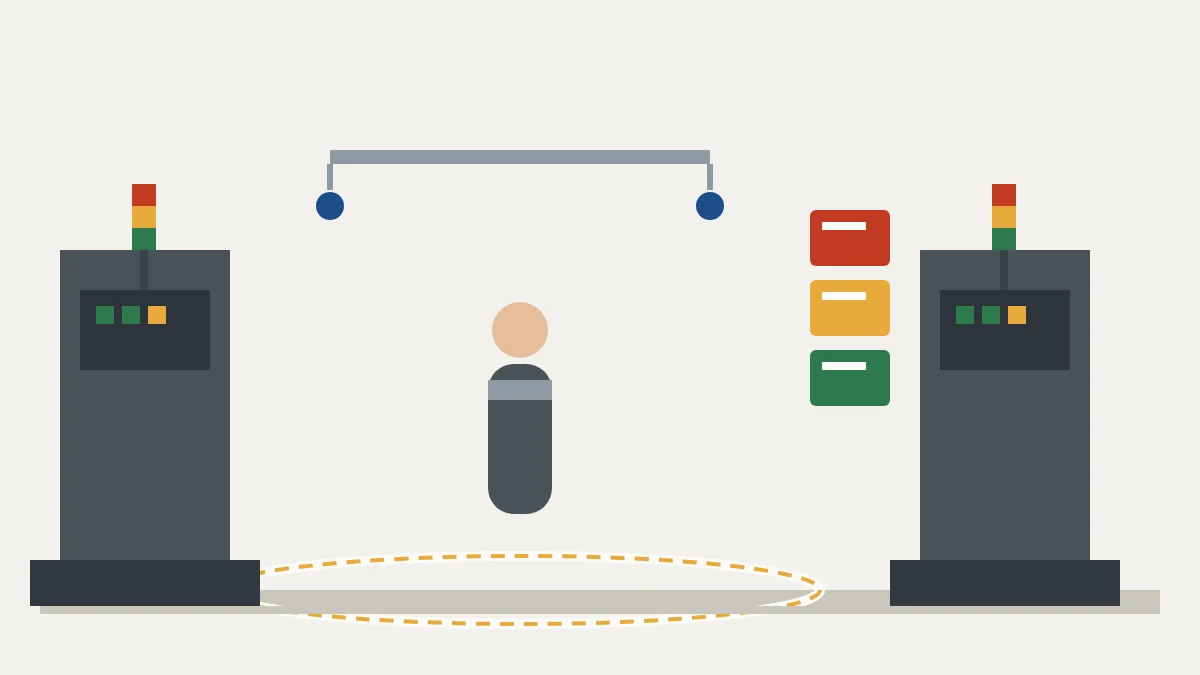
One of the practices most associated with Ohno is the Ohno circle. He asked a manager or engineer to stand inside a circle drawn on the floor, watching a workstation for an extended time, without intervening, until they could see the wastes. The aim was to train the eye and to value what is seen on site.
You can do the same today:
- Choose a station with a recurring problem.
- Mark a space on the floor, or pick a fixed observation point, and stay there for 30 to 60 minutes.
- Write down what you see: waiting, movement, rework, idle parts.
- Talk to the operator and acknowledge what works.
- Choose one small improvement and test it.
The practice is the principle of genchi genbutsu (go and see). For leaders' routine, see the gemba walk and the gemba walk checklist.
Ohno's book
The best-known work is Toyota Production System: Beyond Large-Scale Production, in which Ohno explains the logic of the system in the first person. Published in Japanese in 1978, it appeared in English in 1988 and is a reference for anyone who wants to go to the source. It is worth reading with the context of the time in mind: the book describes a living system, adapted to a specific factory and culture.
Milestones in his career and thinking
- Textile origins: at the Toyoda group company, Ohno lived with the logic of machines that stop by themselves when they detect a fault, the basis of jidoka.
- Machining shops at Toyota: it was there that he tested operators looking after several machines and production in smaller batches.
- Post-war: the shortage of capital pushed the company toward the logic of producing only what is needed, at the right time.
- Following decades: kanban and leveling were refined and taken to suppliers, forming the integrated system.
- 1970s: the oil crisis is usually pointed to as the moment when Toyota's results drew the attention of other companies in Japan and around the world.
- Book: the description of the system in his own words, published in 1978.
The milestones above summarize what biographies usually tell. For exact dates, consult the sources at the end of the article.
How Ohno taught: practice before theory
What repeats most in the accounts of Ohno is the method: he preferred that people learn by doing and observing. Instead of handing over a manual, he set a real problem, asked the manager to go to the site and come back with facts. That is the spirit of genchi genbutsu.
Another striking trait is the use of the question "why?" repeated until the cause is reached. The 5 Whys technique is associated with Toyota's environment and its way of solving problems. The question attacks the process, not the person.
He also treated the problem as an opportunity: a line that stops because of a defect is a sign that the system is working, since it exposes what used to stay hidden. That is the logic of andon, in which any operator can stop and call for help.
Pitfalls when reading Ohno today
- Confusing the system with the tools. Kanban, 5S and andon alone are not the TPS. The system is the logic that connects them.
- Copying without context. Toyota built the system over decades, for its own market. Adapt the principles to your reality.
- Zero inventory as dogma. The goal is to reduce inventories that hide problems, keeping protection where it is still needed.
- Forgetting the people. Without respect and involvement from those who operate, the techniques become impositions and lose strength.
- Expecting quick results. Culture change takes years, and the pace comes from the discipline of improving a little every day.
Ohno, Shingo and Toyoda: who did what
| Name | Most associated contribution |
|---|---|
| Sakichi Toyoda | The loom that stopped by itself on detecting a broken thread, the origin of jidoka |
| Kiichiro Toyoda | The idea of producing only what is needed, at the right time (just-in-time) |
| Taiichi Ohno | The complete system: kanban, leveling, wastes and the routine of observing at the gemba |
| Shigeo Shingo | Engineering methods such as quick changeover (SMED) and source inspection (poka-yoke) |
Learn more about the work of Shigeo Shingo, who worked as a Toyota consultant and complemented the system with specific techniques.
What to apply today, without copying Toyota
- Start with observation. Before changing anything, watch the process happen.
- Look for the waste, not the culprit. The question is "what in the system allowed this?", not "who made the mistake?".
- Produce for real consumption. Reduce batches and inventories, start with the bottleneck and pull production.
- Stop and fix. When something leaves the standard, the problem shows up and is solved at the source, with the 5 Whys.
- Always improve. Today's standard is the basis of tomorrow's kaizen.
The system also receives criticism, mainly when it is applied only as cost and headcount cutting. The TPS itself has continuous improvement and respect for people as pillars. Without them, what is left are loose techniques. For the full picture, see the 14 principles of the Toyota System.
Frequently asked questions
Who was Taiichi Ohno?
He was a Japanese engineer and Toyota executive (1912 to 1990), regarded as the chief architect of the Toyota Production System, which gave rise to Lean Manufacturing.
What did Taiichi Ohno create?
He structured the Toyota Production System, with ideas such as just-in-time, kanban, jidoka, production leveling and the classification of the seven wastes. He organized and integrated concepts that already existed at Toyota, such as Sakichi Toyoda's jidoka and Kiichiro Toyoda's just-in-time.
What is the Ohno circle?
It is an observation exercise: the person stands inside a circle drawn on the floor, watching a workstation for a while, without intervening, to train the eye for waste.
What are Ohno's 7 wastes?
Overproduction, waiting, transport, excess processing, inventory, motion and defects.
What is the difference between Ohno and Shingo?
Ohno was the architect of Toyota's production system. Shingo worked as a consultant and is associated with techniques such as quick changeover (SMED) and poka-yoke.
What is Taiichi Ohno's book?
Toyota Production System: Beyond Large-Scale Production, published in Japanese in 1978 and in English in 1988.
Sources
- OHNO, T. Toyota Production System: Beyond Large-Scale Production. Portland: Productivity Press, 1988.
- LIKER, J. K. The Toyota Way: 14 Management Principles from the World's Greatest Manufacturer. New York: McGraw-Hill, 2004.
- WOMACK, J. P.; JONES, D. T.; ROOS, D. The Machine That Changed the World. New York: Free Press, 1990.
- Lean Enterprise Institute, general reference on lean: https://www.lean.org/
This article is a teaching guide. The numerical examples are fictional and only show how the calculation works; use your own company's data and criteria. For questions about standards or manuals, consult the official document. See also the learning paths and the A–Z glossary.
Want to apply lean with your feet on the ground?
Download the free Lean for Leaders e-book and see how to drive improvement in your area.
Download the e-book
About the author
Lean Manufacturing & Behavioral Management Specialist
Over 20 years in the automotive and metalworking industries (GM and Dana), Lean Manufacturing practitioner since 2006. SENAI instructor and mentor in Brazil’s Brasil Mais Produtivo program, delivering consulting, training and audits for 50+ companies, combining quality, productivity and people development.


