Ten scenarios, one logic
Eliminating waste is not cutting costs in the dark. It means identifying the loss, finding the cause, and applying a countermeasure that keeps the loss from coming back. The ten cases below always follow that sequence.
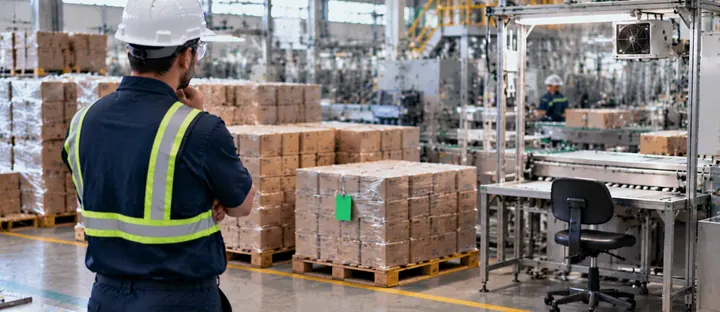
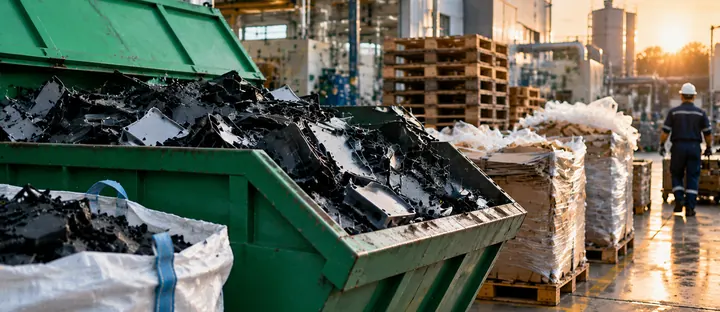
Important notice: all of the scenarios are illustrative. They were built to teach the reasoning and do not describe real companies or measured results. Adapt the cause to your own situation before copying the countermeasure.
If you need to review the categories of loss, see the 7 wastes of Lean.
Overview of the ten scenarios
| # | Scenario | Waste | Main countermeasure |
|---|---|---|---|
| 1 | Parts travel between buildings | Transportation | Bring processes closer together in cells |
| 2 | Semi-finished parts piled up between stations | Inventory | Limit inventory and pull production |
| 3 | Operator searches for a tool | Motion | Organize the workstation with 5S |
| 4 | Machine waiting on a long setup | Waiting | Reduce changeover time |
| 5 | Large batches for convenience | Overproduction | Produce according to demand |
| 6 | Finish beyond what is required | Overprocessing | Align with the specification |
| 7 | Defect found at the end of the line | Defects | Prevent at the source |
| 8 | Suggestions that get no reply | Unused talent | Quick-response routine |
| 9 | Report checked three times | Overprocessing | Eliminate redundant checks |
| 10 | Machine stops with no record | Waiting | Record and treat the cause |
Scenarios 1 to 5: physical flow
1. Parts travel between buildings
Waste: transportation. Cause: a layout organized by department, not by product. Countermeasure: reorganize into cells, as in the product layout.
2. Semi-finished parts piled up between stations
Waste: inventory. Cause: each station produces at its own pace, with no consumption signal. Countermeasure: set a limit on parts between stations and use kanban to authorize production.
3. Operator searches for a tool
Waste: motion. Cause: tools without a fixed location. Countermeasure: shadow boards and a defined position at the workstation, the foundation of 5S.
4. Machine waiting on a long setup
Waste: waiting. Cause: preparation tasks done while the machine is stopped. Countermeasure: separate what can be done while the machine is running, following the quick changeover method.
5. Large batches for convenience
Waste: overproduction. Cause: an expensive setup encourages large batches. Countermeasure: reduce the setup, then shrink the batch and produce at the pace of takt time.
Scenarios 6 to 10: information and people
6. Finish beyond what is required
Waste: overprocessing. Cause: an old habit with no review of the specification. Countermeasure: confirm with the customer what they actually value and rewrite the work instruction.
7. Defect found at the end of the line
Waste: defects. Cause: inspection only at the end. Countermeasure: prevention devices, as in poka-yoke, and stopping the line when an abnormality appears, the principle of jidoka.
8. Suggestions that get no reply
Waste: unused talent. Cause: nobody is responsible for screening them. Countermeasure: an idea board with an owner and a response deadline of a few days.
9. Report checked three times
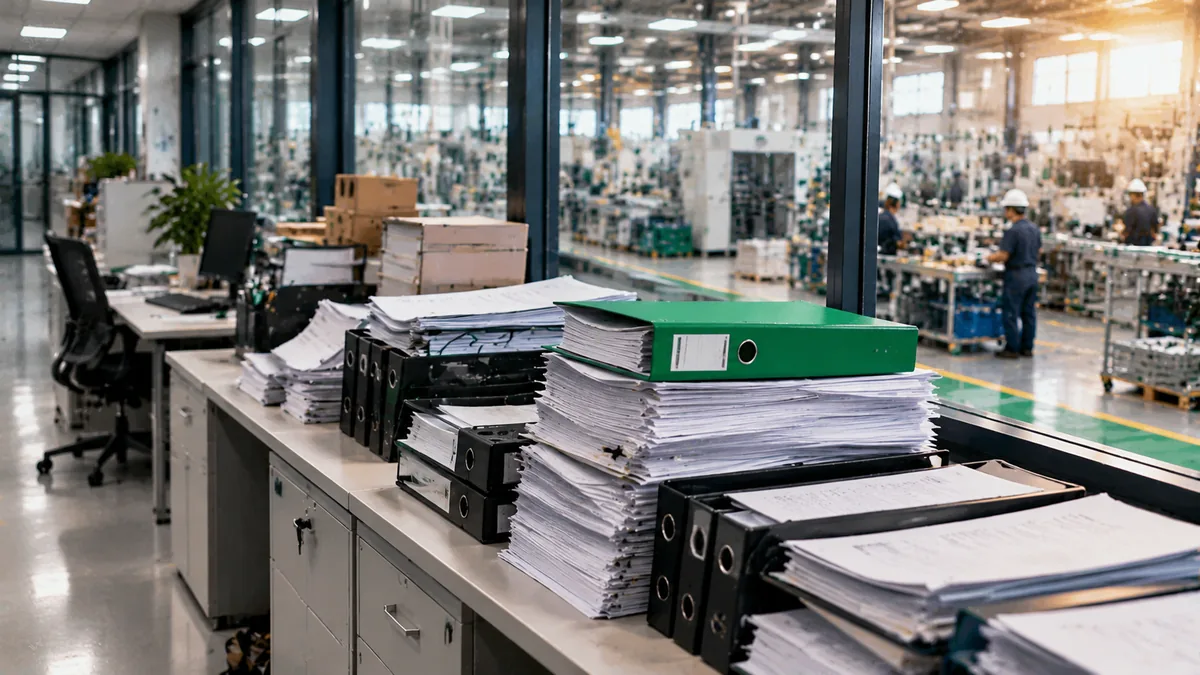
Waste: administrative overprocessing. Cause: distrust of the source data. Countermeasure: fix the source and keep a single check.
10. Machine stops with no record
Waste: waiting. Cause: nobody writes down the reason or the duration. Countermeasure: a simple logging sheet and a weekly analysis with the 5 Whys.
The pattern behind the ten scenarios
Reread the cases and note three repetitions:
- The countermeasure is almost never buying equipment. It is changing a method, a layout, or a rule.
- The root cause lies in an old decision, not in the operator.
- Without a standard and follow-up, the waste comes back within a few months.
For that reason, after applying the countermeasure, write the new standard and choose a simple indicator to watch. Standardized work is where the gain gets recorded.
There is also a fourth point: almost every scenario starts with someone saying that it has always been done that way. The question that unlocks the reasoning is simple: who benefits from this step? If the answer is nobody, the step is a candidate to leave the process.
Another caution is not to confuse occupation with productivity. A workstation that is always busy may be producing inventory, rework, or documents that nobody reads. What matters is the flow of product that the customer accepts, on the agreed date.
How to choose where to start
Not every waste deserves an immediate attack. A practical order:
- List the losses observed in the flow.
- Give a score from 1 to 5 for customer impact and another from 1 to 5 for ease of solving.
- Multiply the two scores. A loss with impact 4 and ease 5 is worth 20 points.
- Start with the highest scores and schedule the rest.
This calculation is a supporting criterion, not an exact science. It lets the team discuss priorities using the same numbers. See the Pareto technique if you have frequency data.
An illustrative numerical example helps. Suppose three losses: inventory between stations (impact 3, ease 4), a defect at the end of the line (impact 5, ease 2), and tool searching (impact 2, ease 5). The products are 12, 10, and 10. Inventory between stations comes first, and the other two tie. In a tie, prefer the one with the greater customer impact, which is the defect, but assign an owner with a longer deadline, since the ease is low.
Do not forget to review the list every cycle. Solving one loss changes the weight of the others.
Next step
Take the scenario most similar to your factory and apply the routine: loss, cause, countermeasure, standard, and indicator. Do this at a single workstation before spreading it across the plant.
To broaden your view, see the article on the 8 wastes of manufacturing and the guide to identifying losses.
Frequently asked questions
Are the examples in the article real cases?
No. They are illustrative scenarios, built to teach the sequence of waste, cause, and countermeasure.
Which waste is usually the hardest to eliminate?
Defects and overproduction, because they depend on changing habits and processes, not just on rearranging space.
Do I need to buy technology to eliminate waste?
In most cases, no. Method, layout, and work rules solve a good share of the losses.
How do I keep the waste from coming back?
Record the new standard, train the team, and track a simple indicator for the workstation.
Keep studying
Sources
- OHNO, T. O Sistema Toyota de Produção: além da produção em larga escala. Porto Alegre: Bookman.
- WOMACK, J.; JONES, D. A Mentalidade Enxuta nas Empresas. Rio de Janeiro: Elsevier.
- Lean Enterprise Institute. Lean Lexicon: Waste. https://www.lean.org/lexicon-terms/waste/
Want the tools ready to use?
Download the free e-book "Problem-Solving Kit", with PDCA, A3, 5 Whys, and Ishikawa.
Download the e-book
About the author
Lean Manufacturing & Behavioral Management Specialist
Over 20 years in the automotive and metalworking industries (GM and Dana), Lean Manufacturing practitioner since 2006. SENAI instructor and mentor in Brazil’s Brasil Mais Produtivo program, delivering consulting, training and audits for 50+ companies, combining quality, productivity and people development.