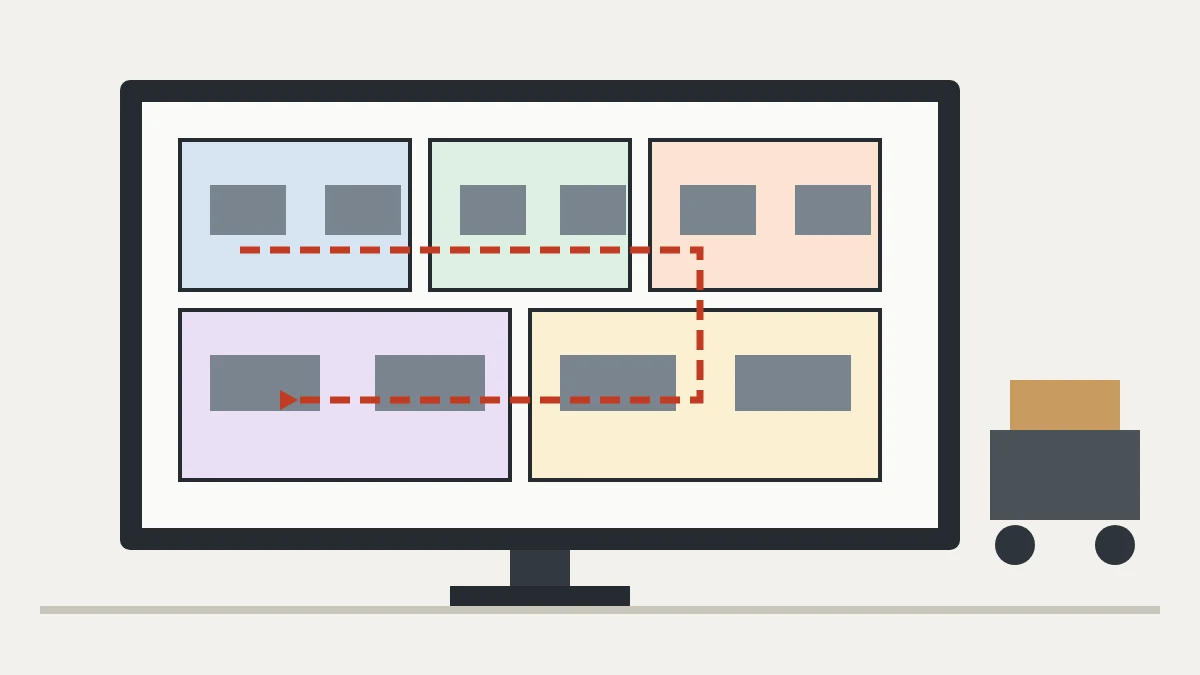
What facility layout is
Facility layout is the physical arrangement of machines, people, materials and flows inside an operation. A good layout cuts travel, shortens lead time, improves safety and frees up space. A bad one creates transport, crossing flows and scattered inventory.
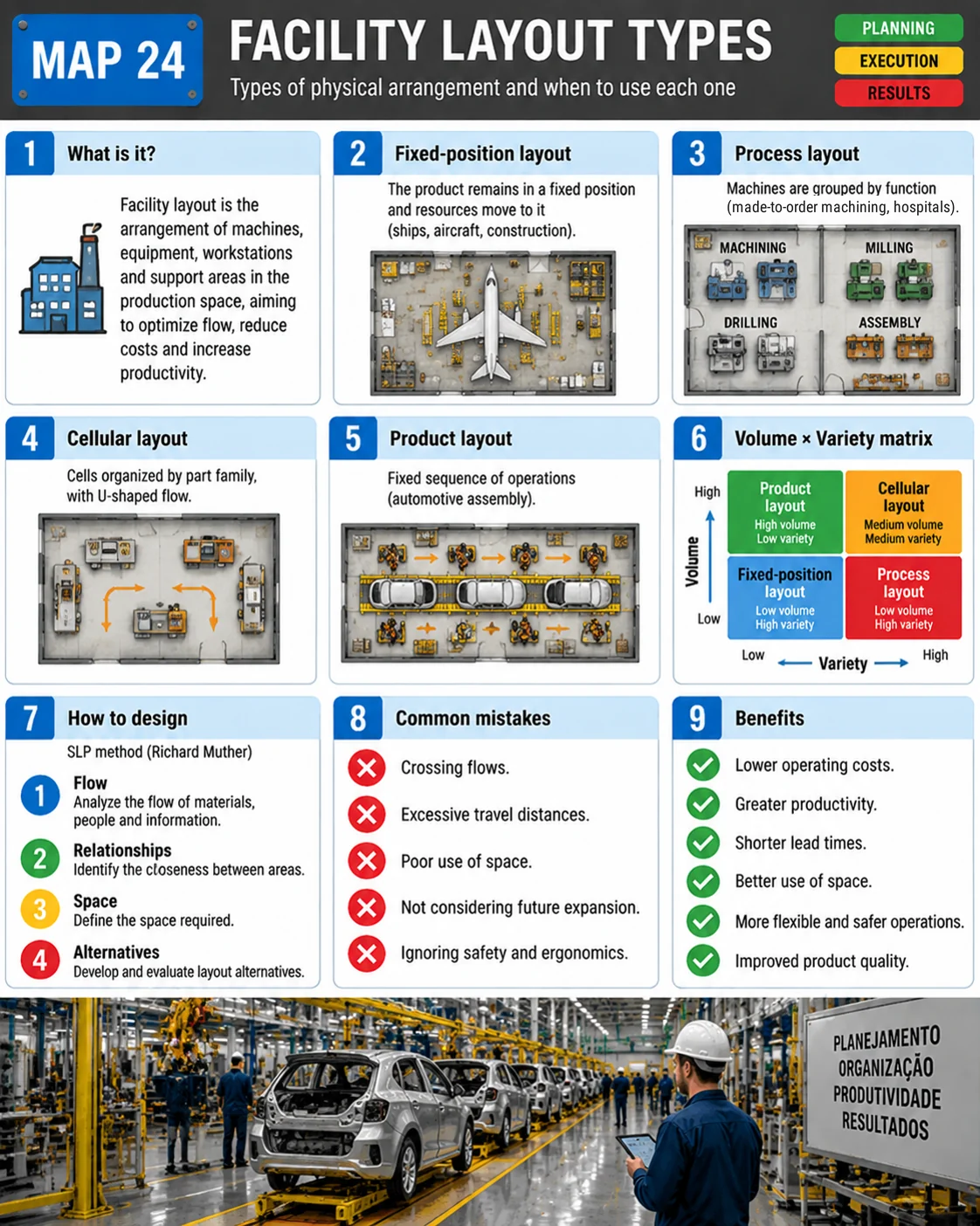
Facility layout visual map
The map shows the four layout types as floor plans, the volume and variety matrix and the design method.
The four layout types
| Type | How it works | Examples |
|---|---|---|
| Fixed-position | The product stays in place and resources come to it | Ships, aircraft, construction |
| Process (functional) | Machines grouped by function; parts travel between departments | Job-shop machining, hospitals |
| Cellular | Cells holding the machines a part family needs, usually U-shaped | Part-family machining, subassemblies |
| Product (line) | Fixed sequence of operations, one after another | Automotive assembly, filling lines |
Volume and variety matrix
The choice depends mainly on how much is made and how many different products flow through the plant:
- Low volume, high variety: fixed-position (large products) or process layout.
- Medium volume and variety: cellular.
- High volume, low variety: product layout.
This product-process relationship was popularized by Hayes and Wheelwright in the late 1970s. Real plants are often hybrids: assembly lines fed by functional areas or cells.
Why Lean favors cells
A cell brings operations close together and allows one-piece flow. In a U shape, the same operator handles the start and end, and the cell can be rebalanced when takt time changes. It cuts transport, waiting and work in process, three of the wastes of Lean.
How to design it: the SLP method
Richard Muther's Systematic Layout Planning organizes the design in four steps:
- Flow: map the flow of materials, people and information.
- Relationships: define how close each area must be to the others.
- Space: calculate the area each department or machine needs.
- Alternatives: sketch and evaluate options, then pick the best.
Value stream mapping and spaghetti diagrams help you see today's flow before changing it.
Common mistakes
- Crossing flows of materials and people.
- Excessive travel distances.
- Poor use of space.
- Not planning for future expansion.
- Ignoring safety and ergonomics.
Benefits of a good layout
- Less material handling and lower operating costs.
- Smoother, more stable production flow.
- Higher productivity.
- Safer operations.
- Better use of space.
Frequently asked questions
What are the types of facility layout?
Fixed-position, process (functional), cellular and product (line) layout.
When should a product layout be used?
When volume is high and variety is low, as in automotive assembly.
What is a cellular layout?
An arrangement in cells, each with the machines a part family needs, usually in a U shape.
What is the SLP method?
Systematic Layout Planning, Richard Muther's method that designs the layout from flow, relationships between areas, space and alternatives.
How does a process layout differ from a cellular layout?
In a process layout machines are grouped by type and parts travel between departments; in a cellular layout different machines sit together for one part family.
Sources
- MUTHER, R. Systematic Layout Planning. Boston: Cahners Books.
- TOMPKINS, J. A. et al. Facilities Planning. Hoboken: Wiley.
- HAYES, R. H.; WHEELWRIGHT, S. C. Link manufacturing process and product life cycles. Harvard Business Review, 1979.
Want flow without back-and-forth?
Download the free "Lean Pocket Guide" e-book and learn to see the flow before changing the layout.
Download the e-book
About the author
Lean Manufacturing & Behavioral Management Specialist
Over 20 years in the automotive and metalworking industries (GM and Dana), Lean Manufacturing practitioner since 2006. SENAI instructor and mentor in Brazil’s Brasil Mais Produtivo program, delivering consulting, training and audits for 50+ companies, combining quality, productivity and people development.