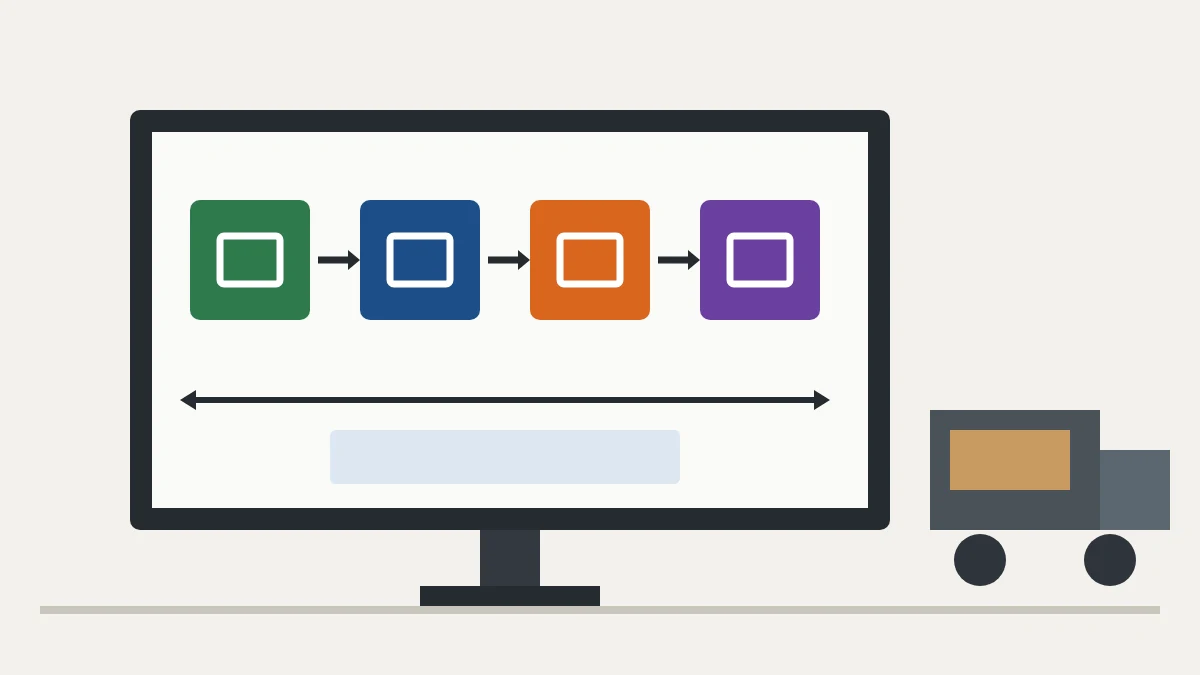
What lead time is
Lead time is the total time from the moment a customer places an order until the product is delivered. It is the delay the customer actually sees, which is why it is so closely tied to customer satisfaction and competitiveness.
Lead time adds up everything along the way: order processing, queues, production, inspection, packaging and transportation. In most plants the largest share of that time is not work but waiting, so cutting lead time almost always starts with attacking queues and inventory between steps.
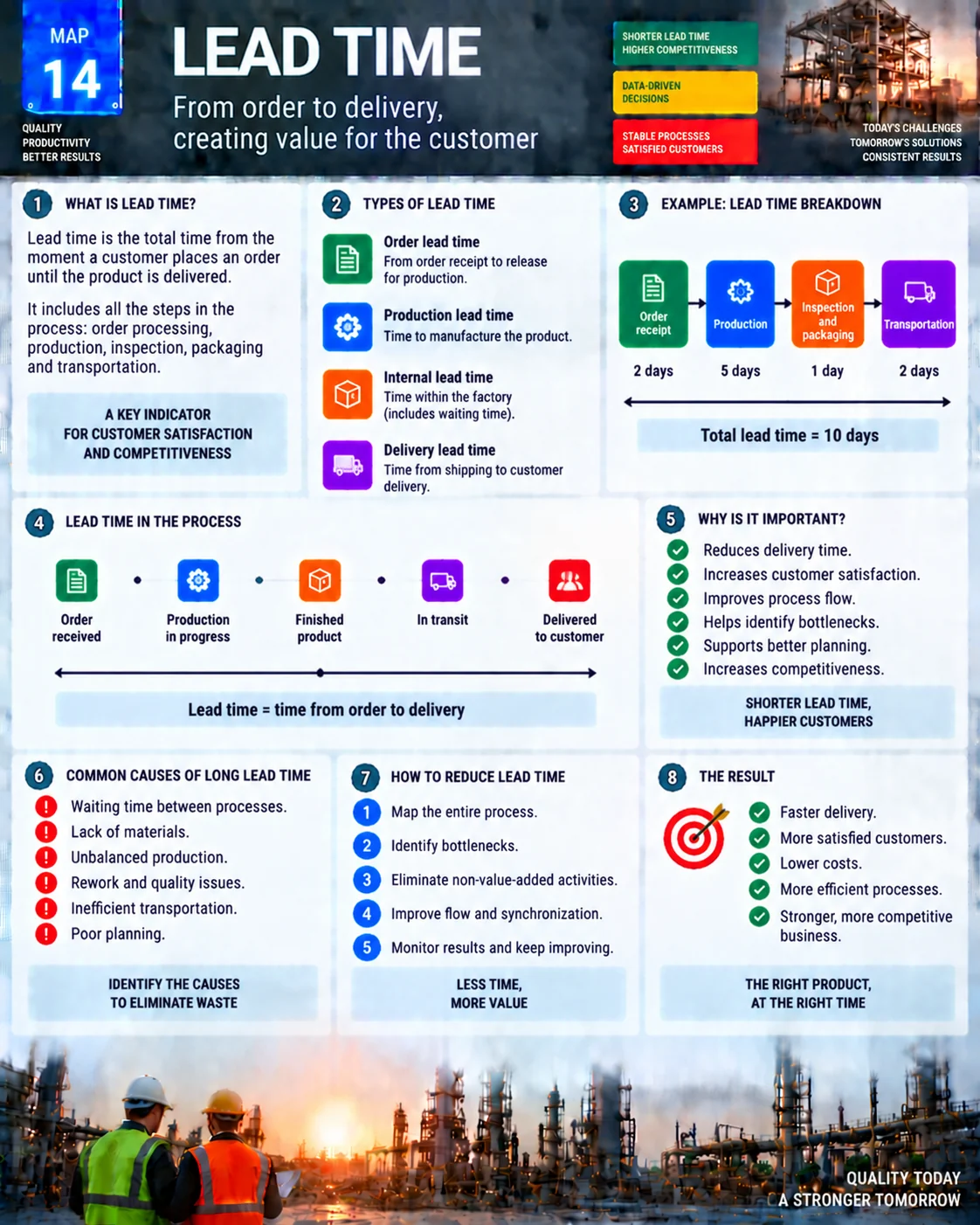
Lead time visual map
The map sums up the types of lead time, a 10-day order-to-delivery example, the usual causes of long lead times and the steps to reduce them.
Types of lead time
| Type | From what to what |
|---|---|
| Order lead time | From order receipt to release for production |
| Production lead time | From work order release to finished product |
| Internal lead time | All time inside the plant, including waiting |
| Delivery lead time | From shipping to receipt by the customer |
| Replenishment lead time | From the purchase order to material available |
The last one is invisible to the customer, but it sets the reorder point and safety stock, as explained in the inventory management guide.
How to calculate lead time
Total lead time = sum of the time of every step, including waiting
In the map's example, the order takes 2 days to be received and released, 5 days in production, 1 day in inspection and packaging, and 2 days in transportation. Total lead time is 10 days.
| Step | Time |
|---|---|
| Order receipt | 2 days |
| Production | 5 days |
| Inspection and packaging | 1 day |
| Transportation | 2 days |
| Total | 10 days |
Measure it with real timestamps: when the order enters the system and when delivery is confirmed. Track the average and the spread, because customers feel the variation more than the average.
Little's Law: work in process becomes lead time
Little's Law, proven by John Little in 1961, links three numbers in any stable process:
Lead time = work in process ÷ throughput
With 300 parts in process and a plant shipping 60 parts per day, each part needs on average 300 ÷ 60 = 5 days to get through production, exactly the production lead time in the example. Without adding capacity, the fastest way to cut lead time is to cut work in process, with smaller lots and pull production.
Lead time vs cycle time vs takt time
| Concept | What it measures |
|---|---|
| Lead time | Order to delivery, from the customer's point of view |
| Cycle time | Interval between two parts leaving an operation or process |
| Takt time | Production pace required by customer demand |
| Value-added time | The part of lead time in which the product is actually transformed |
These terms are often mixed up. Takt time comes from demand, cycle time comes from the process, and lead time is the result the customer feels. The Lean Enterprise Institute lexicon has the reference definitions.
Common causes of long lead times
- Waiting between processes, usually the largest share.
- Missing materials when it is time to produce.
- Unbalanced production, with a queue in front of the bottleneck.
- Rework and quality problems.
- Large lots, which make every part wait for the whole lot.
- Inefficient transportation and poor planning.
How to reduce lead time
- Map the entire process. Value stream mapping shows a timeline of processing and waiting.
- Find the bottleneck. The Theory of Constraints shows that queues build up in front of it.
- Eliminate non-value-added activities such as moves, waiting for approvals and duplicate inspections.
- Shrink lot sizes with quick changeover (SMED) and pull production with kanban.
- Improve flow and synchronization between sales, planning, production and shipping.
- Monitor results and keep improving.
Industrial examples
- Job-shop metalworking: orders wait days for engineering release; an order checklist and a daily review cut order lead time.
- Apparel: cutting lots of a thousand pieces make each piece wait for the whole lot; smaller lots cut production lead time.
- Distribution: picking and shipping in waves through the day shortens the time from order to dispatch.
Common mistakes and checklist
- Measuring only production time and ignoring order waiting time.
- Looking at the average and ignoring variation.
- Trying to shorten delivery with more finished goods stock instead of better flow.
- Speeding up steps that are not the bottleneck.
- Lead time measured from order to delivery with real dates.
- Timeline showing processing and waiting.
- Bottleneck identified.
- Plan to reduce lot sizes and work in process.
- Metric posted on the visual management board.
Frequently asked questions
What is lead time?
The total time from the customer's order to delivery of the product, adding up processing, waiting, production, inspection and transportation.
How do you calculate lead time?
Add up the time of every step, including queues and waiting. In the example, 2 + 5 + 1 + 2 days give 10 days.
What is the difference between lead time and cycle time?
Lead time is the total order-to-delivery time; cycle time is the interval between two parts leaving a process.
How can lead time be reduced?
Map the flow, attack the bottleneck, reduce lot sizes and work in process, eliminate waiting and pull production.
What does Little's Law say?
Lead time equals work in process divided by throughput, so less work in process means shorter lead time.
Sources
- LITTLE, J. D. C. A proof for the queuing formula L = λW. Operations Research, 9(3), 1961.
- ROTHER, M.; SHOOK, J. Learning to See. Cambridge, MA: Lean Enterprise Institute.
- Lean Enterprise Institute. Cycle Time. https://www.lean.org/lexicon-terms/cycle-time/
- Lean Enterprise Institute. Value Stream Mapping. https://www.lean.org/lexicon-terms/value-stream-mapping/
Want to see your real lead time?
Download the free pull production e-book, with kanban, supermarkets and leveling.
Download the e-book
About the author
Lean Manufacturing & Behavioral Management Specialist
Over 20 years in the automotive and metalworking industries (GM and Dana), Lean Manufacturing practitioner since 2006. SENAI instructor and mentor in Brazil’s Brasil Mais Produtivo program, delivering consulting, training and audits for 50+ companies, combining quality, productivity and people development.