
- What production planning and control is
- Production planning visual map
- Where production planning comes from
- The three planning levels
- How the planning cycle works
- Example: an MRP explosion
- Master schedule and time fences
- Planning and lean: push or pull?
- Production planning KPIs
- Industrial examples
- Common mistakes
- How to implement it: steps and checklist
- Frequently asked questions
What production planning and control is
Every plant answers three questions every day: what to make, how many and when. When nobody answers them in a structured way, the answer comes from whichever salesperson calls most often, and the result is familiar: rush orders, overtime, piles of what doesn't sell and shortages of what customers ordered.
Production planning and control (PPC) turns demand into a feasible plan, checks materials and capacity, and tracks execution to correct gaps. It connects sales, purchasing, production and finance around a single plan.
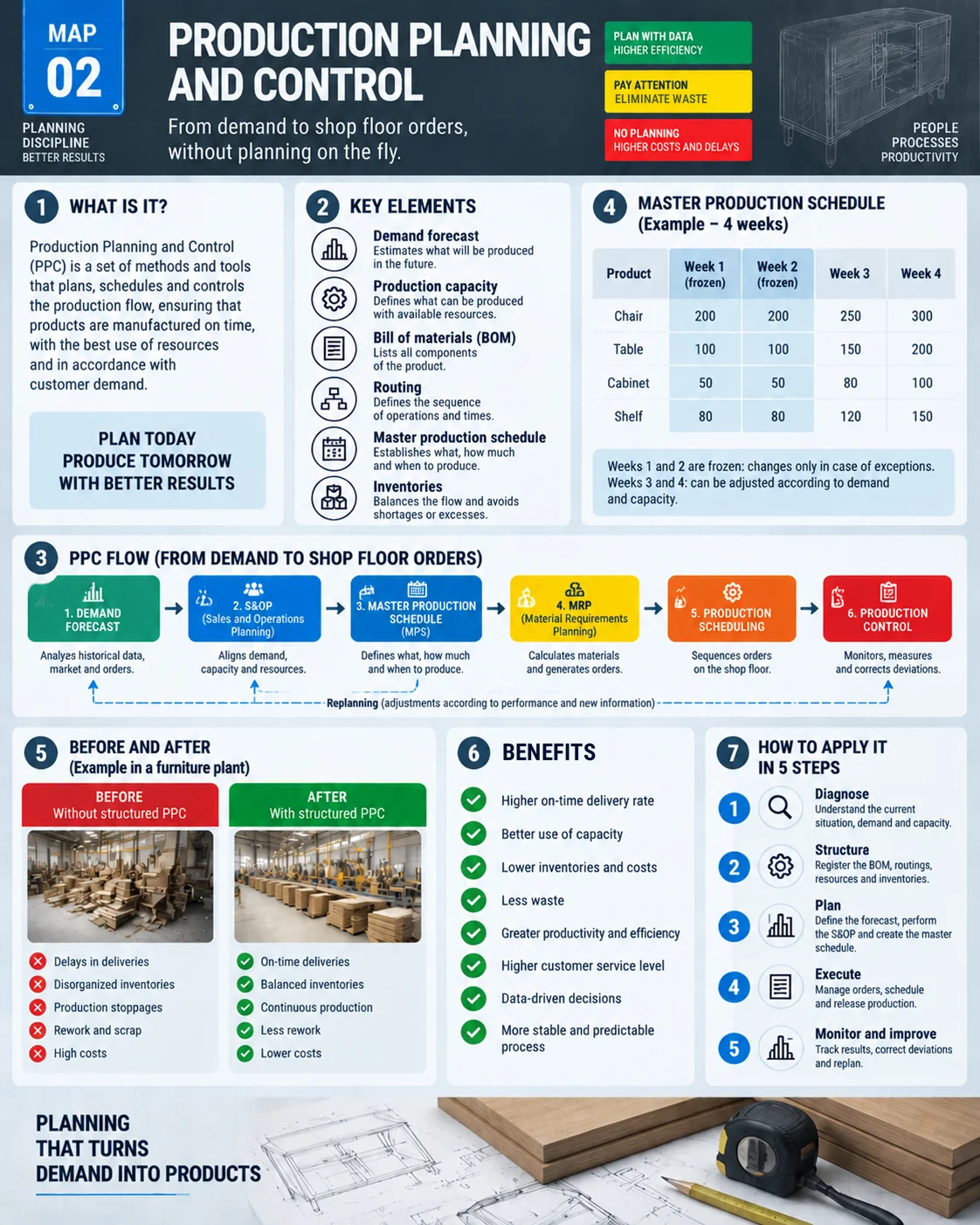
Production planning visual map
The map sums up the key elements, the flow from forecast to control, a 4-week master production schedule with two frozen weeks, a before and after at a furniture plant and the 5 steps to apply it.
Where production planning comes from
Production planning as a discipline grew out of scientific management in the early 20th century, when Henry Gantt created the bar chart that bears his name to schedule work. In the 1960s and 1970s computers made MRP (material requirements planning) practical, calculating material needs from the master schedule and the bill of materials. MRP II later added capacity and finance, followed by ERP systems.
Lean added pull production and production leveling (heijunka), which reduce the shop floor's dependence on forecasts.
The three planning levels
| Level | Horizon | Decisions | Tools |
|---|---|---|---|
| Strategic | Months to years | Installed capacity, new lines, outsourcing | Long-range capacity planning |
| Tactical | Weeks to months | Volume by family, inventory, shifts, overtime | S&OP and aggregate planning |
| Operational | Days to weeks | What runs on each machine and in what order | MPS, MRP, scheduling and sequencing |
The levels feed each other: an operational schedule that never closes usually points to a wrong tactical or strategic decision, not to a bad scheduler.
How the planning cycle works
- Demand forecast: sales history, order book and market input, by product family.
- S&OP and aggregate plan: a monthly meeting where sales, operations, purchasing and finance agree on one volume plan per family that fits capacity.
- Master production schedule (MPS): breaks the aggregate plan into end items per week, with the first weeks frozen for stability.
- MRP: explodes the MPS through the bill of materials, nets out inventory and open orders, and suggests purchase and work orders offset by each item's lead time.
- Scheduling and sequencing: sets what each machine runs and in what order, starting with the bottleneck, as the Theory of Constraints teaches.
- Control: compares actual output with the plan, deals with gaps and feeds replanning.
Example: an MRP explosion
A furniture plant has 150 tables in week 3 of the map's MPS, alongside chairs, cabinets and shelves. Each table takes 4 legs, there are 400 uncommitted legs on hand and the supplier delivers in 1 week.
| Calculation | Legs |
|---|---|
| Gross requirement (150 × 4) | 600 |
| On hand | 400 |
| Net requirement | 200 |
| Supplier lead time | 1 week |
| Planned order release | week 2 |
The same logic runs for the tabletop, the screws and every component, level by level through the bill of materials. That is why MRP is so sensitive to bad master data: a wrong quantity in the BOM becomes a wrong purchase across the whole chain.
Master schedule and time fences
Changing the MPS in the current week disrupts purchasing, scheduling and the shop floor. The usual practice is to use time fences: the first 1 or 2 weeks frozen, changed only with management approval; the following weeks flexible within limits; and the far horizon open. This gives stability without making the company rigid.
Planning and lean: push or pull?
MRP and lean are not enemies. MRP is good at planning long lead time materials and sizing capacity. On the shop floor, kanban and heijunka replace many pushed orders: production replenishes what was consumed, in small, leveled lots. Many companies use MRP for purchasing and mid-term planning and pull for daily execution. Takt time connects both worlds by turning planned demand into a production pace.
Production planning KPIs
| KPI | Calculation | What it shows |
|---|---|---|
| Schedule adherence | Built as planned ÷ planned | Whether the schedule was followed |
| On time in full (OTIF) | Complete orders on time ÷ total orders | The customer's experience |
| Days of supply | Inventory ÷ average daily usage | How many days the stock will last |
| Bottleneck OEE | Availability × performance × quality | How much critical capacity is really used |
| Manufacturing lead time | From order release to finished product | How fast work flows |
For OEE, see the OEE guide with calculator; for turns and days of supply, the inventory management article.
Industrial examples
- Food: the aggregate plan sets shifts for the harvest season; the MPS freezes 1 week because of shelf life.
- Auto parts: daily schedules pulled by the OEM; MRP for steel and castings with multi-week lead times.
- Furniture: standard lines made to stock and custom lines made to order, with the paint shop as the bottleneck that sets the sequence.
- Apparel: seasonal collections where S&OP sets family volumes before the sales peak.
Common mistakes
- Outdated master data: BOMs, routings and standard times.
- Planning with theoretical capacity, ignoring downtime, changeovers and absences.
- Changing the MPS every day.
- Loading every machine to the max, building work in process in front of the bottleneck.
- Planning cut off from sales and purchasing.
- Measuring whether machines are busy rather than whether the plan was met.
How to implement it: steps and checklist
- Clean up master data: BOMs, routings and standard times, reviewed with the people who do the work.
- Measure real capacity, especially at the bottleneck, using downtime and OEE data.
- Start a monthly S&OP meeting with sales, operations, purchasing and finance.
- Build a weekly MPS and set the frozen zone.
- Run MRP, in the ERP or even in a spreadsheet for small companies, for purchases and work orders.
- Schedule the bottleneck first and track adherence daily on a visual management board.
- Master data reviewed in the last 6 months.
- Bottleneck capacity measured in real hours.
- S&OP held on a fixed date with minutes.
- MPS with a defined frozen zone.
- Schedule adherence measured and posted.
- Root causes of gaps recorded and addressed.
Frequently asked questions
What does production planning and control do?
It turns demand into a feasible production plan, decides what, how many and when to make, secures materials and tracks execution.
What is the difference between MPS and MRP?
The MPS sets how many of each end item to build per period. MRP uses the MPS and the bill of materials to calculate how much of each component to buy or make, and when.
What is S&OP?
Sales and operations planning: the monthly process in which sales, operations, purchasing and finance agree on one volume plan for the coming months.
What is a frozen zone?
The near-term part of the master schedule that does not change without approval, giving stability to purchasing and the shop floor.
Does production planning work with lean?
Yes. MRP usually plans purchasing and capacity, while kanban and heijunka pull production day to day.
Sources
- VOLLMANN, T. E.; BERRY, W. L.; WHYBARK, D. C.; JACOBS, F. R. Manufacturing Planning and Control for Supply Chain Management. New York: McGraw-Hill.
- SLACK, N.; BRANDON-JONES, A.; JOHNSTON, R. Operations Management. Harlow: Pearson.
- Lean Enterprise Institute. Heijunka. https://www.lean.org/lexicon-terms/heijunka/
Ready to move from push to pull?
Download the free pull production e-book, with kanban, supermarkets and leveling.
Download the e-book
About the author
Lean Manufacturing & Behavioral Management Specialist
Over 20 years in the automotive and metalworking industries (GM and Dana), Lean Manufacturing practitioner since 2006. SENAI instructor and mentor in Brazil’s Brasil Mais Produtivo program, delivering consulting, training and audits for 50+ companies, combining quality, productivity and people development.