
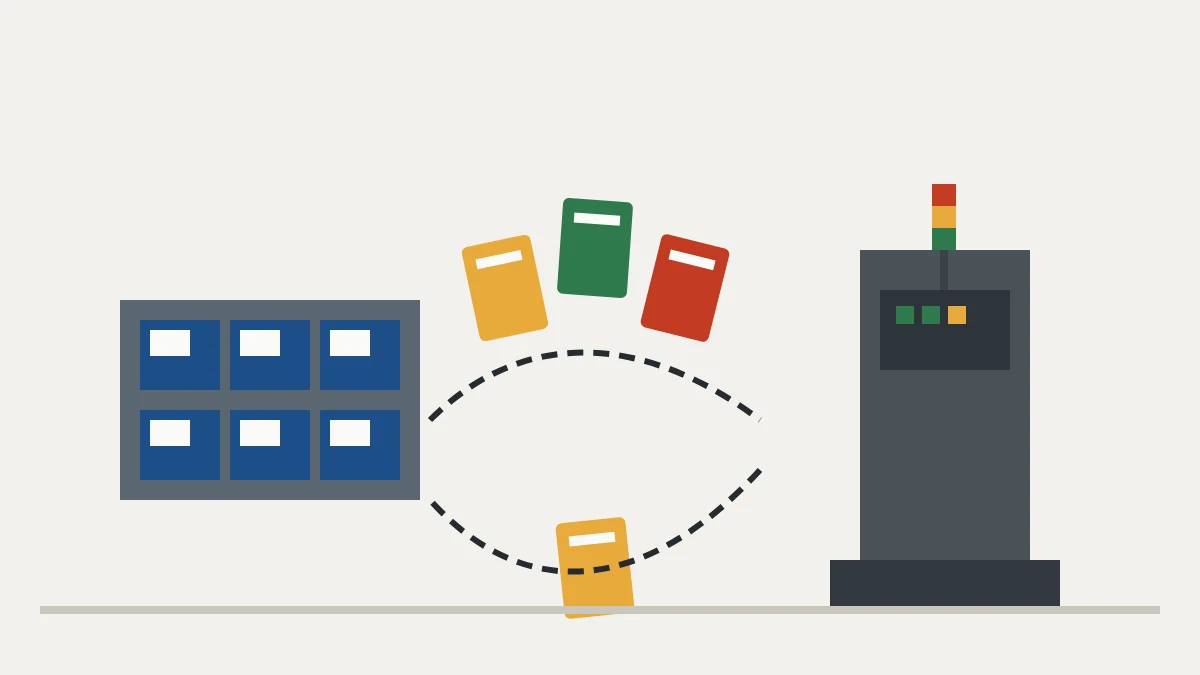
- Why kanban needs rules
- Rule 1: the customer withdraws only what is needed, at the right time
- Rule 2: the supplier produces only what was withdrawn
- Rule 3: never send a defective part
- Rule 4: reduce the number of cards gradually
- What about the other rules Monden describes
- Summary for the shop floor
- Next step
- Frequently asked questions
Why kanban needs rules
Cards do not control anything on their own. A kanban system works when people respect a short set of rules. If one of them is broken, the card becomes paper and inventory starts growing again without warning.
Four rules form the core and appear in most texts on the subject. They rest on the logic described in kanban and pull production and on the just-in-time mechanism.
The rules apply to the entire loop, from receiving to shipping. They also apply to external suppliers, provided the agreement is clear: what is pulled, at what time, and to what quality standard. Without a written agreement, the supplier tends to deliver large lots all at once, for logistical convenience, and the customer goes back to accumulating inventory.
Rule 1: the customer withdraws only what is needed, at the right time
The downstream process picks up from the upstream process only what it is going to use, in the card quantity and when it needs it. Withdrawing extra creates inventory at the customer's site. Withdrawing without a card erases the traceability of consumption.
In practice:
- No withdrawal without a withdrawal card attached to the container.
- Withdrawals at agreed times, such as a fixed supply route.
- The customer does not keep parts beyond the point of use.
In most plants, this rule is broken with good intentions. The operator "gets ahead" on a withdrawal to avoid stopping later, or the material handler takes two containers instead of one to save a trip. The result is the same: the card no longer represents actual consumption, and the supplier starts producing based on distorted information.
Rule 2: the supplier produces only what was withdrawn
The upstream process makes the quantity that left the supermarket, in the order the cards arrive. If the supplier produces on its own because the machine is free, it breaks the limit of the system.
In practice:
- A machine idle for lack of a card is acceptable. It is a sign that there is no consumption.
- The production order follows the sequence of cards on the board.
- No "early" production to make use of the shift.
This rule meets the most resistance. Every operator was trained to keep the machine busy, and now must leave it idle when there is no real demand. Occupying a machine with parts nobody asked for is overproduction, one of the 7 wastes of Lean.
Rule 3: never send a defective part
Because inventory is small, a bad part stops the line. There is no cushion to absorb the defect. That is why the supplier delivers only conforming parts, and the customer does not accept doubtful ones.
In practice:
- Self-inspection at the workstation: whoever produces checks before releasing.
- Error prevention devices, described in poka-yoke.
- Stopping the line when a defect is detected, following the principle of jidoka.
- A bad part goes back with the card and the cause is investigated, not just replaced.
The same care applies to counting. A container with the wrong quantity is a form of defect, because it throws off the consumption calculation. Standardize the container so that only the right quantity fits.
Rule 4: reduce the number of cards gradually
Each card represents a quantity of inventory. Removing cards reduces inventory and exposes problems it was covering, such as an unstable machine, slow tool changes, and irregular transport. The reduction should be gradual and monitored.
Illustrative example: a loop has 12 cards of 20 parts each. The maximum inventory in the loop is 12 × 20 = 240 parts. One card is removed: the maximum drops to 11 × 20 = 220 parts. If there was no shortage for two weeks, another is removed and the maximum drops to 200 parts. If the line stops, the card goes back and the cause of the stoppage becomes an improvement project.
Reducing without investigating causes, or reducing everything at once, creates shortages and discredits the system. The pace of reduction follows the capacity to solve problems. The initial calculation of the number of cards is in kanban sizing.
What about the other rules Monden describes
Yasuhiro Monden, in his book on the Toyota Production System, describes six kanban rules. The four above correspond to the operational core. The other two work as preconditions of the system.
| Complementary rule | What it means | Why it supports kanban |
|---|---|---|
| Level production | Distribute volume and mix evenly across the period | Without leveling, consumption fluctuates and requires more cards or causes shortages |
| Stabilize and rationalize the process | Standardize the work and eliminate variation in machine, method, and material | An unstable process forces safety stock and breaks rules 2 and 3 |
To level, see heijunka. To stabilize, start with standardized work.
Summary for the shop floor
- Did I withdraw only what the card authorizes?
- Did I produce only what the card asked for?
- Did I check the part before releasing it?
- Did I record the day's shortage or surplus?
- Did we review today whether a card can be removed?
Use the list as a weekly five-minute audit, done by the supervisor alongside the operator. The goal is not to score, but to talk through each negative answer.
Next step
Print the four rules on one sheet and post it on the loop's board. Run a five-minute weekly audit with the list above. Each "no" is an opportunity for training or process improvement. When the four rules are routine, start reducing cards, one at a time.
Frequently asked questions
What are the 4 rules of kanban?
The customer withdraws only what is needed at the right time, the supplier produces only what was withdrawn, a defective part is never sent, and the number of cards is reduced gradually.
Why not send a defective part in kanban?
Because the inventory between processes is small. A defect stops the customer almost immediately.
How many rules does Monden describe?
Six. The other two, leveling production and stabilizing and rationalizing the process, complement the four operational ones.
Why reduce cards little by little?
Each reduction exposes problems that inventory was hiding. Doing it gradually gives time to resolve the causes without creating shortages.
Can the supplier produce without a card?
No. Producing without a card creates overproduction and breaks the loop's inventory limit.
Keep studying
Sources
- MONDEN, Y. Toyota Production System: An Integrated Approach to Just-in-Time. CRC Press.
- OHNO, T. O Sistema Toyota de Produção: além da produção em larga escala. Porto Alegre: Bookman.
- Lean Enterprise Institute. Kanban (Lean glossary). https://www.lean.org/lexicon-terms/kanban/
- SMALLEY, A. Criando o Sistema Puxado Nivelado. Lean Institute Brasil.
Want truly pull-based production?
Download the free e-book on pull production, with kanban, supermarkets, and leveling.
Download the e-book
About the author
Lean Manufacturing & Behavioral Management Specialist
Over 20 years in the automotive and metalworking industries (GM and Dana), Lean Manufacturing practitioner since 2006. SENAI instructor and mentor in Brazil’s Brasil Mais Produtivo program, delivering consulting, training and audits for 50+ companies, combining quality, productivity and people development.