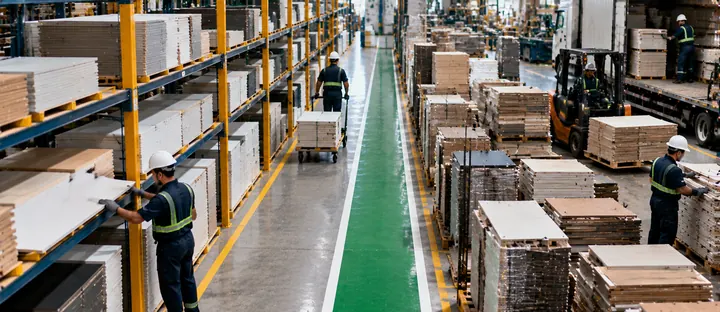
Roadmap overview
Implementing kanban is a three-to-six-month project for one area, not a one-week training session. The safest path is to start small, in a single flow, learn, and then replicate.
The roadmap below has eight phases. It assumes you already know the concept. If not, read the pull production guide first. To calculate the number of cards in phase 4, use kanban sizing. The focus here is the order of the work.
Phases 1 to 4: prepare and design
Phase 1: choose the pilot flow
Select a product family with regular demand, a stable process and a nearby internal supplier. Avoid both the most critical flow and the most chaotic one. The pilot needs a real chance of succeeding.
Phase 2: map the flow
Build the value stream map of the pilot. Identify where inventory accumulates, what the replenishment time is and which pickup points exist.
Phase 3: stabilize and level
Resolve the most serious causes of instability: breakdowns, long setups, scrap. Level the schedule to reduce swings. Without this phase, the cards will only manage chaos.
Phase 4: size and design the system
Calculate the number of cards, define the container contents, the storage points and the board layouts. Write the operating rules on a single page.
Phases 5 to 8: operate, measure and expand
Phase 5: train and prepare the area
Train operators, leaders and logistics. Explain the reason behind each rule. Mark the addresses on the floor and label the containers.
Phase 6: start the pilot
Start with more cards than calculated and remove them gradually. The leader's presence at the start is essential to correct deviations the same day.
Phase 7: measure and adjust
Track inventory, on-time deliveries, shortages and the card count. Adjust the number according to the results and record the causes of stoppages.
Phase 8: standardize and expand
Document what worked, update the procedure and replicate it in new flows, one at a time. Each expansion carries the lessons of the pilot.
Readiness checklist before starting the pilot
- Pilot flow chosen, with regular demand and a defined owner.
- Current-state map built and validated on the shop floor.
- Setup, breakdowns and scrap in the pilot measured and under minimal control.
- Number of cards calculated and reviewed by the area leader.
- Standardized containers, with a fixed quantity per container.
- Supermarket addresses marked on the floor.
- Operating rules written on one page and posted on the board.
- Operators and logistics trained, with an agreed start date.
- Baseline indicators recorded for later comparison.
30-60-90 day plan
The timeline below is a reference for a pilot flow of medium complexity. Adjust it to the reality of the area.
| Period | Focus | Deliverables |
|---|---|---|
| Days 1 to 30 | Prepare | Flow chosen, map built, baseline measured, stabilization actions started |
| Days 31 to 60 | Design and train | Cards calculated, containers and addresses ready, team trained, pilot started |
| Days 61 to 90 | Operate and adjust | Stable pilot, cards reviewed, results compared with the baseline, expansion plan |
At the end of the 90 days, the question is objective: did the pilot reduce shortages and inventory without increasing pressure on the team? If so, expand. If not, go back to phase 3.
Two precautions avoid surprises in the plan. First, do not set the expansion date before seeing the pilot result: the timeline depends on what the pilot reveals. Second, reserve a fixed daily slot in the leader's calendar, even a short one, to walk the circuit during the first weeks. That walk is where rule deviations show up before they become habit.
How to measure the result
Measure a few indicators, all compared with the baseline from the first month.
- Work-in-process and finished-goods inventory in the pilot, in pieces and in days of consumption.
- Material shortages, in occurrences per week.
- On-time deliveries, as a percentage.
- Rule adherence, through the weekly card count.
- Flow lead time, from order to delivery, as described in the article on lead time.
The best sign of success is not just lower inventory. It is fewer shortages with lower inventory. If shortages go up, the system is cutting protection that cannot be cut yet.
Common implementation mistakes
Starting with the whole plant, training once and forgetting about it, copying numbers from another company and implementing without stabilizing the process are among the most frequent. Another mistake is handing the project to production planning (PCP) or IT, with no owner on the shop floor. The area leader is the one who sustains kanban day to day.
A sixth mistake is measuring only inventory. If inventory drops and shortages rise, the area has gained a new problem. Another is forgetting the external supplier: if part of the circuit depends on purchasing, involve the buyer from phase 2 and agree on smaller, more frequent deliveries before reducing safety stock.
Before you start, it is worth learning the golden rules of kanban and the seven success factors.
Next step
Schedule a one-hour meeting with the area leader and choose the pilot flow using the criteria from phase 1. In the same meeting, define who measures the baseline and when. That is the first step of day 1. The rest of the roadmap depends on it.
Frequently asked questions
How long does it take to implement kanban?
A pilot in one flow usually takes two to four months. Expansion to other areas follows, one flow at a time.
Where should kanban implementation start?
With a pilot flow that has regular demand, a reasonably stable process and a nearby internal supplier, not with the most critical one.
Do I need software to implement kanban?
No. A physical system with cards and a board works well. Electronic software comes later, for external suppliers or high volumes.
Which indicators should I track in the pilot?
Inventory in days, material shortages, on-time deliveries, rule adherence and flow lead time, always compared with the baseline.
When should I expand kanban to other areas?
When the pilot is stable, with fewer shortages and lower inventory, and the rules are followed without the leader's constant presence.
Keep learning
Sources
- OHNO, T. O Sistema Toyota de Produção: além da produção em larga escala. Porto Alegre: Bookman.
- SMALLEY, A. Criando o Sistema Puxado Nivelado. Lean Institute Brasil.
- ROTHER, M.; SHOOK, J. Aprendendo a Enxergar. São Paulo: Lean Institute Brasil.
- Lean Enterprise Institute. Supermarket. Glossário Lean. https://www.lean.org/lexicon-terms/supermarket/
Want a truly pull-based production system?
Download the free e-book on pull production, covering kanban, supermarkets and leveling.
Download the e-book
About the author
Lean Manufacturing & Behavioral Management Specialist
Over 20 years in the automotive and metalworking industries (GM and Dana), Lean Manufacturing practitioner since 2006. SENAI instructor and mentor in Brazil’s Brasil Mais Produtivo program, delivering consulting, training and audits for 50+ companies, combining quality, productivity and people development.