
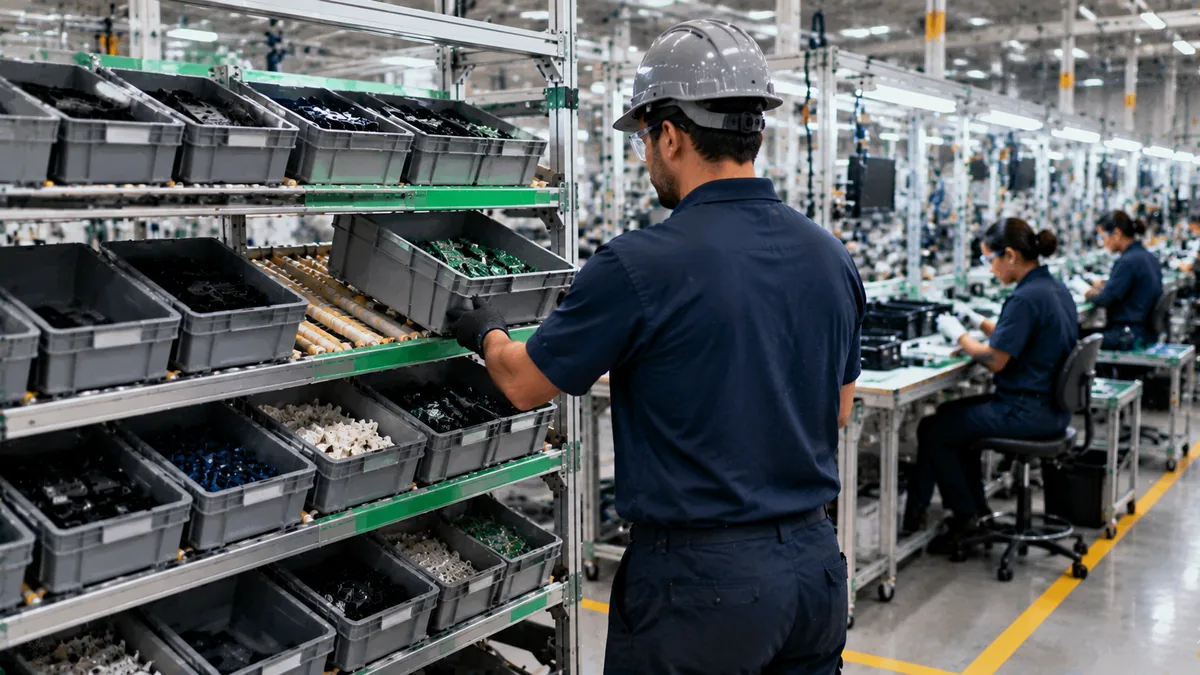
What pull production is
In pull production, a process only produces when the next process consumes and signals. The order starts at the end of the chain, from actual usage, and travels backward. Nobody produces based on a forecast or because a machine is free.
Taiichi Ohno developed this logic at Toyota starting in the 1950s, inspired by supermarkets, where the customer takes what they need and the shelf is restocked. It is the foundation of just in time.
In a push factory, each process works to meet its own schedule. The typical result is familiar: the machining department delivers on time and assembly waits for another component. In pull, the final process sets the pace and the upstream ones follow. The priority becomes the flow of the product, not machine utilization.
Pull vs push
| Aspect | Push | Pull |
|---|---|---|
| Production trigger | Schedule and forecast | Internal customer consumption |
| Work-in-process inventory | Grows without limit | Limited by rule |
| A problem at one workstation | Stays hidden behind inventory | Shows up quickly, because the flow stops |
| Control | Central production order | Local signal (card, space, container) |
| Lead time | Long and variable | Short and more stable |
| Response to change | Slow, requires rescheduling everything | Fast, consumption adjusts the pace |
Pull does not eliminate planning. It limits what planning can pile up between processes. For a direct comparison, read kanban vs pull production.
See the effect in daily routine. In push, the supervisor spends the day putting out fires caused by excess and shortage at the same time. In pull, the inventory limit turns a shortage of one component into a visible event that mobilizes the team immediately.
Prerequisites for pulling
Pulling without preparation causes part shortages and scrambling. Three conditions before starting:
- Leveled demand: peaks and valleys force large inventories. Leveling by volume and mix is covered in heijunka.
- Small batches and quick changeovers: without them, the process produces in large batches and the system jams. See SMED.
- Stable quality: with little inventory, a bad part stops the internal customer. Source inspection and poka-yoke are essential.
If the process fails often, also start with maintenance and standards. Pull flow exposes problems; it does not solve them.
A fourth point is often forgotten: the work standard. When each shift works its own way, the replenishment time varies and the supermarket becomes unstable. See standardized work before defining quantities. Finally, assess the reliability of the internal or external supplier. If it is often late, the safety stock will be larger and the gain smaller.
Steps to adopt it
- Map the value stream and choose a product family. The guide is in VSM.
- Define where continuous flow is possible and where a supermarket between processes will be needed.
- Set up the supermarket: a location with a defined space for each item, a maximum quantity and identification.
- Choose the replenishment signal: kanban card, marked space or empty container. The full technique is in the practical kanban guide.
- Size the supermarket inventory. The calculation of the number of cards is in kanban sizing.
- Define the reorder point: the level at which the signal is sent to the supplying process, considering the replenishment time.
- Train people and give clear rules: without a card or signal, nothing is produced.
- Monitor and adjust: reduce the number of signals as problems are solved.
Supermarket and reorder point in practice
The supermarket works as the memory of consumption. The customer process withdraws the item. The empty space or the released card alerts the supplier. The supplier produces only what was withdrawn.
The reorder point must cover what the customer consumes during the replenishment time. A container that takes one hour to be replenished requires the signal to go out while there is still at least one hour of consumption left in the supermarket. This reasoning applies to a card, a painted line or two bins.
Two simple examples help. In the first, the supermarket has two bins of each item: when the first one empties, the operator signals and the supplier produces while the customer consumes the second. In the second, a painted band limits the maximum quantity on the shelf: if the band is full, the supplier does not produce. In both, the rule is visible and does not depend on a production order.
Common mistakes
- Starting with the whole system: start with one family, learn and expand.
- Ignoring demand variation: without leveling, the supermarket runs empty or overflows.
- Too many cards: they hide problems, just as in push production.
- Producing without a signal: one exception opens the door for all of them.
- No review discipline: the system ages and loses alignment with actual demand.
Another mistake is using pull for low-turnover items, which sit idle in the supermarket. For those, consider make-to-order. And remember that a pull system does not replace management: someone needs to track shortages and excesses every week and adjust the quantities.
Next step
Choose a pair of processes with an inventory or shortage problem. Draw the current flow on a sheet of paper, define a supermarket with a maximum quantity and a simple replenishment signal. Run it for two weeks and measure work-in-process inventory and shortages.
Record the problems that come up. They show what needs to be solved before expanding the system.
Frequently asked questions
What is pull production?
It is the system in which each process produces only when the next process consumes and signals, avoiding production based on forecasts or isolated schedules.
What is the difference between pull and push production?
In push, the schedule defines what to produce. In pull, actual consumption triggers production and the inventory between processes is limited.
Can every process be pulled?
No. Items with very irregular demand, low turnover or made to order may require other rules, such as make-to-order production.
Are kanban and pull production the same thing?
No. Kanban is one of the tools for signaling replenishment. Pull production is the logic, and it can use cards, marked spaces or containers.
What is the first step to adopt pull production?
Map the value stream of one product family and define a supermarket with a replenishment rule between two processes.
Keep studying
Sources
- OHNO, T. O Sistema Toyota de Produção: além da produção em larga escala. Porto Alegre: Bookman.
- SMALLEY, A. Criando o Sistema Puxado Nivelado. Lean Institute Brasil.
- Lean Enterprise Institute. Supermarket (glossário). https://www.lean.org/lexicon-terms/supermarket/
- Lean Enterprise Institute. Just-in-Time (glossário). https://www.lean.org/lexicon-terms/just-in-time/
Want pull production done right?
Download the free e-book on pull production, with kanban, supermarkets and leveling.
Download the e-book
About the author
Lean Manufacturing & Behavioral Management Specialist
Over 20 years in the automotive and metalworking industries (GM and Dana), Lean Manufacturing practitioner since 2006. SENAI instructor and mentor in Brazil’s Brasil Mais Produtivo program, delivering consulting, training and audits for 50+ companies, combining quality, productivity and people development.