
What kanban sizing means
Kanban sizing sets how many cards circulate between the customer workstation, the supermarket and the supplier workstation. Each card authorizes refilling one container. Too few cards starve the line; too many build inventory and hide problems.
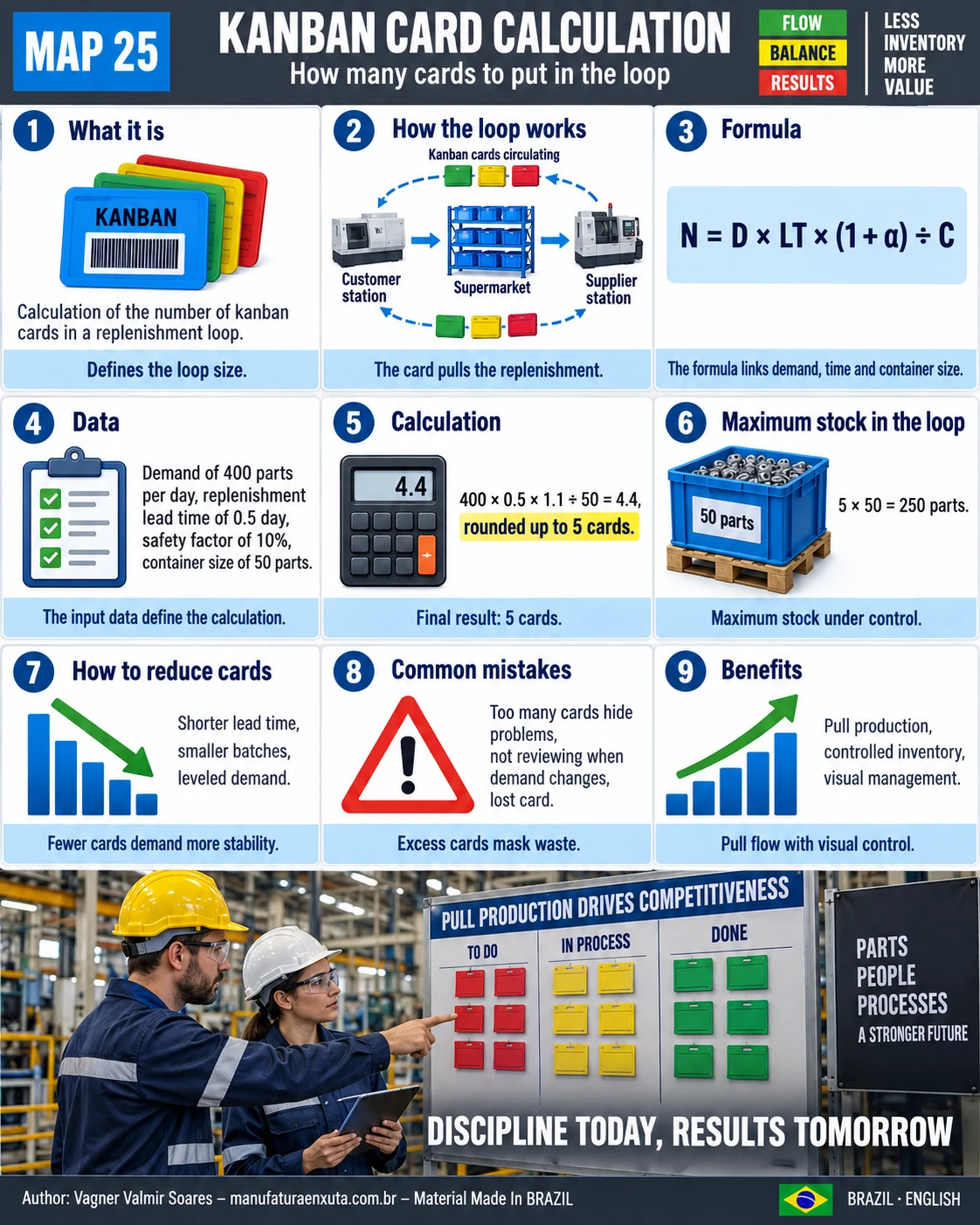
Kanban card calculation visual map
The map shows the loop, the formula and the example calculation.
The formula
N = D × LT × (1 + α) ÷ C
| Symbol | Meaning |
|---|---|
| N | Number of cards |
| D | Average demand per period |
| LT | Replenishment lead time, in the same time unit |
| α | Safety factor |
| C | Parts per container |
Worked example
| Data | Value |
|---|---|
| Demand | 400 parts per day |
| Replenishment lead time | 0.5 day |
| Safety factor | 10% |
| Container size | 50 parts |
N = 400 × 0.5 × 1.1 ÷ 50 = 4.4, rounded up to 5 cards. Always round up: 4 cards would not cover demand during replenishment.
Maximum inventory in the loop = 5 × 50 = 250 parts, a little over half a day of demand.
How to reduce the number of cards
- Shorter lead time: more frequent replenishment and shorter routes.
- Smaller lots: smaller containers, made possible by SMED.
- Level demand: with heijunka, the safety factor can come down.
Pulling cards out one at a time is a classic Lean way to expose problems.
Common mistakes
- Calculating once and never revisiting when demand changes.
- Using a high safety factor to cover an unstable process.
- Mixing time units.
- Losing cards without control.
Frequently asked questions
How do you calculate the number of kanban cards?
Use N = D × LT × (1 + α) ÷ C and round up.
What is the kanban safety factor?
A percentage buffer that covers variation in demand and replenishment.
How many cards in the example?
400 × 0.5 × 1.1 ÷ 50 = 4.4, so 5 cards.
Why round up?
Fewer cards than calculated leave the line without material during replenishment.
When should the card count be reviewed?
Whenever demand, lead time or container size changes.
Sources
- MONDEN, Y. Toyota Production System: An Integrated Approach to Just-in-Time. Boca Raton: CRC Press.
- OHNO, T. Toyota Production System: Beyond Large-Scale Production. Portland: Productivity Press.
- SMALLEY, A. Creating Level Pull. Cambridge, MA: Lean Enterprise Institute.
Want real pull production?
Download the free pull production e-book, with kanban, supermarkets and leveling.
Download the e-book
About the author
Lean Manufacturing & Behavioral Management Specialist
Over 20 years in the automotive and metalworking industries (GM and Dana), Lean Manufacturing practitioner since 2006. SENAI instructor and mentor in Brazil’s Brasil Mais Produtivo program, delivering consulting, training and audits for 50+ companies, combining quality, productivity and people development.