
What MRP is
MRP (material requirements planning) turns the production plan for finished products into purchase and work orders for components, in the right quantity and on the right date.
It answers three questions: what to buy or make, how much and when. It sits at the heart of production planning and control for dependent-demand items.
MRP visual map
The map shows the inputs, the product tree and the tables for a table example.
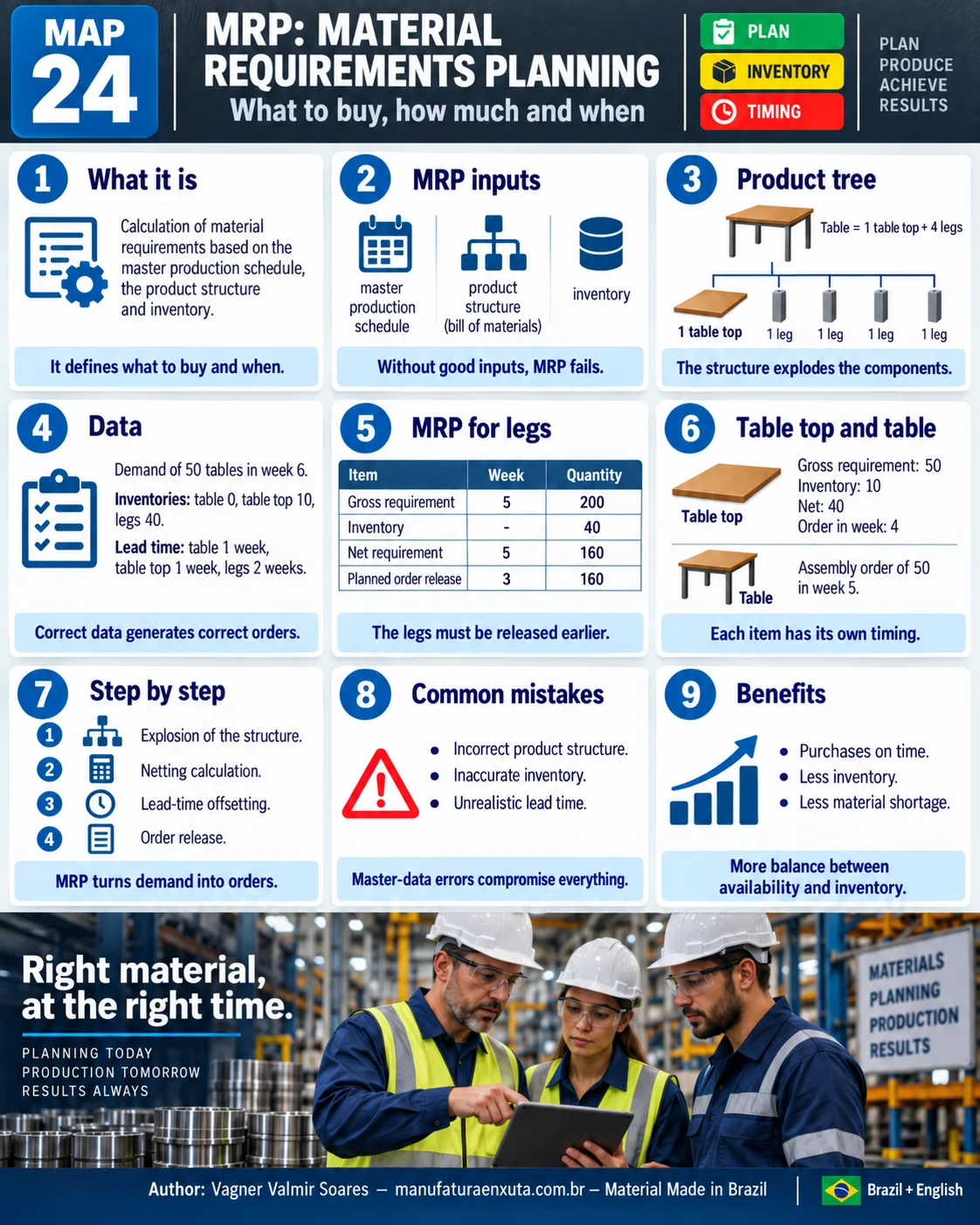
The three MRP inputs
| Input | What it provides |
|---|---|
| Master production schedule | How many finished products and when |
| Bill of materials | Which components and how many |
| Inventory and open orders | What is on hand and what is already on its way |
With each item's lead time, MRP calculates when orders must be released.
Example: 50 tables in week 6
A table uses 1 table top and 4 legs. Demand is 50 tables in week 6.
| Item | On hand | Lead time | Gross requirement | Net requirement | Planned order release |
|---|---|---|---|---|---|
| Table (assembly) | 0 | 1 week | 50 in week 6 | 50 | Week 5 |
| Table top (1 per table) | 10 | 1 week | 50 in week 5 | 40 | Week 4 |
| Legs (4 per table) | 40 | 2 weeks | 200 in week 5 | 160 | Week 3 |
Assembly must start in week 5, so tops and legs must be ready that week. Legs take 2 weeks: the order for 160 goes out in week 3. Tops take 1 week: the order for 40 goes out in week 4.
Step by step
- Explosion: multiply demand by the quantity per parent (50 × 4 = 200 legs).
- Netting: net requirement = gross − on hand − scheduled receipts (200 − 40 = 160).
- Lead time offsetting: move the date back by the item's lead time (week 5 − 2 = week 3).
- Release: issue purchase or work orders on those dates.
The example uses lot-for-lot sizing. With minimum or multiple lot sizes, orders are rounded up and the remainder becomes inventory.
MRP and kanban
MRP plans from the forecast and pushes orders; kanban replaces what was consumed. Many plants use both: MRP for long-lead purchases and expensive items, kanban for high-runner parts on the shop floor.
Common mistakes
- Wrong or outdated bill of materials.
- Inaccurate inventory: MRP calculates on a balance that does not exist.
- Unrealistic lead times.
- Replanning every day without freezing the short term.
Frequently asked questions
What is MRP?
Material requirements planning: it turns the production plan into dated purchase and work orders for components.
What is the difference between gross and net requirements?
Gross is what production needs; net subtracts inventory on hand and scheduled receipts.
How does lead time affect MRP?
Orders are released earlier than the need date by the item's lead time.
What are the inputs to MRP?
The master production schedule, the bill of materials and inventory status.
What is the difference between MRP and MRP II?
MRP plans materials; MRP II also covers capacity, costs and other manufacturing resources.
Sources
- ORLICKY, J. Material Requirements Planning. New York: McGraw-Hill, 1975.
- JACOBS, F. R. et al. Manufacturing Planning and Control for Supply Chain Management. New York: McGraw-Hill.
- HOPP, W. J.; SPEARMAN, M. L. Factory Physics. Long Grove: Waveland Press.
Want real pull production?
Download the free pull production e-book, with kanban, supermarkets and leveling.
Download the e-book
About the author
Lean Manufacturing & Behavioral Management Specialist
Over 20 years in the automotive and metalworking industries (GM and Dana), Lean Manufacturing practitioner since 2006. SENAI instructor and mentor in Brazil’s Brasil Mais Produtivo program, delivering consulting, training and audits for 50+ companies, combining quality, productivity and people development.