
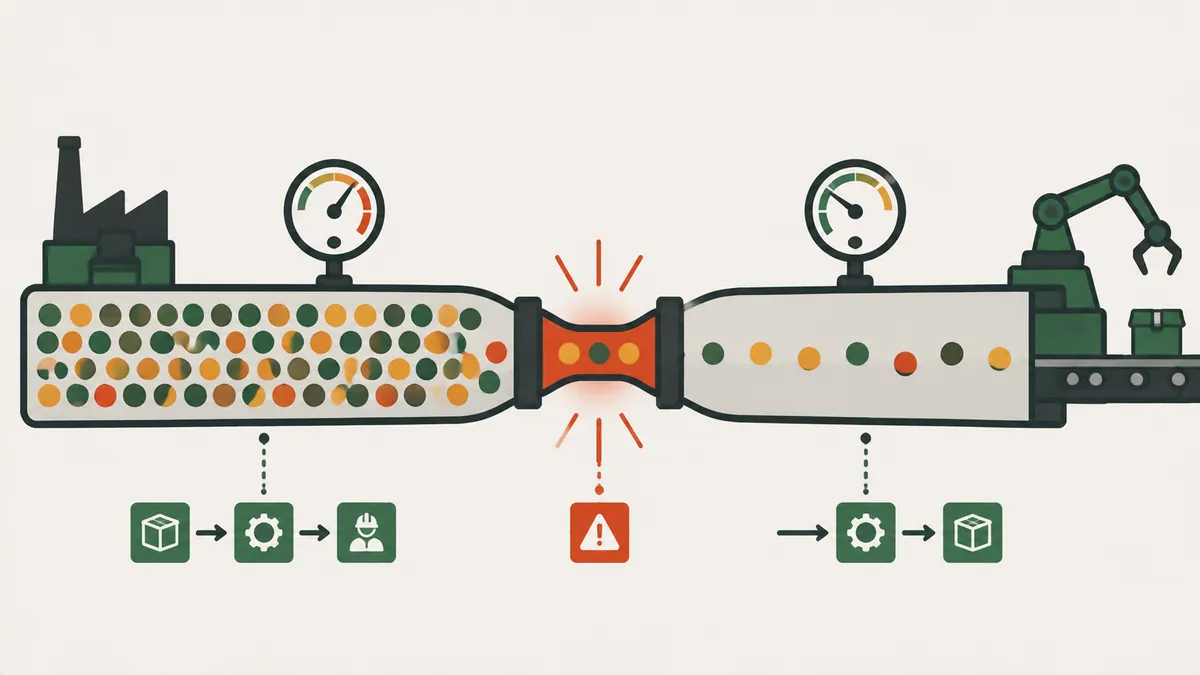
Continuous flow and bottlenecks are the same problem
Continuous flow (one-piece flow) means producing and moving one part at a time, without stopping between steps. In practice, it only exists when no workstation is much slower than the others. That is why talking about flow means talking about bottlenecks.
A bottleneck is the resource that limits the output of the entire system. Every extra part it processes becomes an extra part at the output. Every minute it stops is a minute lost for the factory, not just for the workstation. The full theory is in theory of constraints: how to identify and manage the bottleneck.
How to find the bottleneck
Use four clues, in order of reliability:
- Queue: the workstation with the most material waiting in front of it is usually the constraint.
- Cycle time: the longest cycle in the sequence sets the capacity of the line.
- Utilization: the resource that never stops and never waits for material.
- Downstream starvation: the following stations run out of parts, and the preceding ones are blocked.
Confirm with measurement in the field, at the gemba, and not just from the system. For the capacity calculation, see production capacity.
Beware of the false bottleneck. A large queue can come from a poorly scheduled batch rather than a lack of capacity. If the workstation with the queue is empty at other times, it is not the constraint. The real bottleneck limits output all the time. Observe at least one full shift before deciding where to invest.
Balancing with takt time
Takt time is the pace that demand requires. The cycle of each workstation must be equal to or below it.
Takt time = available time ÷ demand for the period
If the bottleneck has a cycle longer than takt, the line does not deliver the demand. If the other workstations have much shorter cycles, they produce more than the bottleneck can absorb, and the excess becomes inventory. The method for distributing tasks is in line balancing.
Numerical example (illustrative)
A line has four workstations in sequence. The shift is 8 hours (28,800 s), with 1,800 s of breaks, leaving 27,000 s available. Demand is 450 parts per shift.
Takt = 27,000 s ÷ 450 parts = 60 s per part
| Workstation | Cycle (s) | Capacity per shift | Status against takt |
|---|---|---|---|
| A | 45 | 27,000 ÷ 45 = 600 | Slack |
| B | 58 | 27,000 ÷ 58 = 465 | Within takt |
| C | 82 | 27,000 ÷ 82 = 329 | Bottleneck, above takt |
| D | 50 | 27,000 ÷ 50 = 540 | Slack |
The line delivers 329 parts per shift, and demand is 450. The shortfall is 121 parts. Duplicating workstation C into two parallel stations gives an effective cycle of 41 s (82 ÷ 2). The new bottleneck becomes B, at 58 s, and capacity rises to 465 parts per shift, above demand.
Note the lesson: when you resolve one constraint, another appears. The work is continuous.
The five focusing steps of TOC
- Identify the constraint.
- Exploit the constraint: make sure it never stops and never processes a bad part.
- Subordinate everything else to the pace of the constraint.
- Elevate the constraint: invest in capacity, but only after exploiting it.
- Repeat: when it stops being the limit, go back to step 1.
In the example, step 2 could reduce the 82 s of workstation C before thinking about duplicating it. Faster tool changes, as in SMED, and inspection before the bottleneck protect capacity.
Reducing batch size and building U-shaped cells
A large batch hides the bottleneck and lengthens lead time. With the same example, a batch of 50 parts that passes through all workstations before moving on takes 50 × (45 + 58 + 82 + 50) = 11,750 s, or about 196 minutes, to come out complete.
With single-piece flow, the first part comes out in 235 s, and the other 49 come out at the pace of the bottleneck: 235 + 49 × 82 = 4,253 s, or about 71 minutes. The reduction is approximately 64%. More on the topic in lead time.
The U-shaped cell brings the workstations closer together, and the operator follows the part through several of them. It reduces walking, makes the flow visible, and lets you adjust the number of operators to the takt. Define the layout with the support of the industrial layout guide.
To sustain single-piece flow, also evaluate transport between workstations. If the part travels dozens of meters between one operation and the next, the flow is still broken, even without a batch. In the U-shaped cell, the operator who hands the part to the next station is also the one who receives the previous one, and the number of operators can go up or down with takt. When demand falls from 450 to 360 parts per shift, takt becomes 27,000 ÷ 360 = 75 s, and the same work can be done with fewer people.
Next step
Choose one product family. Measure the cycle of each workstation in the field, calculate takt, and mark the bottleneck. Record the gap to demand and choose one TOC step 2 action. Reassess in a week.
If your factory uses pull replenishment to supply the bottleneck, see the practical kanban guide.
Frequently asked questions
What is continuous flow?
It is producing and moving one part at a time between steps, with no waiting and no intermediate inventory. It is also called one-piece flow.
How do I identify the production bottleneck?
Look for the longest queue, the longest cycle time, the always-busy resource, and the following stations with no parts. Confirm by measuring in the field.
What are the five steps of TOC?
Identify, exploit, subordinate, elevate the constraint, and repeat. Each step avoids investing before making use of what already exists.
Does continuous flow work with any process?
No. Processes with very different cycle times or long changeovers first require balancing and setup reduction, or a supermarket between steps.
Why reduce batch size?
Because a large batch increases waiting, hides defects, and lengthens lead time. Small batches reveal problems earlier.
Keep studying
Sources
- GOLDRATT, E. M.; COX, J. A Meta. São Paulo: Nobel.
- ROTHER, M.; SHOOK, J. Aprendendo a Enxergar. São Paulo: Lean Institute Brasil.
- Lean Enterprise Institute. Theory of Constraints (glossário). https://www.lean.org/lexicon-terms/theory-of-constraints/
- Lean Enterprise Institute. Takt Time (glossário). https://www.lean.org/lexicon-terms/takt-time/
Want a quick reference guide?
Download the free Lean pocket guide e-book, with the concepts and tools on one page each.
Download the e-book
About the author
Lean Manufacturing & Behavioral Management Specialist
Over 20 years in the automotive and metalworking industries (GM and Dana), Lean Manufacturing practitioner since 2006. SENAI instructor and mentor in Brazil’s Brasil Mais Produtivo program, delivering consulting, training and audits for 50+ companies, combining quality, productivity and people development.