Roadmap overview
Implementing lean manufacturing is a change project, and change projects respond better to stages than to campaigns. The roadmap below is a practical organization in five steps, not a standard. Each step has a question, a deliverable and a criterion for moving on. If you are still looking for the conceptual basis, start with the article What Is Lean Manufacturing.
| Step | Question | Deliverable |
|---|---|---|
| 1. Diagnose | Where is the biggest loss? | Current-state map |
| 2. Pilot | What should we test first? | Pilot result |
| 3. Standardize | How do we keep the gain? | Standards and boards |
| 4. Expand | Where do we replicate? | Plan by flow |
| 5. Sustain | How do we avoid backsliding? | Management routine |
Step 1: diagnose the value stream
The diagnosis starts on the shop floor, with a stopwatch and a spreadsheet. Choose a product family and map its path with VSM. Record processing time, inventory between steps and total lead time.
One simple number guides prioritization: the ratio between processing time and lead time. If a part takes 20 minutes of processing over 5 working days of 8 hours, the lead time is 5 × 8 × 60 = 2,400 min, and the ratio is 20 ÷ 2,400, or about 0.8%. Almost all the time is waiting, and that is where the project should aim.
Criterion to move on: the map has been validated by the operators and there is a short list of losses ranked by impact.
Step 2: choose and run a pilot
Select a small flow with a clear pain point and an engaged manager. Define a numerical target and a deadline, for example reducing work-in-process inventory and lead time in 8 to 12 weeks. Apply a few tools, the ones that attack the biggest loss from step 1:
- waiting between steps: kanban and leveling;
- long changeover stoppages: SMED;
- disorganized workstation: 5S.
An illustrative example of a target: a flow with 4 steps has 1,200 parts sitting between them and consumes 600 parts per day. Work-in-process inventory equals 1,200 ÷ 600 = 2 days of production. If the pilot reduces that inventory to 600 parts, the equivalent drops to 1 day, and the lead time of that segment decreases in the same proportion, given that the consumption rate holds.
During the pilot, set aside a short weekly meeting to review the board, record what was tested and decide the next experiment. Also noting the attempts that failed avoids repeating them in the expansion.
Criterion to move on: the target was met, or the team understands why it was not, and the lessons are written down.
Step 3: standardize what worked
The pilot's gain disappears if it depends on the memory of two people. Turn the new method into a standard: work sequence, times, replenishment rules and responsible people. See how to structure this in standardized work.
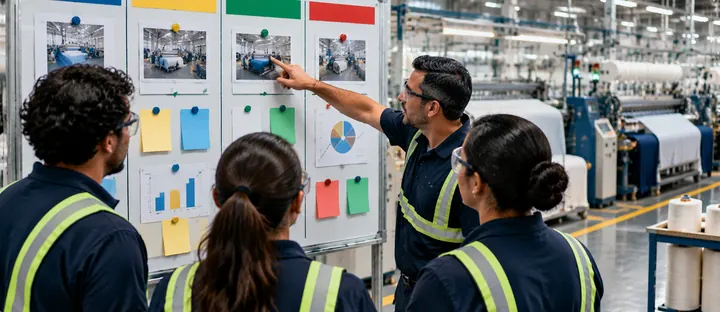
Display the standards at the workstation and train each operator on their shift. Add a simple board with the pilot's indicators, updated every shift. Visual management lets anyone spot a deviation in seconds.
Criterion to move on: a new operator performs the standard without help from whoever designed it.
Step 4: expand by flow, not by tool
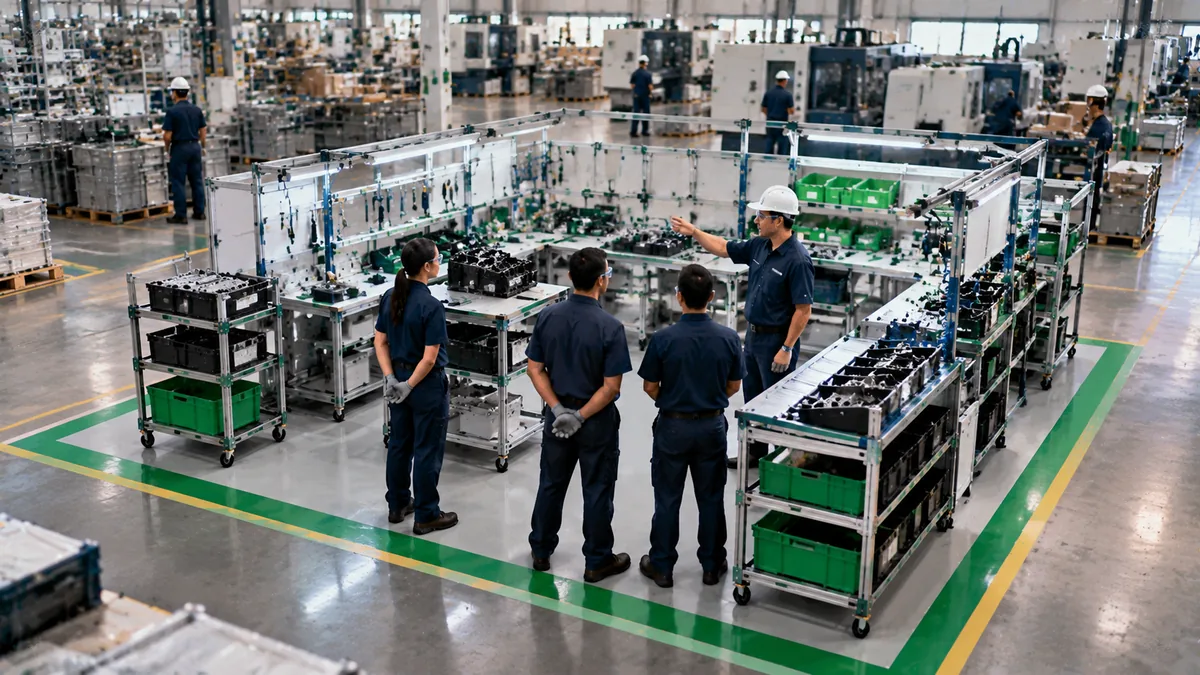
After the pilot, the temptation is to launch "5S across the whole plant" or "kanban in every department." The safest path is to expand by value stream: take the validated set of practices to the next product or cell, adapting to the context.
- Rank the flows by impact and by the readiness of local leadership.
- Bring a pilot leader along as a multiplier.
- Replicate one flow at a time, with a review every four weeks.
Also record what did not work in the pilot, so that the next flow does not repeat the same path.
Use production planning and control (PCP) to align the scheduling of the areas involved, because a pull flow changes the way scheduling is done.
Criterion to move on: each new flow reaches the target with less outside support than the previous one.
Step 5: sustain with a management routine
The last step is the most neglected. Sustaining means creating routines that do not depend on enthusiasm: a short daily meeting in front of the board, standard audits, manager walks and a regular improvement cycle. The gemba walk and PDCA sustain that rhythm.
Also include incentives: if the supervisor's target is still "produce the maximum," he will push production and ignore the pull system. Align the indicators with the new method.
Maturity criterion: the program survives a change of manager.
Pitfalls that get in the way of implementation
- Skipping the diagnosis. Without a map, the project acts on symptoms.
- A pilot that is too big. The larger the scope, the slower the learning, and the harder it becomes to show a convincing result in time.
- Standardizing too early. Freezing the method before testing it produces bad standards.
- Forgetting the supplier. Irregular deliveries break the internal flow.
Next step
Set aside two weeks for step 1: choose the product family, time the flow and calculate the ratio between processing and lead time. With that number in hand, present the leadership with a proposal for a 12-week pilot, with a target, an owner and a tracking board. The article 10 tips to get started offers a complement of good practices.
Frequently asked questions
What are the 5 steps to implement lean manufacturing?
Diagnose the value stream, run a pilot, standardize the gains, expand by flow and sustain with a management routine. It is a practical organization, not a standard.
How long does implementation take?
A pilot takes 8 to 12 weeks. Expansion depends on the number of flows, and consolidating the culture takes years.
Can I skip the pilot?
It is not advisable. The pilot reduces risk, generates learning and creates evidence to convince the rest of the company.
How do I keep Lean from regressing?
With management routines, standard audits and indicators aligned with the new method. Without them, the old routine gradually returns.
Keep learning
Sources
- WOMACK, J.; JONES, D. A Mentalidade Enxuta nas Empresas. Rio de Janeiro: Elsevier.
- ROTHER, M.; SHOOK, J. Aprendendo a Enxergar. São Paulo: Lean Institute Brasil.
- Lean Enterprise Institute. Value Stream Mapping. https://www.lean.org/lexicon-terms/value-stream-mapping/
Want to lead change with a method?
Download the free e-book Lean for Leaders and see how to sustain lean culture day to day.
Download the e-book
About the author
Lean Manufacturing & Behavioral Management Specialist
Over 20 years in the automotive and metalworking industries (GM and Dana), Lean Manufacturing practitioner since 2006. SENAI instructor and mentor in Brazil’s Brasil Mais Produtivo program, delivering consulting, training and audits for 50+ companies, combining quality, productivity and people development.