
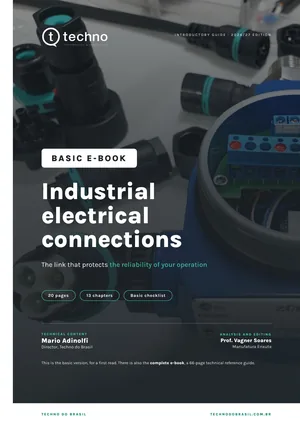
Basic Guide · Free
Industrial electrical connections: basic guide
The link that protects the reliability of your operation
Introduction, core concepts and an understanding of the technology.
In a modern production line, thousands of points join one cable to the next. Almost nobody thinks about them while they work; when one fails, the line stops and the search for the cause often starts in the wrong place. This library brings together free technical guides to see that weak point and decide better.
Topics:
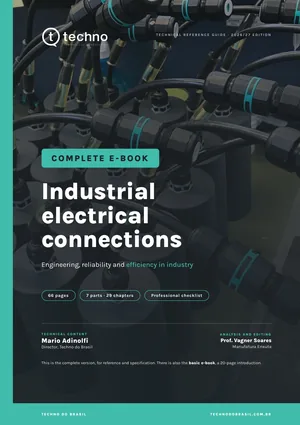
Choose the depth. The download is direct, with no form.
Basic Guide · Free
The link that protects the reliability of your operation
Introduction, core concepts and an understanding of the technology.
Complete Guide · Free
Engineering, reliability and efficiency in industry
Technical depth, applications, examples, checklist and implementation criteria.
Each question points to a chapter of the guides. The figures are illustrative examples, labelled as such in the e-books; they are not results measured at customers.
In lean thinking, choosing a component is a process decision. A poorly chosen connector does not show up on the value stream map as a cause: it shows up later as downtime, scrap or rework. Each of the classic wastes has an equivalent at the connection point.
Go deeper Complete guide, ch. 16
A three-hour stoppage makes the report; six 25-minute stoppages spread across the month often do not. In the e-books' illustrative example, with line downtime at R$ 8,000 per hour (hypothetical), that is 2.5 hours and R$ 20,000 in the month.
Go deeper Complete guide, ch. 17
Probably condensation and capillarity along the cable, not a sealing failure. The enclosure warms up in operation and cools at standstill; as it cools, it draws in humid air through any micro-path, including through the cable itself. An illustrative example: air cooling from 60 °C to 20 °C loses about 12% of its pressure.
Go deeper Basic guide, ch. 5 · complete, ch. 10
Opening boxes and redoing terminals in the field is movement that can be avoided. A locking plug and socket lets you replace the equipment without opening boxes and without the risk of swapping connections; chapter 16 links each waste to the specification decision that prevents it.
Go deeper Complete guide, ch. 3 and 16
OEE shows that there is a loss, not the cause. To reach the connection, the stoppage record needs a specific code, such as "connection, splice or cable entry", separate from the generic "electrical". An intermittent fault has this pattern: the machine stops, the operator moves the cable and it runs again.
Go deeper Complete guide, ch. 17
Connections work in series: one failing is enough to stop the circuit. In the illustrative example, 20 connections, each with a 99% chance of getting through the year without failing, give about an 82% chance of a year without stoppage. The levers: reduce the interruptions in the cable and raise the reliability of each one.
Go deeper Basic guide, ch. 9 · complete, ch. 15
With method: analyse the environment (seven agents), choose cable and connector together and eliminate the weak points of the circuit. Technology comes in as the answer to what the environment demands: co-moulded sealing, resin-free connection and an anti-condensation barrier.
Go deeper Basic guide, ch. 7 · complete, ch. 5 and 23
The product data below comes from Techno do Brasil's general catalogue and technical presentation, the technical source of the guides. The company appears here because the answer to the problem is, above all, engineering.
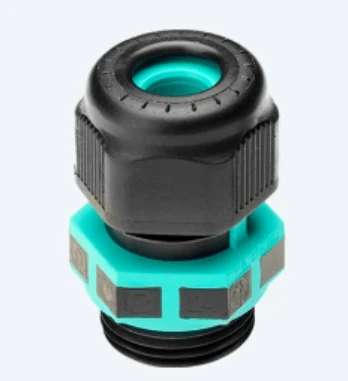
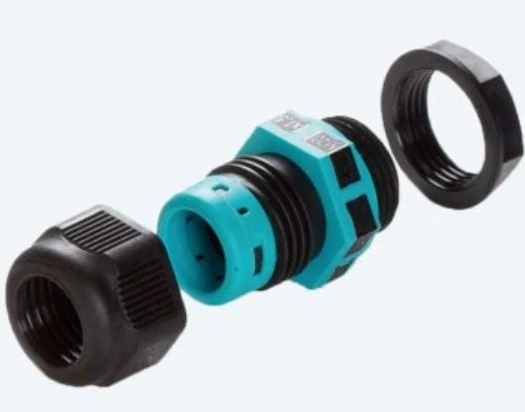
Plastic and rubber are injected together, forming a single part. According to Techno, the result is faster installation, with fewer components and fewer assembly errors, because there is no loose sealing ring to forget or misplace.
Splices and boxes that seal through mechanical design, without potting. That is why they can be reopened for inspection and reused, which makes the connection re-inspectable.
Placed between the connector and the equipment, it blocks moisture travelling through the inside of the cable, the path the outer seal does not close. The catalogue reports a 90% reduction in water ingress, with no voltage drop.
| Family | Function |
|---|---|
| TEETUBE® | In-line splices and T, Y and H branches |
| TEEPLUG® | Disconnectable plug and socket |
| TEEBOX® | Junction boxes and distributors |
| TEEGLAND® | Co-moulded cable glands |
| IoTH® | Platform to integrate electronics and sensors |
Techno do Brasil: electrical connection technology · Techno do Brasil website
The IP protection rating follows IEC 60529: the first digit indicates protection against dust and the second against water. The IK code (IEC 62262) covers impact.
| Marking | Protects against | Where it makes sense |
|---|---|---|
| IP66 | Dust and powerful water jets | Outdoor areas, hose washing |
| IP67 | Dust and temporary immersion | Points subject to brief flooding |
| IP68 | Dust and continuous immersion, under conditions agreed with the manufacturer | Underground boxes, pumps, probes |
| IP69 | Dust and high-pressure, high-temperature jets | Sanitising in food and meat plants |
Every piece of information in the e-books shows its origin. This is the legend used in this library:
No illustrative example represents a result measured at a customer. When there is a real record, the text states the source; one of them, the football pitch lighting, carries an installer's account of opening the connector four years later and finding no trace of water. It is a single account, without laboratory measurement.
Not necessarily. Immersion and jet are different tests. For high-pressure, high-temperature washdown, the marking must include IP69.
IP69K comes from the road vehicle standard ISO 20653. IP69 is the equivalent test added to IEC 60529. In practice they indicate the same kind of requirement.
Probably from condensation or capillarity through the cable.
That prevents inspection and hides assembly defects. The recommendation is to use a connection designed for the environment.
No. IP is a type test on a new product. Durability depends on the materials and the ageing tests.
No. Start with the critical points and those where failures concentrate, with a pilot and measurement.
Continuous-improvement tools that appear in the guides:
Download the basic guide for a first read, or the complete one for reference and specification.
Choose my e-book