
- The chamber that floods and the connector that stayed dry
- Map of the cases by environment
- Buried, submerged and outdoors
- Heat, humidity and washdown: motors and process machines
- When what runs through the cable is information
- Machine panels: replacing rectangular with circular
- Failure mode and design decision: what repeats
- Frequently asked questions
A connection case only teaches something when you can identify in it the failure mode that dominated the application and the design decision that neutralises it.
That is the lens through which I read the second half of the presentation “Complicated and Hostile Applications” (Portuguese original), which Techno do Brasil gave at Mundo SENAI in Marechal Cândido Rondon (PR) and which I describe in the guide to the company. These are field cases, almost all carrying the “Approved by the Customer” stamp; for each one, I look for the physical mechanism that justifies the choice.
The chamber that floods and the connector that stayed dry
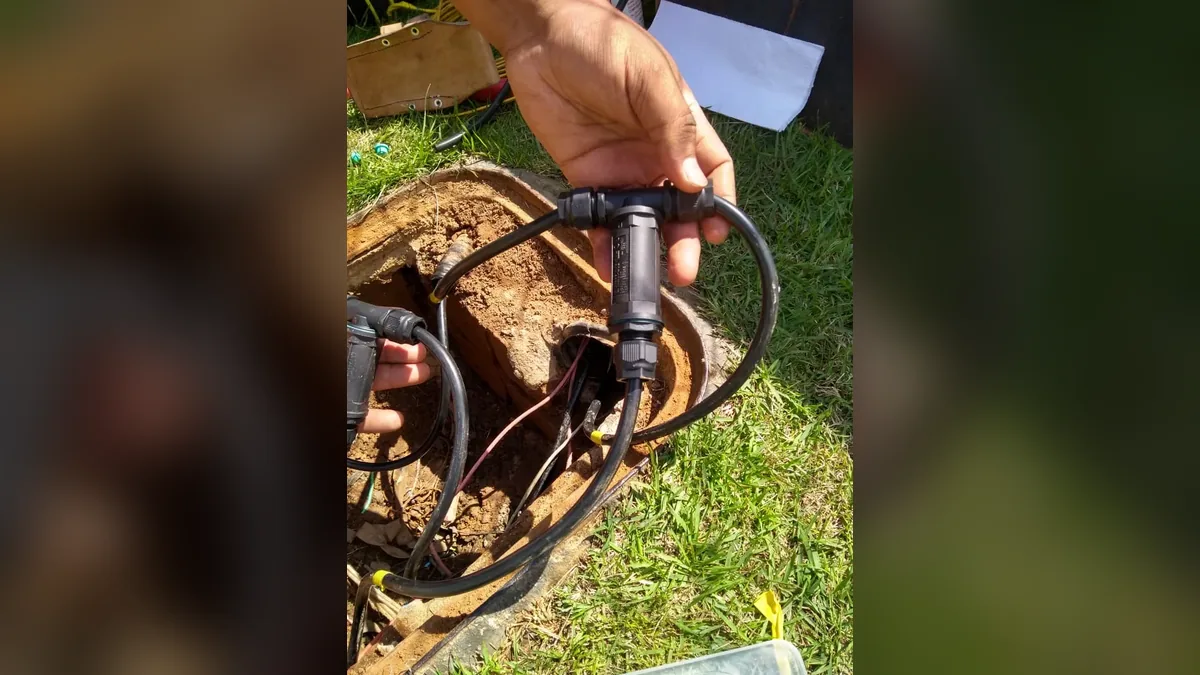
Scenario. Floodlighting for a football pitch, with an underground and submerged installation. One of the case slides mentions Mogi das Cruzes (SP). The splices sit in inspection chambers buried in the turf, which fill with water at every heavy rain.
Dominant failure mode. Long-term immersion. The hydrostatic pressure in a shallow chamber is small, but permanent; what brings the splice down is time. The rubber of the seal undergoes permanent deformation under compression (so-called compression set): after months of load and temperature, it loses the ability to recover its shape and the interface loosens.
Design decision. THB.402 branch connector. According to the Techno general catalogue, the TH402 series is a three-way T branch connector, IP68 and IK07, for up to 6 poles, 32 A and 450 V. IP68 is the rating for permanent submersion; the seal is mechanical, with no resin or gel, which makes the joint re-openable.
What the case shows. The installer's account, reproduced on the slide and published on Instagram, says that four years later he opened the connector to check its effectiveness and found no trace of water, in a chamber that is full on rainy days.
What each rating promises, and what lies outside the test, is covered in IP66, IP68 and IP69K: what they mean.
Map of the cases by environment
The cases range from street lighting to machine panels. The codes below are the ones that appear on the slides.
| Environment | Application | Solution cited |
|---|---|---|
| Buried, submerged and outdoor | Football pitch floodlighting, underground and submerged | THB.402 |
| Underground street lighting (Curitiba) | THB.370 | |
| Outdoor industrial lighting, agricultural machinery manufacturer | THB.391.R4A.L with xDRY | |
| Outdoor and in-ground recessed lighting | THB.391.A4A | |
| Lighting in the pulp industry | THW.400.5-13,5 8-17 | |
| Telemetry of sanitation pipelines | Box 210 + connectors 381 and 387 | |
| Water purity control probe | THB.387.N4A xDRY | |
| Flat table in pulp and paper | THB.391.A4A | |
| Heat, humidity and washdown | Pasta machine, 85 °C continuous and 90% humidity | THB.387.A4A |
| Meat-processing plant | THB.405.S5A | |
| Motors in a rice-processing plant | THB.387 | |
| Power tool motors (OEM) | THB.387 family, 4 poles | |
| Industrial machines | THB.387 | |
| Signal, weighing and safety | Field instrumentation, gas distribution company | THB.381 |
| pH sensor | THB.400 + THB.381.A2A + THB.381.B2A | |
| 2- and 4-load-cell scales | THB.389 (A4E/B4E) + THH.629.Y4EU | |
| Protection of an alignment sensor (pulp and paper) | Sensor protection solution | |
| Guard locking switch and safety tower | THB.405.A8A + THB.405.B8A | |
| Panels | Machine panels, customised solution | THB.381, THB.384, THB.405, THB.406 |
Buried, submerged and outdoors
The largest group is lighting and outdoor infrastructure. This is where the connection faces rain, sun, soil, the daily thermal cycle and flooding all at once.
Underground street lighting in Curitiba (THB.370)
The problem here is one of series reliability. In a street-lighting circuit, each buried splice acts as an element in series: Rsystem = R1 × R2 × … × Rn. With illustrative numbers, 20 splices with 99% annual reliability each give 0.9920 ≈ 0.82, that is, about an 18% chance of at least one failure in that section during the year. There are two levers: reduce the number of cable interruptions and raise the reliability of each one. The case shows the underground installation with the THB.370 series, which acts on the second. The first is what the Techno method asks for when it requires every cable interruption to be quantified.
Outdoor industrial lighting with xDRY (THB.391.R4A.L)
At an agricultural machinery manufacturer, the outdoor lighting uses the THB.391 circular connector in the xDRY version. The dominant failure mode is not rain, it is enclosure breathing. A sealed volume that heats up in the sun and cools down at night changes its internal pressure in proportion to the absolute temperature (ΔP/P ≈ ΔT/T). Cooling from 60 °C to 20 °C reduces the internal pressure by about 12%, something like 0.12 bar, the equivalent of a 1.2 m water column. That suction draws humid air through any micro-path, including through the inside of the cable, and the moisture condenses at the coldest point.
The IP test does not reproduce this cycle, which is why anti-condensation protection exists. In the presentation, the comparison was direct: in the standard connector, “water inside the device”; in xDRY, an anti-condensation barrier between connector and equipment. Techno presents the line as 100% tested and, in the catalogue, associates it with a 90% reduction in water ingress. The full mechanism is covered in Condensation and water ingress in connections.
Outdoor and in-ground recessed lighting (THB.391.A4A)
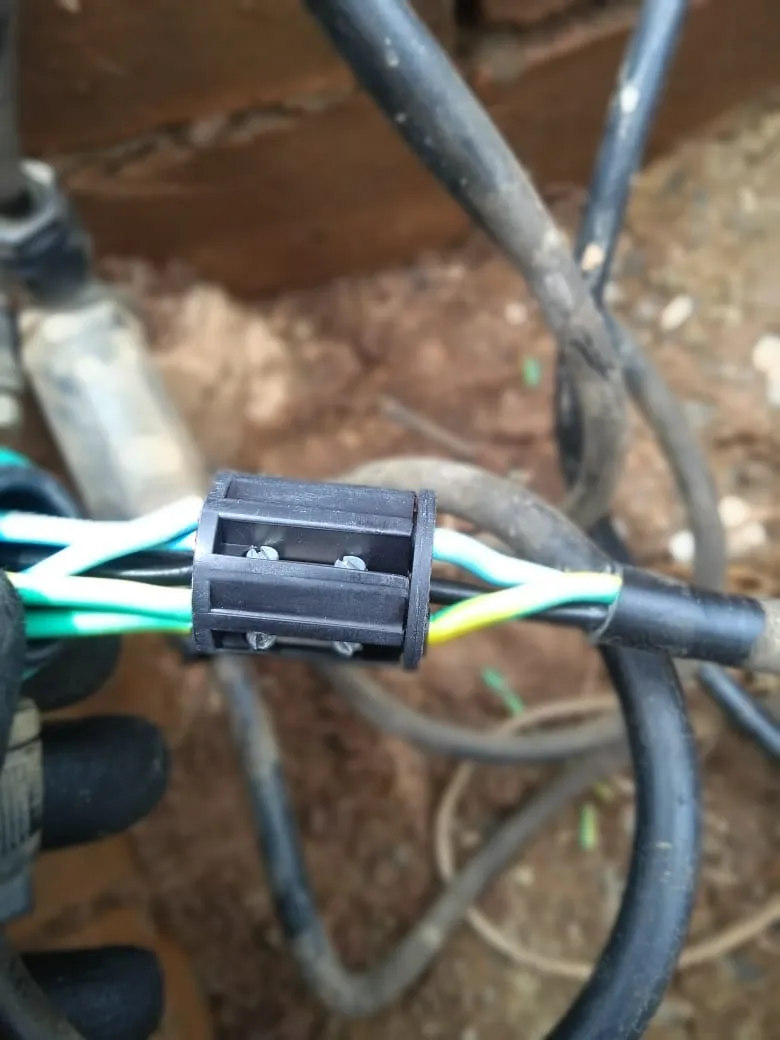
A luminaire recessed in the ground combines three stresses: water from above, moisture from below and mechanical load, sometimes from vehicle wheels. The luminaire itself heats up and adds thermal cycling. The case shows several luminaires connected with 4-pole TH391 connectors. According to the catalogue, the TH391 is a circular splice connector, IP68/IP69 and IK07, with screw termination for field assembly. The IK rating is a design requirement: a cracked housing cancels any IP rating.
Sanitation: pipeline telemetry (box 210)
This is one of the few cases with explanatory text on the slide. Box 210 was used in the telemetry of sanitation pipelines, which the presentation describes as crucial for managing water supply and sewage. It ensures IP68 for the electronic board and connects the 381 and 387 connectors to the sensors. The change of scale matters: the item being protected is the electronics that generate the data, and the typical PCB failure in a damp field is corrosion and leakage due to condensation, which shows up first as a wrong reading and only later as an outright failure. With disconnectable sensors, the sensor can be replaced without exposing the board.
Water purity probe and flat table in pulp
The water purity control probe uses the THB.387.N4A in the xDRY version. This is consistent with the mechanism described above: the sensor is in contact with water at one temperature and with air at another, a gradient that favours condensation in the connection. On the flat table in the pulp and paper sector, the THB.391.A4A appears in two dated photos, October 2017 and November 2018, under the word “Partnership”. A year at the same point is a condition record, the raw material of any reliability analysis. The same sector appears with a lighting solution (THW.400) and with the protection of an alignment sensor.
Heat, humidity and washdown: motors and process machines
Here the aggressor is the process itself: steam, hot water, cleaning chemicals, vibration and motors that need to come out for maintenance without stopping the line.
Pasta machine: 85 °C continuous and 90% humidity (THB.387.A4A)
In a pasta plant, the THB.387.A4A was installed on the motor of a machine that operates, according to the presentation, at 85 °C continuously and 90% humidity, with an inspection eight months later (photos of the connector and the cable gland). It is one of the harshest environments for an electrical point, because it adds up three mechanisms. Temperature accelerates ageing and the compression set of the elastomer; by the Arrhenius rule of thumb, the rate of these chemical reactions grows exponentially with temperature. Humidity exploits any gap the seal leaves as it ages. And motor vibration produces micromotion at the contacts, with fretting corrosion (fretting), oxidation, increased contact resistance and localised heating.
The TH387 series is a plug and socket with rotary locking and, according to the catalogue, withstands up to 1,000 mating cycles. The mechanical lock limits micromotion; the cycles ensure that frequent disconnection of the motor does not degrade the contact. To replicate a hot application, good practice is to check the operating temperature on the data sheet of the chosen series (the product's T-marking), in addition to the general range of the material, which Techno gives as −40 °C to +125 °C. The procedure for this check is in How to choose industrial electrical connectors.
Meat-processing plant (THB.405.S5A)
A meat-processing plant combines cold, hot-water washdown and chemicals. The thermal shock of washdown on a cold connection is the accelerated version of the breathing described above. The case uses the TH405 series, which the catalogue describes as a bayonet plug and socket for up to 8 poles, 25 A and 630 V and cables up to 16.5 mm. From a reliability standpoint, the merit of the bayonet is that it eliminates the intermediate state: a poorly mated connector has an effective IP rating of zero, and bayonet engagement can be felt by hand and seen by eye. It is an assembly poka-yoke that keeps working after every sanitation cycle.
Motors: rice processing and a tool manufacturer
Two cases show the THB.387 family on motors. In rice processing, the aggressor is fine dust combined with vibration. At the tool manufacturer (an OEM application), the version is 4-pole and the connector leaves the factory fitted to the motor. The relevant decision here is about maintainability: a motor that is replaced via plug and socket does not require re-terminating inside the terminal box. Mean time to repair (MTTR) falls by design, and the risk of reversing a phase on reconnection disappears, because the contact sequence is fixed.
When what runs through the cable is information
In power circuits, a degraded connection usually gives itself away: it heats up, trips, burns out. In signal circuits, it deceives. A resistive leakage that is irrelevant in a power circuit is already enough to shift a millivolt reading. That is why the dominant failure mode in instrumentation is drift, not interruption.
Field instrumentation in gas distribution (THB.381)
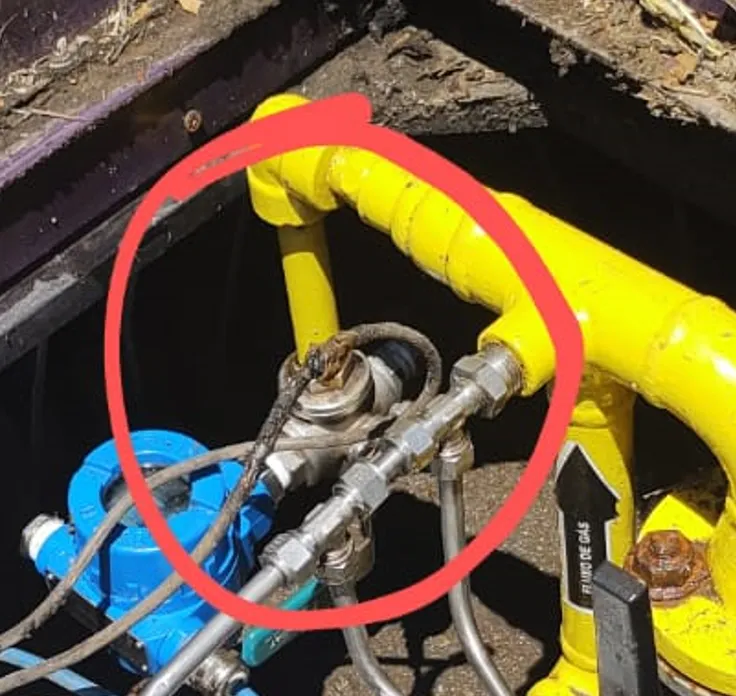
A gas distribution company appears on more than one slide, with THB.381 connectors linking transmitters in underground chambers. According to the catalogue, the TH381 is a disconnectable micro connector, IP66/IP68/IP69, with push-pull locking. The chamber subject to flooding defines the watertightness requirement; periodic calibration defines the disconnection requirement. With a plug and socket, the technician removes, calibrates and refits the instrument without touching the wiring, and every terminal re-tightening that no longer takes place is one less opportunity for error. Another case shows the same series combined with a cable gland.
pH sensor (THB.400 + THB.381)
A pH sensor is a wear item and lives wet. The solution combines the THB.400 box with the THB.381.A2A (male) and THB.381.B2A (female) pair. The engineering decision is to separate the consumable from the permanent: the box protects the fixed branch, and the disconnectable pair allows the probe to be replaced without opening the rest of the circuit.
2- and 4-load-cell scales (THB.389 + THH.629)
In a meat-processing plant, the scales with 2 and 4 load cells were connected with THB.389 mini connectors (A4E and B4E versions) and the THH.629.Y4EU branch connector. A load cell delivers a signal in the millivolt range. Moisture in the connection creates leakage paths between conductors, and contact oxidation changes the circuit resistance; both show up as reading drift and, in the end, as kilos given away or overcharged. With daily washdown, the watertightness of the branch connection is part of the scale's accuracy.
Machine safety (THB.405.A8A + THB.405.B8A)
A guard locking switch was connected with the 8-pole pair THB.405.A8A and THB.405.B8A, and another case, from the pulp sector, shows the assembly drawing of a safety tower with locking. Intermittent contact in a safety circuit causes nuisance stops and teaches the team to distrust the device. An unambiguous connection that is easy to inspect is a requirement; the design and validation of the circuit remain with whoever is responsible for machine safety. Before opening any of these points, lockout/tagout of energy sources comes first.
Machine panels: replacing rectangular with circular
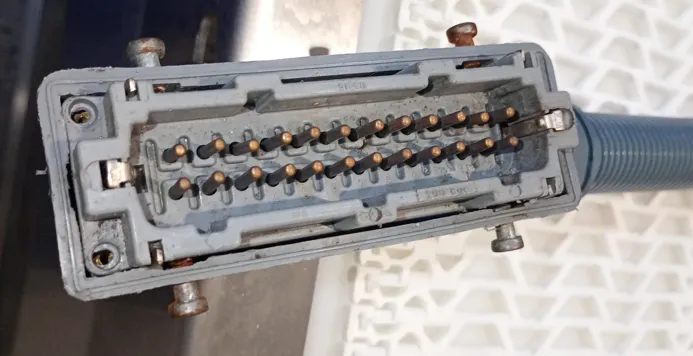
The last case is the one most closely linked to machine design. Techno replaced rectangular multipole panel connectors with circular panel connectors, cable by cable, according to the number of cores:
| Cable | Solution shown |
|---|---|
| 12 cores | THB.406.A1E + THB.405.B2E |
| 8 cores | THB.405.A8A / THB.405.B8A + 6000087LF |
| 3 cores | THB.381.A3E / THB.381.B3E |
| 3 cores | THB.384.A1A / THB.384.B1A + 6000347LA |
The change is justified by three engineering arguments. First, geometry: sealing a circular interface with a radial ring is simpler and more robust than sealing the perimeter of a rectangle, where the corners concentrate failure. Second, according to the catalogue, the panel connector allows the equipment to be connected and disconnected without opening it, which preserves the enclosure seal over its life. Third, different connectors for each function make it physically impossible to plug the wrong cable into the wrong place: poka-yoke by design, the subject of Lean and waste in component selection.
Failure mode and design decision: what repeats
Read in sequence, the cases fit into a simple table, which is my technical reading of the material.
| Application | Dominant failure mode | Design decision that addresses it |
|---|---|---|
| Flooded inspection chamber | Long immersion, seal ageing | IP68 branch connector with re-openable mechanical seal |
| Underground street lighting | Many splices in series | Fewer interruptions in the design and more reliable splices |
| Outdoor lighting, water probe | Thermal breathing and condensation | Anti-condensation barrier (xDRY) |
| In-ground luminaire | Water combined with impact | IP68/IP69 with specified IK |
| Sanitation telemetry | Corrosion and leakage in the electronics | IP68 box for the PCB and disconnectable sensors |
| Pasta machine | Thermal ageing and fretting | Mechanical locking and checking of the T-marking |
| Meat-processing plant | Thermal shock and incomplete mating | Bayonet with unambiguous engagement |
| Motors | High MTTR and reconnection errors | Plug and socket with fixed sequence |
| Instrumentation, pH, scales | Signal drift due to moisture and oxidation | Watertight micro and mini connectors, consumable kept separate |
| Machine panels | Opening the panel and swapping cables | Circular panel connectors by function |
Four conclusions come out of this table.
- Water rarely comes alone. Almost every application combines water with temperature, chemicals or mechanical stress. The IP rating is necessary, but it is a type test, short and on a new assembly; ageing and thermal cycling lie outside it. That is why the presentation devoted so many slides to material tests (ozone, salt spray, 1000 h UV, glow-wire, IK).
- Function defines the series before the environment does. Permanent splice, disconnectable for a motor or instrument, panel connector: the first decision is about what the connection needs to do over its life, including during maintenance.
- Re-inspection appears in every long-term record. Four years at the pitch, eight months on the pasta machine, one year on the flat table. That is what TPM asks of a connection: that it can be looked at, opened and maintained.
- The cases are the output of a method. Techno presented a three-step method: analysis of the environment, selection and harmonisation of the cables, and elimination of the circuit's weak points. Each row of the table is one of those steps applied.
In my assessment, this last point is the differentiator. The company treats the connection as a system (environment, cable, interruptions, connection, validation), not as a catalogue item. It designs to reduce interfaces and assembly errors, covers the failure mode that IP does not cover and qualifies the material for the service life, not just for the test. This is a differentiator because it moves the decision to the phase in which it is cheap. By the well-known 1-10-100 rule of thumb, what costs 1 to prevent at the design stage costs 10 to correct during installation and 100 when it fails in operation.
When the failure recurs in your plant, the question is the same as in each case: what is the mechanism? Root cause analysis and a well-executed FMEA will get there. If the sensors feed an IIoT system, the physical connection becomes part of data quality. The financial effect of these decisions is covered in total cost of connections.
The products are on the Techno do Brasil website: Splices, Disconnectables, Panels and Cable glands, and more application videos are on the company's YouTube channel.
One practical recommendation rounds off the topic: every time the team opens an inspection chamber, record its condition with a photo and the date. Four years from now, that field history from your own plant will be worth more than any brochure.
Frequently asked questions
What kinds of application appear in the Techno do Brasil cases?
Underground street and sports lighting, outdoor industrial lighting, sanitation telemetry, water probes, motors, food machinery, meat-processing plants, gas instrumentation, pH sensors, scales, machine safety and panels. The common factor is exposure to water, humidity, heat or washdown.
Which connector was used in the inspection chamber that floods?
The THB.402 branch connector, a three-way T, IP68 and IK07 according to the catalogue. The installer reported that, when he opened the connector four years later, there was no trace of water, even though the chamber fills up on rainy days.
What is the xDRY version for in the cases?
It creates an anti-condensation barrier between the connector and the equipment. The target is thermal breathing: as it cools, the enclosure loses internal pressure and draws in humid air. In the cases, it appears in outdoor industrial lighting and in the water purity probe.
Why replace rectangular connectors with circular ones on machine panels?
A circular interface is simpler to seal, the panel connector allows connecting and disconnecting without opening the equipment, and different connectors for each function prevent a cable from being plugged into the wrong place.
Can I repeat the same solution in my plant?
The way forward is to redo the reasoning of the case: identify the dominant failure mode of the environment, check current, voltage, poles, cross-section, cable diameter and operating temperature on the data sheet of the series, and only then define the model.
In this series
- Techno do Brasil: electrical connection technology (series guide)
- Industrial electrical connections and productivity
- How to choose industrial electrical connectors
- IP66, IP68 and IP69K: what they mean
- Condensation and water ingress in connections
- Industrial connections and TPM: reliability
- Lean and waste in component selection
- Electrical connection cases in harsh environments
- Total cost of industrial connections (TCO)
Sources
- Techno do Brasil. Presentation “Complicated and Hostile Applications” (Portuguese original), given by Mário Adinolfi at the Techno do Brasil Installation Certification Course, Mundo SENAI, Marechal Cândido Rondon (PR), November 6, 2026.
- Techno General Catalogue (CATGENIT102024), Portuguese edition.
- Installer's account of the inspection after four years (Instagram).
- Techno do Brasil: official website.
- Techno do Brasil on YouTube.
Bookmark this address: Manufatura Enxuta is your lean manufacturing school. Come back whenever you need to study, with complete articles, a visual map and reliable sources. Follow one of the study tracks or check the A–Z glossary.
Explore the technology at the source
This series explains the technology behind connections and its effect on waste. For the technical data of each item, consult the catalogue and data sheets on the official Techno do Brasil website.
Visit the official website
About the author
Vagner Soares
Specialist in Lean Manufacturing and Behavioural Management
More than 20 years in the automotive and metalworking industries (GM and Dana), and a Lean Manufacturing specialist since 2006. SENAI instructor and mentor in the Brasil Mais Produtivo programme, with consulting, training and audits in more than 50 companies, bringing together quality, productivity and people development.


