
- What an IP rating certifies
- How to read the IP code
- IP66, IP68 and IP69K side by side
- IP68: the agreed condition
- NEMA 6 and 6P: the North American reading
- IK rating: when the risk is impact
- The IP rating belongs to the assembled unit
- Materials and tests that make the IP rating last
- Temperature: material range and T-marking
- How to choose the degree of protection, point by point
- Frequently asked questions
What an IP rating certifies
An IP rating is the result of a type test: short, under controlled conditions, with the assembly new and correctly fitted. It answers one precise question (does this form of water get into this enclosure?) and no other. Read that way, the number is very useful. Read as a promise of service life, it is misleading.
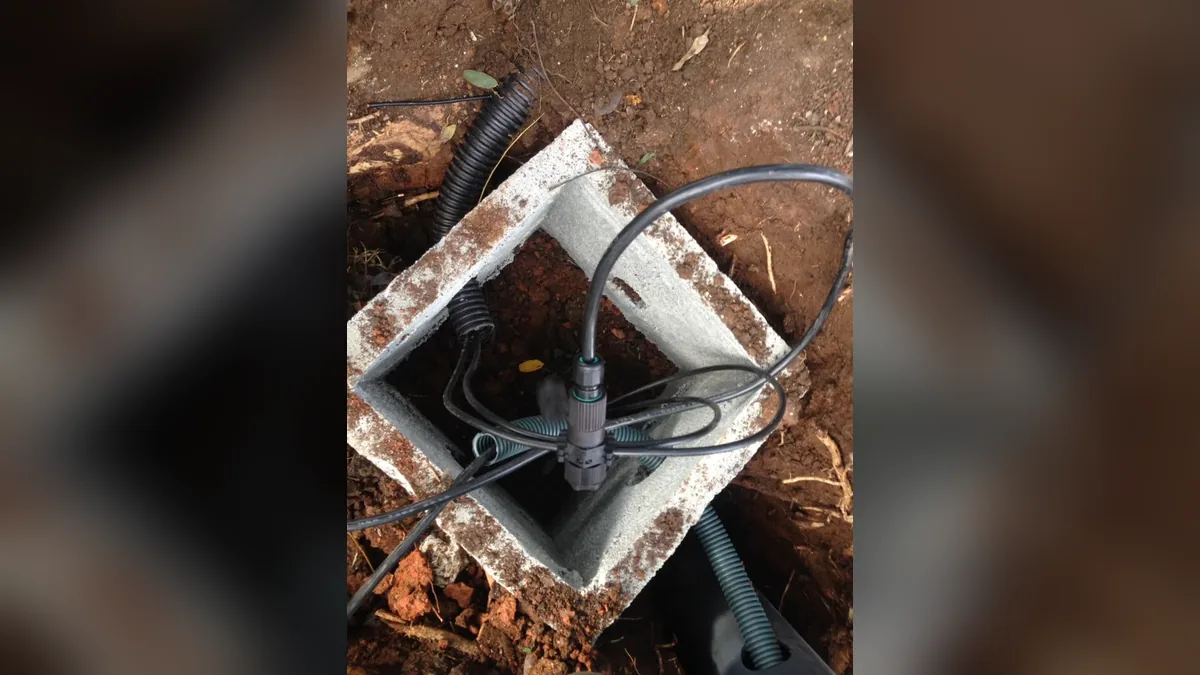
The first consequence is that “wet area” is not a specification. A buried junction box that fills up every time it rains exposes the connector to standing water for hours, under a small head of pressure. The deboning room of a meat plant at the end of a shift exposes it to a hot jet from a washer, applied at close range. These are physically different threats, and each has its own test. Techno do Brasil organises its range along exactly this logic, with three ratings side by side: IP66 for powerful water jets, IP68 for permanent submersion and IP69 for high-temperature, high-pressure water, at 80 °C and 80 to 100 bar. Each number corresponds to a concrete threat, and that is how a degree of protection should be read.
How to read the IP code
The IP code (from Ingress Protection) is defined by the IEC 60529 standard. It has two digits. The first describes protection against the ingress of solids and dust; the second, against the ingress of water. An “X” in place of a digit indicates that that aspect has not been classified: IPX7, for example, refers to water only.
| Digit | Meaning |
|---|---|
| 6 (first digit) | Dust-tight |
| 5 (second digit) | Water jets |
| 6 (second digit) | Powerful water jets |
| 7 (second digit) | Temporary immersion |
| 8 (second digit) | Continuous immersion, under conditions agreed between manufacturer and user |
| 9 (second digit) | High-temperature, high-pressure water jets |
A detail that often goes unnoticed: the water digits do not form a ladder in which the higher number includes all the lower ones. Jets and immersion are different tests. That is why it is common to find products with dual or triple marking, such as IP66/IP68, which have passed more than one test. The parameters of each (flow rate, nozzle, distance, depth and duration) are set out in the standard itself.
IP66, IP68 and IP69K side by side
| Rating | Threat the test represents | Typical industrial situation |
|---|---|---|
| IP66 | No dust ingress; powerful water jets do not penetrate in harmful quantities | Hose washdown, heavy rain, outdoor areas, mining |
| IP68 | No dust ingress; the assembly withstands continuous immersion under an agreed condition | Floodable junction boxes, underground installations, pumps and probes |
| IP69K | High-pressure, high-temperature jets, at close range and from several angles | Sanitation in food and meat processing, washing of agricultural machinery and vehicles |
Where the “K” in IP69K comes from
IP69K originated in the automotive world, for vehicles and equipment that undergo heavy washing. The “K” marking comes from ISO 20653, the standard for road vehicles. IEC 60529 later incorporated the equivalent level as second digit 9. In practice, manufacturers of industrial components use both notations, and the data sheet indicates which test was applied. The values shown by Techno (80 °C and 80 to 100 bar) describe the type of attack well: it is hot water at industrial washer pressure, applied at close range.
On the cover of the material, the IP69K, IP68 and IP66 labels appear together with a fourth label, “Resin-gel free”. It indicates that the seal does not depend on resin or gel poured in during assembly, which has a direct consequence for maintenance: the connector can be opened, inspected and closed again.
IP68: the agreed condition
IP68 has a feature that changes the way it is specified: the immersion depth and duration are agreed between manufacturer and user, provided they are more severe than those for IPX7. Two IP68 products may have been tested under very different conditions. In practice:
- for points that remain submerged for long periods, ask the manufacturer for the test depth and duration;
- compare conditions, not just codes;
- remember that a socket without its plug, or a plug without its cap, does not have the same protection as the mated assembly.
The Techno general catalogue lists, per series, combinations such as IP66/IP68, IP66/IP68/IP69 and IP66/IP67/IP68, which shows the same series assessed under more than one type of test. A field example that illustrates IP68 well is the lighting of a sports court in Mogi das Cruzes (SP), with an underground and submerged installation, described in condensation and water ingress in connections.
NEMA 6 and 6P: the North American reading
On the materials slide, Techno also cited the NEMA ratings, used in the United States and common on imported or exported machinery. Type 6 protects against water ingress during temporary submersion at a limited depth. Type 6P goes further: prolonged submersion (the “P” stands for prolonged) and resistance to corrosive environments, such as salt water. NEMA is not a direct translation of IP, because it includes requirements such as corrosion, but it helps when dealing with projects that arrive with a North American specification.
IK rating: when the risk is impact
The IP rating says nothing about impact. That is what the IK rating is for, defined by IEC 62262 (EN 62262 in Europe), which measures the impact energy the enclosure can withstand.
| IK rating | Impact energy | Practical reading |
|---|---|---|
| IK07 | 2 J | Light knocks during handling |
| IK08 | 5 J | General industrial use, a slipping tool |
| IK09 | 10 J | Areas with materials handling |
| IK10 | 20 J (5 kg mass) | The highest level on the scale |
In the presentation, Techno indicated IK08 as the reference and IK10 (20 J, 5 kg) as the maximum value, according to EN 62262; the catalogue records, depending on the series, values from IK07 to IK10. In forklift aisles, agricultural machinery yards or platforms where someone steps on the cable, IK deserves a place in the specification alongside IP. A perfect seal is of little use if the body cracks at the first knock.
The IP rating belongs to the assembled unit
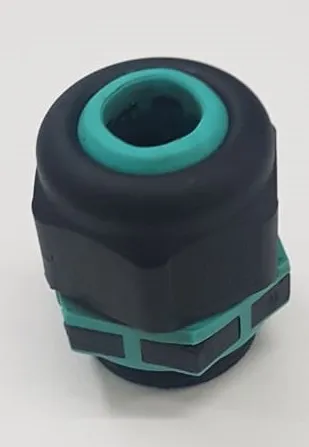
Every degree of protection is a test result obtained with the product correctly assembled, with the cable within the diameter range and the coupling fully mated. In the field, it is the installer who reproduces (or fails to reproduce) the test condition. That is why the co-moulded seal, in which the rubber is injected together with the plastic, carries technical weight. Techno pointed to three consequences: faster installation, because few components are used; fewer assembly errors, with joints that prevent leakage; and greater strength, thanks to the chemical-mechanical adhesion between plastic and rubber.
In the language of a design FMEA (DFMEA), every separate part and every field assembly step is a failure mode with its own occurrence: a forgotten ring, a reversed ring, a ring pinched in the thread. When the ring is no longer a loose part, these failure modes cease to exist. Occurrence falls by design, not by training: it is a poka-yoke built into the component. The other precautions remain with the team: cable within range, correct tightening and engagement up to the latch. Keeping the cable within range also matters over time: elastomers under compression and heat undergo permanent deformation under compression (compression set) and lose sealing force; an assembly that starts at the lower limit of compression is the first to leak. The step-by-step guide to getting the cable right is in the checklist for choosing industrial electrical connectors.
Materials and tests that make the IP rating last
The IP rating is measured on a new product, in a single test session. Ageing, UV radiation, ozone, salt spray, chemical attack and thermal cycling are outside its scope. In the field, however, it is these agents that decide when the seal stops working: the rubber dries out and cracks, the polymer loses toughness, the sealing surface is no longer smooth. That is why material tests complement the IP rating rather than repeat it. Techno summed up the principle on one slide: “choosing the right materials is fundamental to the life of connections”. What the company presented:
| Characteristic | Test or reference cited | What it means on the shop floor |
|---|---|---|
| Body in PA66 with 30% glass fibre | UL 94 V0/V2 | Reinforced nylon: holds its shape and withstands use; flammability behaviour classification |
| Fire behaviour | Glow-wire at 850 °C and 960 °C; UL 94 class 5VA | 5VA is the most demanding UL 94 class for enclosures. See the UL page on flame tests for plastics |
| UV radiation | EN 60079-0, 1,000 h; f1 materials (UL 746C) | f1 indicates a material suitable for outdoor use, with UV, water immersion and temperature variation |
| Ozone | Ageing in ozone-laden air, ISO 1431-1 | Ozone dries out and cracks rubber; relevant near motors and outdoors |
| Salt spray | EN 60068-2-11 | Corrosion resistance in port and coastal areas and areas with salt splash |
| Composition | Halogen-free (REACH and RoHS), sulphur-free and silicone-free | Less toxic smoke in a fire; sulphur-free, compatible with LEDs; silicone-free, since silicone is a known contaminant in paint lines |
Chemical resistance
The presentation also included a chemical resistance table. According to Techno, the materials resist acetylene, ammonia, benzene, calcium chloride, petrol, fertilisers, lubricating oils, crude oil, phosphates and seawater. Methyl alcohols and chlorine are listed as partial resistance. For those serving meat processing plants (ammonia), agribusiness (fertilisers) or water treatment (chlorine), this table is worth as much as the IP rating when making the choice.
Temperature: material range and T-marking
The catalogue gives a range of −40 °C to +125 °C for the materials and, separately, a temperature marking (T-marking) per series, with values such as +60 °C, +85 °C or +100 °C. These are different pieces of information: the range refers to the material; the T-marking, to the operating temperature for which the series has been qualified. As good engineering practice, it is the T-marking of the series that should be checked against the actual temperature at the point.
One of the cases in the presentation shows why this figure matters. At a pasta manufacturer, a machine runs at a continuous 85 °C and 90% humidity, and the THB.387.A4A connector was fitted on the motor. Techno showed photos from the day of installation and from an inspection carried out eight months later. It is the kind of environment that combines heat, humidity and cleaning cycles, in which the specification has to look at the IP rating, the material and the operating temperature at the same time. Continuous heat accelerates precisely the mechanisms that the IP test does not measure: ageing of the elastomer and oxidation of the contacts.
How to choose the degree of protection, point by point
- Describe the worst real condition at each point: rain, daily washdown, hot high-pressure washdown, occasional flooding or permanent immersion.
- Map by point, not by machine. The same line can have IP66 points, IP68 points and IP69K points.
- Ask for the test condition when the point is submerged or critical.
- Add the IK rating wherever there is traffic, foot traffic or materials handling.
- Check materials and temperature: chemistry of the environment, exposure to sunlight and the T-marking of the series.
- Monitor in the field. Planned inspections, including thermography, reveal abnormal heating at connections. It is the symptom of a degraded contact: humidity, micro-movement from vibration and thermal cycling (fretting corrosion, or fretting) and oxidation raise contact resistance, and the power dissipated at the point grows with it.
If moisture-related failures persist, a Pareto chart shows which points concentrate the occurrences, and a root cause analysis on the most critical ones indicates whether the problem is the chosen rating, the assembly or a mechanism that the IP rating does not measure, such as internal condensation. The effect of this on production is the subject of industrial electrical connections and productivity, and the full view of the technology is in the Techno do Brasil guide.
In my assessment, the degree of protection works like a contract with two signatures. The manufacturer signs for the test; the plant signs for the assembly, the cable and the environment. What sets the Techno approach apart is that it covers the gap between the two: the co-moulded seal reduces dependence on the installer, the ozone, UV and salt spray tests qualify the material for time and not just for the day of the test, and the xDRY® anti-condensation barrier addresses a failure mode, the breathing of the enclosure with thermal cycling, that no IP test reproduces. This is a differentiator because it shifts reliability from the field to the design, which is where it costs least.
Frequently asked questions
Is IP68 better than IP66?
Not necessarily. IP68 covers continuous immersion; IP66, powerful jets. They are different tests, and a product can have both. The choice depends on the real condition at the point.
What does the K in IP69K mean?
The K comes from ISO 20653, the standard for road vehicles, and indicates the test with a high-pressure, high-temperature water jet. IEC 60529 includes the equivalent level as second digit 9.
What is the difference between an IP rating and an IK rating?
IP covers the ingress of dust and water; IK, resistance to mechanical impact, from IK00 to IK10 (20 J). They are independent, and many industrial applications require both.
Does the IP rating apply to a disconnected connector?
In general, the rating applies to the mated assembly. The unmated half may need a cap to maintain protection; the product data sheet will tell you.
Is an IP68 connector resistant to any chemical?
No. The IP rating does not assess chemical resistance. That depends on the materials of the body and the seals. Techno presents its own table of resistance to substances such as ammonia, petrol, fertilisers and seawater.
In this series
- Techno do Brasil: electrical connection technology (series guide)
- Industrial electrical connections and productivity
- How to choose industrial electrical connectors
- IP66, IP68 and IP69K: what they mean
- Condensation and water ingress in connections
- Industrial connections and TPM: reliability
- Lean and waste in component selection
- Connection cases in harsh environments
- Total cost of industrial connections (TCO)
Sources
- IEC 60529: Degrees of protection provided by enclosures (IP Code): reference standard for the IP code.
- IEC 62262: Degrees of protection against external mechanical impacts (IK code): reference standard for the IK code.
- ISO 20653: Road vehicles, degrees of protection (IP code), origin of the IP69K marking.
- UL: flame tests for plastics (UL 94).
- Techno General Catalogue (CATGENIT102024), Portuguese edition: IP and IK ratings, materials, temperature range and T-marking per series.
- Presentation “Complicated and Hostile Applications” (Portuguese original: “Aplicações Complicadas e Hostis”), Techno do Brasil, delivered by Mário Adinolfi on 06/11/2026 (Techno do Brasil Installation Certification Course, Mundo SENAI, Marechal Cândido Rondon/PR): IP66/IP68/IP69 ratings, material tests, chemical resistance, co-moulded sealing and cases.
Save this address: Manufatura Enxuta is your lean manufacturing school. Come back whenever you need to study, with complete articles, a visual map and reliable sources. Follow one of the study paths or check the A–Z glossary.
Explore the technology at the source
This series explains the technology behind connections and its effect on waste. For the technical data of each item, consult the catalogue and the data sheets on the official Techno do Brasil website.
Visit the official website
About the author
Vagner Soares
Specialist in Lean Manufacturing and Behavioural Management
More than 20 years in the automotive and metalworking industries (GM and Dana), and a Lean Manufacturing specialist since 2006. SENAI instructor and mentor in the Brasil Mais Produtivo programme, with consulting, training and audits in more than 50 companies, bringing together quality, productivity and people development.


