
A circuit with twenty splices and connectors, each with 99% reliability over the year, has about an 18% probability of stopping at least once in that period. The calculation is simple and rarely done, and it explains why industrial electrical connections, the cheapest component in the circuit, are often among the causes that stop production most. The typical entry on the work order is “intermittent fault, back to normal”: the sensor loses its signal after washdown, someone moves the cable and everything comes back. The defect is not in the sensor or the PLC. It is in a few centimetres of splice, where water found a way in.
This article explains why the connection is the weak link, which physical mechanisms attack it, how this shows up in OEE and where to start treating the subject as a productivity decision. The company and the technology behind this series are covered in the guide Techno do Brasil: electrical connection technology.
Where the circuit is weakest: cable breaks
A well-specified industrial cable is robust. So are the motor, the sensor and the luminaire. The weakness appears where the cable is interrupted: at the splice, at the branch, at the panel entry, at the point where it connects to the equipment. Each break is a place where the seal can fail, the contact can oxidise and the assembly may have been done in a hurry.
From a reliability standpoint, these breaks behave as elements in series: one failure is enough to stop the circuit, and the reliability of the whole is the product of the individual reliabilities (Rsystem = R1 × R2 × … × Rn). That is where the 18% in the opening comes from: 0.9920 ≈ 0.82. There are only two levers: reduce the number of breaks and raise the reliability of each one.
The method Techno do Brasil presented at Mundo SENAI tackles both. Its third step, “eliminate all weak points”, calls for: the circuit layout, the distances in metres between components, the identification and count of all cable breaks, the type of each one (straight splice, T, Y, H or multiple branch), changes in conductor size and the distances between breaks. Underneath, the sentence: this “cannot be missing from the detailing of your electrical design”.
In my assessment, this is the decisive point. In the companies where I have worked, the electrical design usually details loads, protection devices and conductor sizes, but rarely the number of breaks on a critical line. Without that number, there is no way to calculate the circuit's reliability or to prioritise where to invest. It is a blind spot in the design, and it is exactly where maintenance will be working later.
What attacks an electrical connection on the shop floor
The first step of the same method is to analyse the external environment, and Techno lists seven stressors: humidity, water, chemical agents, pressure, heat, temperature swings and condensation. Each leaves a different signature, and learning to recognise it saves a great deal of diagnostic time.
| Stressor | What it does to the connection | Sign that maintenance finds |
|---|---|---|
| Water and humidity | Oxidises contacts, creates leakage current and intermittent faults | Darkened contacts, water marks, falling insulation resistance |
| Water pressure | Forces liquid in during jet washdown | Failures clustered right after sanitation |
| Chemical agents | Degrade the seal and the plastic body | Swollen or dried-out rubber, cracks, loss of elasticity |
| Heat | Accelerates material ageing | Hardened seal, deformation, localised heating |
| Temperature swings | Expand and contract different materials at different rates; make the connector “breathe” | Gaps in the seal, loose cable gland |
| Condensation | Forms water inside the enclosure, even with no external ingress | Droplets inside a connector that seemed well sealed |
| Impact and mechanical stress | Cracks the body and displaces the seal | Cracked connector, pulled cable, deformed entry |
Three mechanisms explain many of the failures that “go away on their own”. The first is thermal breathing: a sealed enclosure that cools from 60 °C to 20 °C loses about 12% of its internal pressure, roughly 0.12 bar, and that suction draws humid air through any micro-path. That is why condensation does not respect the degree of protection, which is a short test carried out at a stable temperature. The second is capillary action: in stranded cables, water can wick along the inside, between the strands, and reach the connector even when the sheath is intact at the entry. The third is the micro-motion of contacts under vibration and thermal cycling, which causes friction-induced corrosion (fretting), raises contact resistance and generates localised heating. All three are intermittent by nature, which is why they cost so much diagnostic effort. Condensation, and the anti-condensation barrier Techno developed for it, are covered in Condensation and water ingress in connections. To find out what each IP code actually promises, read IP66, IP68 and IP69K: what they mean.
How a cheap connection reaches OEE
The electrical connection has a characteristic that makes it dangerous for productivity: its cost is disproportionately small compared with the cost of the failure it can cause. It shows up in all three OEE losses:
- Availability: downtime from a short circuit, a trip or a motor without power.
- Performance: the minor stoppages of a sensor that loses its signal for a second and forces the machine to restart its cycle. They are rarely logged as “failures”, but they eat up minutes of every shift.
- Quality: unstable readings from a weighing scale or a probe, which produce off-spec product, scrap or rework.
To size the effect, the useful calculation does not compare one connector with another. It compares the cost of the decision with the cost of the event:
Cost of failure = (downtime hours × line cost per hour) + repair labour + materials + scrap and rework.
There is also the cost that does not appear in the calculation: intermittent faults consume hours of diagnosis, lead to replacing parts that were fine (the sensor, the PLC card) and erode operations' trust in maintenance. The full comparison between options, with a break-even point, is in Total cost of industrial connections (TCO).
Where the plant's critical connections are
The cases shown in the presentation help build a map of where to look. Each one represents a type of critical point that exists in many plants:
- Motors in hot, humid environments. In a pasta plant, Techno showed a connector installed on a machine motor operating at a continuous 85 °C and 90% humidity, with photos of the inspection carried out eight months later.
- Equipment under washdown. In meat-processing plants, 2- and 4-cell weighing scales and frequently washed equipment were fitted with watertight disconnectable connections.
- Field instrumentation. Transmitters in gas distribution and water purity probes in water and wastewater systems, often in underground chambers.
- Outdoor and buried lighting. Underground public lighting in Curitiba and pitch lighting with an inspection chamber that fills with water when it rains.
- Machine panels. Multipole rectangular connectors replaced by circular ones, for 3-, 8- and 12-core cables.
- Machine safety. Guard-locking switches, where a connection failure means a safeguard that does not respond.
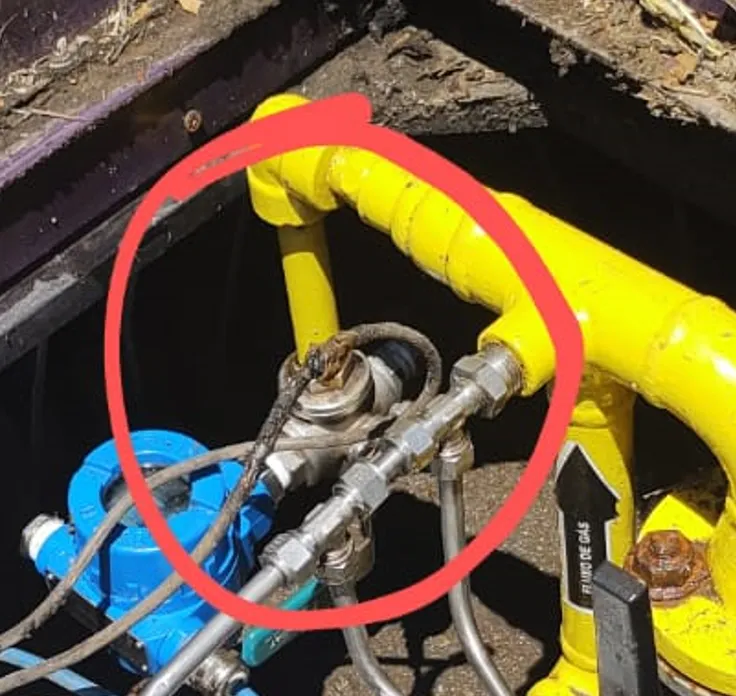
What these locations have in common: they are hard to access, they are exposed to water or heat and, when they fail, they stop something bigger than themselves. The full stories, with scenario, need and solution, are in Connection cases in harsh environments.
What connection technology already solves
The good news is that connector engineering has advanced precisely at the points where failure originates. In Techno's presentation and catalogue, four ideas stand out for their direct effect on production:
| Technology | How it works | Effect on operations |
|---|---|---|
| Co-moulded seal | Plastic and rubber injected together, bonded by chemical-mechanical adhesion | Fewer parts to assemble and, according to Techno, fewer installation errors |
| Pre-wired versions | Cable and connector injection-moulded as a single part, tested at the factory | The splice leaves the field and is made in a controlled environment |
| Watertight plug and socket | Disconnectable connection with a degree of protection up to IP69K | Replace a motor or sensor without redoing the connection, which reduces repair time |
| xDRY® anti-condensation barrier | Barrier between the connector and the equipment that stops moisture from reaching the device | Tackles the cause of intermittent faults due to internal moisture |
Add to this the materials: a body in polyamide 66 with 30% glass fibre, a range of −40 °C to +125 °C, and ozone, salt mist, UV and impact tests, all described in the guide to Techno do Brasil's technology. Read together with the series reliability calculation, the table shows why the approach is a differentiator: each item acts on one of the two levers. Pre-wired and disconnectable connections reduce breaks made in the field; co-moulding eliminates an assembly interface, which in a failure mode analysis (DFMEA) means one less occurrence; xDRY and the material tests raise the reliability of each point against mechanisms that the IP test does not reproduce. For the Lean side of these choices, see Lean and waste in component selection.
Where to start in your plant
There is no need to replace every connection in the plant. The path I recommend is the same as for any well-executed improvement: data, focus and standard.
- Pull the history. Sort last year's work orders by cause and component. A Pareto chart quickly shows whether splices, connectors and cable entries are among the recurring causes. Be suspicious of entries marked “back to normal, nothing replaced”.
- Choose the most critical line and count the cable breaks, as the method requires: type, location, environment and change in conductor size.
- Investigate the cause of recurring failures with a root cause analysis or with the 5 Whys. Often the answer is “the connection was not specified for this environment”.
- Run a pilot on one piece of equipment and track MTBF and MTTR before and after.
- Standardise what worked in the purchasing specification and in the inspection plan, following the logic of TPM. The article Industrial connections and TPM shows how.
For the specification stage, the checklist for choosing industrial electrical connectors organises everything that needs to be decided.
A plant's productivity is made of big decisions, such as buying a machine, and small decisions, such as choosing where and how a cable will be spliced. The big ones show up in the budget. The small ones show up, or not, on the night shift.
Frequently asked questions
Why are electrical connections a critical point in industry?
Because they concentrate the cable break points, where the seal, the contact and the assembly can fail. A robust cable and robust equipment still depend on a splice or connector that is properly specified for the environment.
Are electrical connections a design issue or a maintenance issue?
Both. Design defines the specification and the number of breaks; maintenance finds out in practice where the choice did not hold up. Ideally, the failure history feeds back into the specification.
Does an IP68 connector solve every water problem?
No. The IP rating describes the protection of the assembled unit under defined test conditions. Compatible cable diameter, correct assembly and internal condensation remain points of attention.
How can I tell whether my plant's failures come from connections?
Sort the work orders by cause and component and build a Pareto chart. Intermittent faults that return after washdown or rain and are cleared by “moving the cable” are strong candidates.
How much does it cost to switch to more robust connections?
It depends on the point and the environment. What matters is comparing total cost, including downtime and rework, not just purchase price. The article on the total cost of connections sets out the method with an example.
In this series
- Techno do Brasil: electrical connection technology (series guide)
- Industrial electrical connections and productivity
- How to choose industrial electrical connectors
- IP66, IP68 and IP69K: what they mean
- Condensation and water ingress in connections
- Industrial connections and TPM: reliability
- Lean and waste in component selection
- Connection cases in harsh environments
- Total cost of industrial connections (TCO)
Sources
- Techno. Aplicações Complicadas e Hostis (“Complicated and Hostile Applications”, technical presentation in Portuguese), given by Mário Adinolfi on 6 November 2026 at Mundo SENAI, Marechal Cândido Rondon (PR).
- Techno. General Catalogue (CATGENIT102024), Portuguese edition.
- Techno do Brasil: official website.
- IEC 60529: Degrees of protection provided by enclosures (IP Code).
- Lean Enterprise Institute: what is Lean.
Save this address: Manufatura Enxuta is your lean manufacturing school. Come back whenever you need to study, with complete articles, a visual map and reliable sources. Follow one of the study paths or check the A–Z glossary.
Explore the technology at the source
This series explains the technology behind connections and its effect on waste. For the technical data of each item, consult the catalogue and the data sheets on the official Techno do Brasil website.
Visit the official website
About the author
Vagner Soares
Specialist in Lean Manufacturing and Behavioural Management
More than 20 years in the automotive and metalworking industries (GM and Dana), and a Lean Manufacturing specialist since 2006. SENAI instructor and mentor in the Brasil Mais Produtivo programme, with consulting, training and audits in more than 50 companies, bringing together quality, productivity and people development.


