
- Sealed outside, wet inside
- Capillary action: water that travels inside the cable
- Four years in a box that fills with water
- The fault that disappears when the technician arrives
- xDRY®: the barrier between connector and equipment
- Where moisture weighs most: cases from the presentation
- When to consider anti-condensation protection
- A roadmap for investigating a moisture-related failure
- Frequently asked questions
Sealed outside, wet inside: the breathing effect
A connector that has passed the immersion test can accumulate water inside without any seal having failed in the classic sense. The cause is thermodynamic, not an assembly issue: every sealed enclosure that heats up and cools down works like a small vacuum pump.
The calculation is that of an ideal gas at constant volume, where the change in pressure follows the change in absolute temperature: ΔP/P ≈ ΔT/T. A motor or luminaire running with its internal air at 60 °C (333 K) that cools to 20 °C (293 K) after being switched off sees its internal pressure fall by about 12%. Starting from atmospheric pressure, that is roughly 0.12 bar of negative pressure, equivalent to a column of about 1.2 m of water. For comparison, the IPX7 temporary immersion test is carried out at 1 m. The difference is that the test lasts minutes, once, whereas the breathing repeats with every on-off cycle, every day, for years.
This negative pressure draws in whatever is on the other side of any micro-path: a seal slackened by ageing, a cable outside its range, the interstices of the cable itself. If there is humid air outside, water vapour gets in. If there is water, as in a flooded junction box, liquid water gets in.
Inside the enclosure, the dew point completes the mechanism. Air at 30 °C and 80% relative humidity carries about 24 g of water vapour per cubic metre; at 15 °C, saturated air can hold only about 13 g/m³. The difference condenses on the coldest surfaces, like on an ice-cold glass on a hot day. Each cycle deposits only a little, but the water has no way out and accumulates.
That is why the IP rating does not settle the question. It is a type test, short and under controlled conditions, that measures water ingress from outside to inside with the assembly new. The difference between the ratings is detailed in IP66, IP68 and IP69K: what they mean.
Capillary action: water that travels inside the cable
The second path is less intuitive and explains many “impossible” failures. In a stranded conductor, the spaces between the strands form fine channels that behave like capillary tubes. Water that reaches the end of a cable, at a submerged splice or a poorly sealed termination, can migrate lengthwise along these channels (wicking), and also through the voids between the conductors inside the sheath. It reaches the connector, or the equipment, through the inside of the cable, with the sheath intact and the cable gland properly tightened at the entry.
The two mechanisms add up. Capillary action opens the path; the breathing of the equipment, which cools and creates negative pressure, pumps the water along it. One end of the cable in a flooded box and the other in a motor that switches on and off is the classic combination. The engineering consequence is clear: a seal that only compresses the outer sheath does not block this flow. The block has to be in the path between the cable and the device.
Four years in a box that fills with water
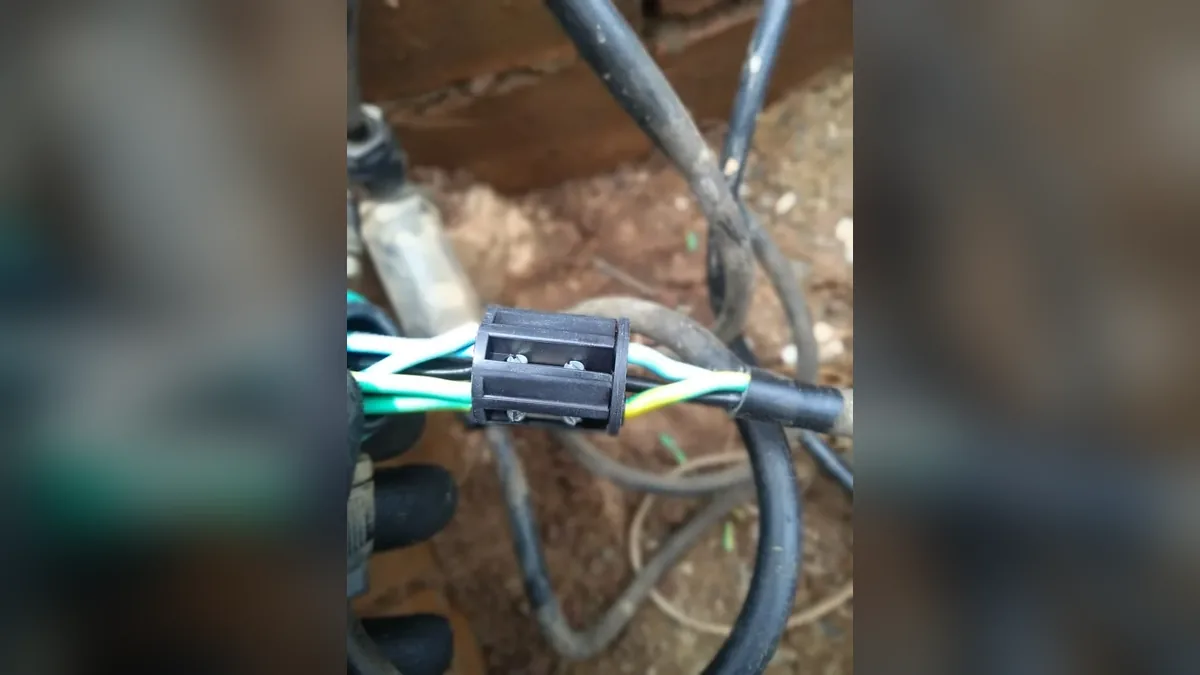
Among the cases Techno do Brasil showed at Mundo SENAI (the event is described in the series guide), the lighting of a football pitch in Mogi das Cruzes (SP) is the one that tests exactly these two mechanisms. The cables run through underground inspection chambers, in an underground and submerged installation, with the THB.402 connector. The slides place two photos side by side: the day of installation and an inspection carried out four years later.
The text accompanying the photos is the installer's own, published on social media. He says that, four years after installing the connector, he decided to open it to see how well it had performed and found no trace of water. And he adds the detail that gives the account technical weight: that junction box fills with water on rainy days.
The photo at the top of this article is from that inspection. What usually turns up when you open a buried splice after a few years is well known: verdigris, blackened wire, insulating tape peeling off. Four years of intermittent immersion add up to hundreds of cycles of wetting, drying and temperature change; that is what gives value to the reported result.
The fault that disappears when the technician arrives
Internal moisture rarely causes a clean breakdown. It produces the worst kind of failure for maintenance: the intermittent one.
| Effect of internal moisture | How it shows up in operation |
|---|---|
| Corrosion and oxidation of contacts | Higher contact resistance, heating, voltage drop |
| Leakage current and tracking | Protective device tripping, unstable sensor readings |
| Intermittent failure | The machine stops and restarts; the technician arrives and cannot reproduce the fault |
| Damage to connected electronics | Contaminated boards, transmitters and modules |
The biggest cost lies in diagnostic time, repeat call-outs and good parts replaced “just in case”. With hypothetical numbers, just to show the calculation: a line with a downtime cost of R$ 8,000 (Brazilian reais) per hour that stops six times a month, for 25 minutes each time, loses 2.5 hours, or R$ 20,000 a month, because of a component that costs a fraction of that. To run this calculation with your plant's data, see how to calculate the machine-hour cost and the total cost of industrial connections. In the metrics, this type of failure drives MTBF down and inflates MTTR at the same time, as explained in MTBF and MTTR.
xDRY®: the barrier between connector and equipment
Techno's answer to this problem is called xDRY®. In the presentation, the company showed a two-panel comparison: with the standard connector, water reaches the inside of the device; with the xDRY® connector, condensation is stopped before that. The central idea is an anti-condensation barrier positioned between the connector and the equipment, to prevent moisture from reaching the device.
According to the general catalogue and the presentation, the technology:
- is a patented anti-condensation barrier, against water ingress and condensation;
- protects the system in critical operating conditions, keeps out dirt and water and reduces failure costs, in Techno's own words;
- maintains electrical continuity with no voltage drop, according to the catalogue;
- provides, according to Techno, a 90% reduction in water ingress, and xDRY® connectors are 100% tested, as indicated by the “Testati 100%” label on the slides;
- is available in series such as TH387 (plug and socket), TH391 and TH393 (circular) and TH392 (4-way branch), in IP66/IP68 lines and, in some cases, IP69.
In my assessment, the decisive point here is one of method, not of product. The anti-condensation barrier addresses the failure mode that lies outside the test: water that enters through the breathing of the equipment and through the inside of the cable. The position of the barrier, between the connector and the equipment, is consistent with the physics: it is in this section that capillary action and suction meet. This is a differentiator because it closes a real gap between what the standard certifies and what the field demands.
How to recognise an xDRY® product by its code
The catalogue identification guide indicates the patterns THB.xxx.Rxx, THB.Dxxx.xxx and THB.xxx.xxx.XD. An example appears in one of the cases: the THB.391.R4A.L, used in outdoor industrial lighting with xDRY®. Teaching the storeroom to read this avoids replacing a connector that has the barrier with an equivalent that does not. For a full reading of the codes, see the checklist for choosing industrial electrical connectors.
Where moisture weighs most: cases from the presentation
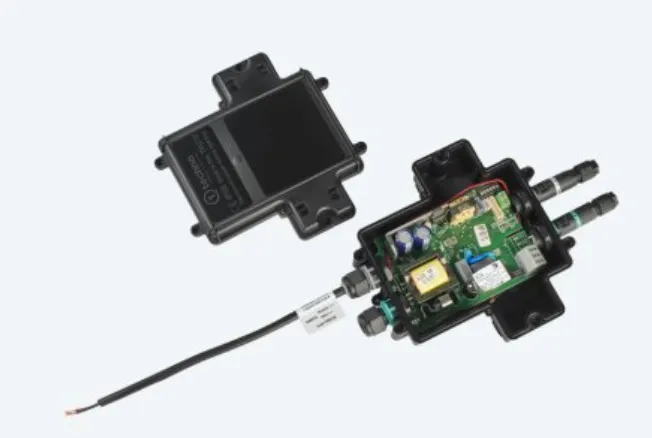
Four applications from the presentation show the pattern:
- Telemetry in water and sanitation. In a pipeline telemetry system, the 210 box ensures IP68 for the electronic board and links the 381 and 387 series connectors to sensors and devices. In water supply and sewerage, a lost reading means a decision made blind.
- Water purity probe. The THB.387.N4A connector with xDRY® is shown fitted to a purity control probe. In a measuring instrument, moisture turns into a wrong reading before it turns into a breakdown.
- Outdoor industrial lighting. At an agricultural machinery manufacturer, the outdoor lighting uses the THB.391.R4A.L with xDRY®. A luminaire is the classic case of a connection that breathes: it heats up at night, cools down during the day and gets rained on.
- Pasta machine. At a food plant, a motor runs at a continuous 85 °C and 90% humidity, with the THB.387.A4A. Techno showed photos of the inspection eight months after installation. Heat combined with humidity and washdown cycles is the condition in which the breathing of the enclosure works hardest.
The remaining cases, with scenario, solution and result, are in cases of electrical connections in harsh environments.
When to consider anti-condensation protection
Not every connection needs an anti-condensation barrier. It makes sense when two factors come together: thermal cycling and humidity. Typical signs:
- outdoor installations with a large temperature difference between day and night;
- equipment that heats up and cools down in cycles, such as motors and lighting;
- areas that are washed and then put back into hot operation;
- junction boxes that flood and then dry out;
- sensors, probes and transmitters, where a little moisture is already enough to alter the reading.
For lines with xDRY®, the catalogue mentions applications such as port areas, biological tanks and underfloor heating. When in doubt, the failure history decides: if occurrences are concentrated at specific times of day or seasons, condensation is a strong suspect.
A roadmap for investigating a moisture-related failure
- Record the pattern. Time, weather, operating cycle, washdown. A failure in the early hours, right after washdown or at the first start-up of the day points to condensation.
- Open and photograph before cleaning. Water marks, oxidation, position of the seal. The photo is the main piece of evidence for the root cause failure analysis.
- Check the installation. Cable within the diameter range, connector engaged up to the latch, correct tightening. Water that got in through faulty assembly is ingress, not condensation, and the action is different.
- Follow the cable. If there is water in the connector and the seal is intact, check the other end of the cable and the splices along the route. Water in the interstices between the strands when you cut the cable a few centimetres back is a sign of migration by capillary action.
- Ask why. Use the 5 Whys until you reach the system cause: specification, inspection plan or assembly standard.
- Choose the action. Correct the installation, switch to a version with an anti-condensation barrier, or both.
- Measure before and after. Number of occurrences and hours of downtime over the same comparable period.
This roadmap fits well into the routine of TPM applied to industrial connections: what is learned from a failure becomes an item in the inspection plan and the assembly standard.
What the installer in Mogi das Cruzes did, opening a connector that was working just to look inside and photograph it, is an inspection that almost no plant carries out in a planned way. In the pasta machine case, Techno also showed an inspection at eight months. From a reliability standpoint, this “opening photo” of a few critical connections is the data point that closes the loop: the type test tells you how the connector behaves in the laboratory; periodic inspection tells you how it behaves in your environment, with your thermal breathing and your cables.
Frequently asked questions
Can an IP68 connector have water inside?
Yes. Water can form through condensation, with heating and cooling cycles, or get in through an assembly fault, such as a cable outside the diameter range. The IP rating assesses water ingress from outside to inside under test conditions.
What is the difference between water ingress and condensation?
Ingress is water that comes in from outside, through a failed seal or faulty assembly. Condensation is water that forms inside the enclosure when the humid internal air cools below the dew point. The causes and the corrective actions are different.
What is xDRY® technology?
It is an anti-condensation barrier that Techno applies to some connectors, between the connector and the equipment, and which the company's catalogue describes as patented. According to the company, it reduces water ingress by 90%, and the connectors are 100% tested.
Can water reach the connector through the inside of the cable?
Yes. In stranded conductors, water migrates by capillary action through the spaces between the strands and between the conductors, even with the sheath intact. The negative pressure created when the equipment cools helps to draw it in.
Does every installation need anti-condensation protection?
No. It is justified where thermal cycling is combined with humidity, or where there is sensitive electronics such as probes and transmitters. The plant's failure history is the most reliable criterion.
In this series
- Techno do Brasil: electrical connection technology (series guide)
- Industrial electrical connections and productivity
- How to choose industrial electrical connectors
- IP66, IP68 and IP69K: what they mean
- Condensation and water ingress in connections
- Industrial connections and TPM: reliability
- Lean and waste in component selection
- Connection cases in harsh environments
- Total cost of industrial connections (TCO)
Sources
- Techno General Catalogue (CATGENIT102024), Portuguese edition: xDRY® technology, available series and code identification guide.
- Presentation “Complicated and Hostile Applications” (Portuguese original: “Aplicações Complicadas e Hostis”), Techno do Brasil, delivered by Mário Adinolfi on 06/11/2026 (Techno do Brasil Installation Certification Course, Mundo SENAI, Marechal Cândido Rondon/PR): standard connector × xDRY® comparison and application cases.
- Installer's account of the inspection after four years (Instagram).
- IEC 60529: Degrees of protection provided by enclosures (IP Code): reference standard for the IP code.
Save this address: Manufatura Enxuta is your lean manufacturing school. Come back whenever you need to study, with complete articles, a visual map and reliable sources. Follow one of the study paths or check the A–Z glossary.
Explore the technology at the source
This series explains the technology behind connections and its effect on waste. For the technical data of each item, consult the catalogue and the data sheets on the official Techno do Brasil website.
Visit the official website
About the author
Vagner Soares
Specialist in Lean Manufacturing and Behavioural Management
More than 20 years in the automotive and metalworking industries (GM and Dana), and a Lean Manufacturing specialist since 2006. SENAI instructor and mentor in the Brasil Mais Produtivo programme, with consulting, training and audits in more than 50 companies, bringing together quality, productivity and people development.


