
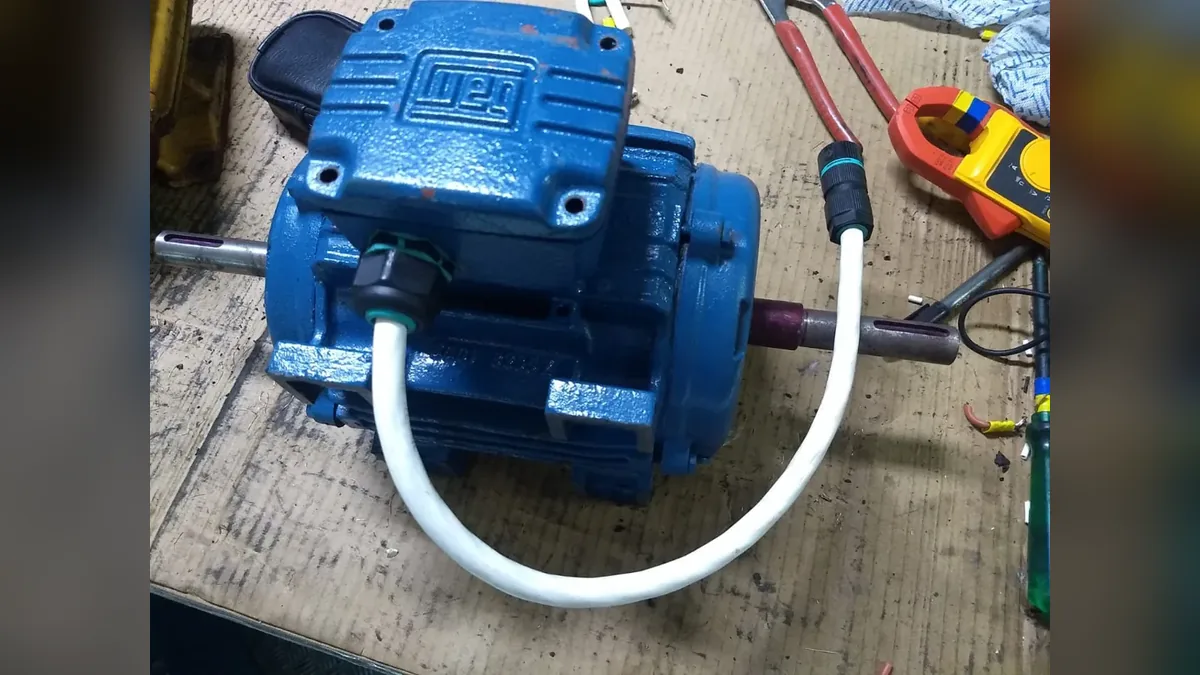
- Who Techno do Brasil is
- Mário Adinolfi's presentation at Mundo SENAI
- The technologies inside a watertight connector
- The three-step method: environment, cable and weak points
- The cases at a glance
- What lies ahead: IoT and the Zhaga standard
- Why the approach sets the company apart: an engineering assessment
- Series map: the 8 articles
- Frequently asked questions
Electrical connections rarely make it onto a design review agenda. They show up later, through the work order: the yard light that has gone out, the sensor that “sometimes” loses its signal, the motor that trips after washdown. The presentation Techno do Brasil brought to Mundo SENAI in Marechal Cândido Rondon (Paraná state, PR) on 6 November 2026, given by its owner, Mário Adinolfi, took the opposite route. It treated the connection as an engineered component, with environment, cable, material, sealing and installation method defined before purchase. The title of the first screen, “Complicated and Hostile Applications”, and the sentence right after it, “highly specialised against dust and water”, mark out the scope clearly.
In my assessment, it is this approach, more than any single catalogue item, that sets the company apart. This page is the series guide: it introduces Techno do Brasil, the technologies it applies, the method it proposes and the cases, and it explains, with reliability arguments, why this way of handling the electrical connection makes a difference on the shop floor.
Who Techno do Brasil is
Techno is an Italian manufacturer of electrical connectors. The slide footers carry the parent company's brand, Techno Srl, and the “Made in Italy” mark. Techno do Brasil is the Brazilian operation, headquartered in Curitiba (PR), with its own website; the Italian website is linked in the header of the Brazilian site. According to the general catalogue (edition CATGENIT102024), the company has more than 30 years of experience in plastic injection moulding.
The focus is narrow and well defined: electrical connections that must survive water, humidity, chemicals, pressure, heat and temperature swings. The catalogue organises products by function (splicing, disconnecting, entering a panel, distributing, sealing the cable entry), not by industry. For whoever writes the specification, this helps: the question stops being “what do people use in a meat-processing plant?” and becomes “what kind of cable break do I have here?”.
Mário Adinolfi's presentation at Mundo SENAI
Mundo SENAI 2026 at the Marechal Cândido Rondon campus welcomed around 350 students on 5 and 6 November. The programme for the 6th, from 8 a.m. to 12 noon, included the Techno do Brasil Installation Qualification Course (Curso de Homologação de Instalações Techno do Brasil), taught by Mário Adinolfi to 30 SEED students: the third year (T3) of the Mechatronics Technician programme and the first year (T1) of the Electrical Technician programme. Techno's participation in the event was organised by the team at Eletro Painel, a distributor of low- and medium-voltage electrical materials that also builds custom panels and has branches in Maringá, Cuiabá, Curitiba and Cascavel.
The supporting material was the presentation “Complicated and Hostile Applications”, with 72 slides. The sequence is well thought out: it starts with degrees of protection, moves on to materials and their tests, shows the co-moulded seal and the xDRY anti-condensation barrier, presents the custom solutions, teaches a three-step installation method and closes with more than forty slides of real applications, almost all with field photos. The last slide is a “Thank you very much”, signed by Mario Adinolfi.
The audience is not a minor detail. Many connection failures originate at installation: a cable outside the cable gland's diameter range, a poorly seated seal, a splice made in a hurry. Bringing specification criteria into technical training attacks the cause where it starts, with the people who will assemble and maintain these connections.
The technologies inside a watertight connector
A connector for a harsh environment is a small system: body, contacts, seal, cable entry and, in some cases, a barrier against the moisture that forms inside it. The presentation goes through each layer.
IP66, IP68 and IP69K degrees of protection and IK impact resistance
The IP code (IEC 60529) states what the enclosure has been tested against. Techno presents three levels: IP66, against powerful water jets; IP68, for permanent submersion; and IP69, against high-pressure, high-temperature water, at 80 to 100 bar and 80 °C, the typical condition of industrial washdown. The cover of the presentation shows the IP69K, IP68 and IP66 marks and a fourth one, “Resin-gel free”: sealing is achieved without resin or gel. For impact, the material cites IK08 and, at most, IK10, which corresponds to 20 joules (a 5 kg mass), according to EN 62262. How to read each code without falling into traps is the topic of IP66, IP68 and IP69K: what they mean.
Materials: glass-fibre-reinforced nylon and a battery of tests
“Choosing the right materials is fundamental to the life of connections”, says one of the slides. The body is made of PA66 GF, polyamide 66 with 30% glass fibre, rated UL94 V2/V0. The fibre provides dimensional stability and wear resistance, and the stated operating range is −40 °C to +125 °C. The rubbers were chosen for their resistance to UV and ageing. The presentation lists the tests that support these choices:
| Stressor | Test or rating cited | What it means in practice |
|---|---|---|
| Ozone and weathering | Ageing in ozone-laden air (ISO 1431-1) | Rubber that does not dry out or crack over time |
| Saline environment | Salt mist, EN 60068-2-11:2000 | Use in coastal areas and with corrosive splash |
| Sun | UV per EN 60079-0, 1,000 hours; f1 material (UL 746C) | f1 indicates a plastic approved for outdoor use: UV, water immersion and thermal cycling |
| Fire | Glow-wire 850 °C / 960 °C; class 5VA (UL 94) | 5VA is the most demanding UL 94 class for plastic enclosures |
| Impact | IK08, up to IK10 (EN 62262) | A body that withstands knocks from tools and handling |
| Prolonged water | NEMA Type 6 and 6P | Temporary submersion (6) and prolonged submersion, with a corrosive environment (6P) |
There are also three “free of” claims that say a lot about the intended use: halogen-free (in line with REACH and RoHS), sulphur-free, for LED compatibility, and silicone-free. One slide also includes a chemical resistance table with substances such as ammonia, calcium chloride, petrol, fertilisers, lubricating oils, crude oil, phosphates and seawater, marked as resistant, and methyl alcohol and chlorine, marked as partially resistant. For anyone working in agribusiness, water and wastewater or meat processing, that table is worth more than any adjective.
Co-moulded seal
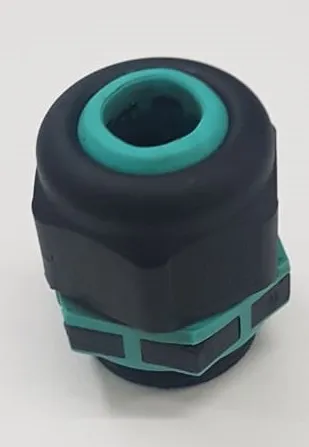
In a co-moulded seal, plastic and rubber are injected together and are bonded by chemical-mechanical adhesion. According to Techno, this brings fast installation with few components, fewer assembly errors thanks to the anti-leak joints, and greater reliability. In a design failure mode and effects analysis (DFMEA), the gain is clear: every loose O-ring is one more interface and one more assembly step, each with its own probability of occurrence (ring forgotten, reversed, pinched or overtightened). Integrating the seal into the body eliminates that interface. It is poka-yoke at the source: instead of training people not to make mistakes, the design removes the opportunity for the mistake. The cable gland in the TEEGLAND® line is an example of this construction.
xDRY: the barrier against water that forms inside
Not all water gets in through the seal. A sealed enclosure that heats up and cools down “breathes”: by the gas laws, internal pressure varies in proportion to absolute temperature. Cooling from 60 °C to 20 °C lowers internal pressure by about 12%, roughly 0.12 bar, the equivalent of a 1.2 m water column. That suction draws humid air, or water, through any micro-path, and the moisture condenses inside on every cycle. The IP test, which is short and carried out with the assembly at a stable temperature, does not reproduce this mechanism. The presentation shows the comparison in two images: in the standard connector, “water inside the device”; in the connector with xDRY®, the anti-condensation barrier between the connector and the equipment interrupts the moisture path. Techno lists three benefits: protecting the system under critical operating conditions, blocking dirt and water, and reducing failure costs. The slides carry the marks “Stop condensa” and “Testati 100%”, which the company uses to indicate that parts are tested one by one, and the catalogue describes the technology as patented and presents a 90% reduction in water ingress. The physics behind the problem, and why it produces the intermittent faults that are hardest to diagnose, is covered in Condensation and water ingress in connections.
Splices, disconnectable connectors and panel connections
The TEE family, presented as “high-performance electrical connectors (IP66/IP68/IP69K)”, is divided into three uses:
- Splices (TEETUBE® line): in-line connections and T, Y and H branches for permanent installations, with a connection that can be re-inspected.
- Disconnectable (TEEPLUG® line): plug and socket for motors, sensors, weighing scales and modules that need to be removed for maintenance.
- For panels: the connection enters the equipment without having to open it.
The catalogue also describes pre-wired versions, in which cable and connector leave the factory as a single injection-moulded part, with cables from 0.5 to 5 m and electrical and mechanical tests performed at source. The splice is no longer made in the field, in the rain or in a hurry, but in a controlled environment.
Custom solutions and complete systems
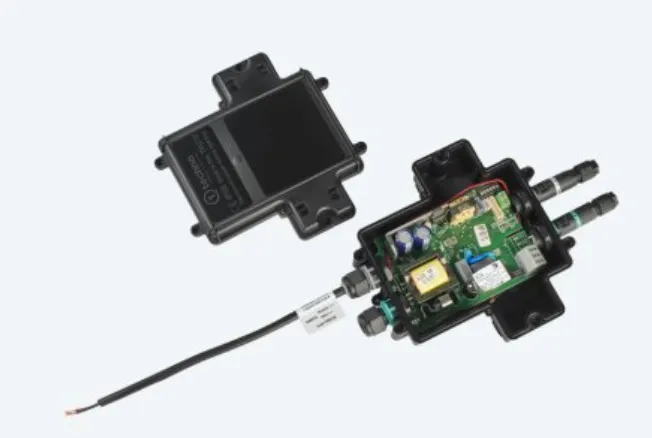
One slide sums up the change of stance: “Not just connection… custom solutions”. Combining TEEPLUG® with TEEBOX® creates low-voltage AC and DC systems, with boxes and distributors that protect embedded electronics. The presentation shows a Micro Box, an “open platform” of boxes and branches, premium end-to-end IP66 to IP69 solutions and an example of DC lighting assembled with T distributors, a 5-way box and 5 and 10 m extensions. The catalogue also mentions custom development, 3D printing and an innovation lab. The working logic appears on a simple slide: project, problem, thinking, solution, customer.
The three-step method: environment, cable and weak points
From an engineering standpoint, this is the most solid part of the material. Techno presents itself as a design partner (“Professional Connectivity”: cable selection, layout, application and validation) and proposes a method for correct, long-lasting installation:
- Analyse the external environment: humidity, water, chemicals, pressure, heat, temperature swings and condensation.
- Choose and match the cables: outer diameter, number of poles, cross-section of each pole and the cable's technical specification, because the seal only works if the cable matches the connector.
- Eliminate all weak points: draw the circuit layout, measure the distances between components, identify and count every cable break, classify its type (straight splice, T, Y, H or multiple branch), highlight changes in conductor size and the distances between breaks. The slide is blunt: this “cannot be missing from the detailing of your electrical design”.
The third step has a mathematical basis. In a circuit, cable breaks behave as elements in series: one failure is enough to stop the circuit, and the reliability of the whole is the product of the individual reliabilities. Twenty connections with 99% annual reliability each give 0.9920 ≈ 0.82, that is, about an 18% probability of at least one failure in the year. There are only two levers: reduce the number of breaks and raise the reliability of each one. Counting and classifying the breaks on the layout is what makes both visible.
The presentation also covers cables and conduits. EPR (ethylene propylene rubber) cable offers good flexibility and excellent performance in water and damp locations, and is recommended for underground networks, wet areas and panels with tight bends. Polyether-based PU (TPU) is immune to hydrolysis and resists fresh and salt water, sewage, fungi and microbial attack, as well as mineral oils, greases, solvents and weak acids and bases. For conduits, the material suggests yellow corrugated PVC in walls, orange PVC in slabs and floors, and black HDPE with UV protection in outdoor areas. The slides also point to a video on cables. The complete step-by-step procedure, turned into a checklist, is in How to choose industrial electrical connectors.
The cases at a glance
More than half of the presentation consists of real applications, most of them with the “Customer Approved” mark. Together, they draw a map of where connections suffer:
| Industry or application | Need | Solution presented |
|---|---|---|
| Football pitch lighting | Underground, submerged installation, with an inspection chamber that fills with water when it rains | THB.402 connector, with inspection 4 years later |
| Pasta industry | Motor on a machine at a continuous 85 °C and 90% humidity | THB.387.A4A, with inspection after 8 months |
| Meat processing | 2- and 4-cell weighing scales and equipment under washdown | THB.389 with THH.629 on the scales; THB.405.S5A on the equipment |
| Water and wastewater | Telemetry for water and sewage pipelines, purity probes and pH sensors | Box 210 ensuring IP68 for the electronic board, connectors 381 and 387, probe with THB.387.N4A xDRY |
| Pulp and paper | Alignment sensors, flat table, lighting and safety tower | THB.391.A4A on the flat table, with photos from 2017 and 2018; THW.400.5 on the lighting |
| Gas distribution and instrumentation | Field transmitters | THB.381, including with a cable gland |
| Rice industry and machinery | Motors in an environment with grain and dust | THB.387 family |
| Public and industrial lighting | Underground network in Curitiba; outdoor lighting for an agricultural machinery manufacturer | THB.370 in Curitiba; THB.391.R4A.L with xDRY |
| Machine safety | Guard-locking switches | THB.405.A8A with THB.405.B8A |
| Machine panels | Replacing multipole rectangular connectors | Circular connectors for 3-, 8- and 12-core cables |
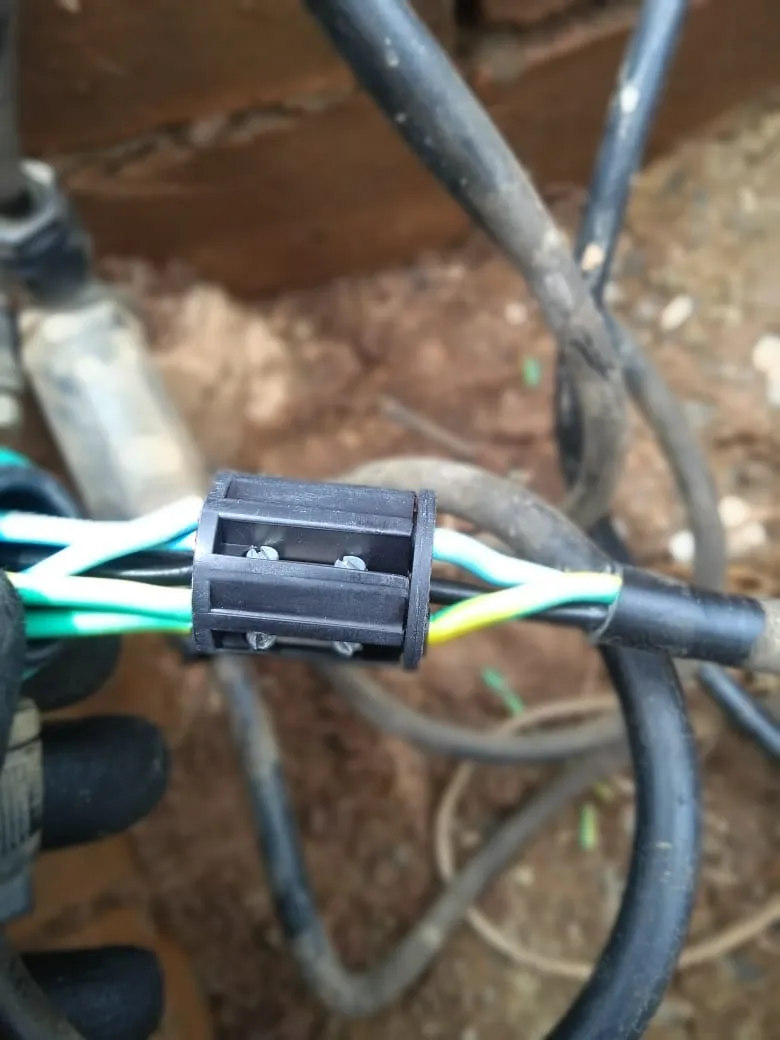
The pitch case has the greatest technical value. The presentation shows the photo from installation day and the photo from the inspection, four years later. In the installer's report, the inspection chamber fills with water on rainy days and, when the connector was opened after those four years, there was no trace of water inside. What gives the report weight is the condition: repeated submersion, day-night thermal cycling and real ageing, exactly what a type test does not cover. And the inspection was done by choice, not because of a fault, which is rare for a buried connection. Each of these cases is described in detail, with scenario, need and solution, in Connection cases in harsh environments.
What lies ahead: IoT and the Zhaga standard
The last slides look ahead. The IoT Family (TEEIOT) is presented as a “connectivity ecosystem”, with items such as TH400 IOTH, TH209 IOTH, TH625 IOTH, TH210 IOTHKit and IOTHBox, organised into three levels of functionality and three levels of complexity. The other front is the evolution of the TEE family with a focus on the Zhaga standard, which defines common interfaces for luminaires and lighting modules, including receptacles for sensors and control. The new items mentioned (Sensor Kit, DC Distributor Kit, TEEGLAND IOTH, TEETUBE IOTH) work at IP66 to IP68, up to 400 VAC and 60 VDC, for lighting and IoT applications.
My reading is simple: when the luminaire becomes a data collection point, the connection no longer carries only power; it also carries information. A sensor that fails because of moisture does not just turn off a lamp; it delivers wrong data to whoever makes decisions. To understand the architecture of these networks, see Industrial IoT (IIoT): what it is, architecture and cases.
Why the approach sets the company apart: an engineering assessment
Watertight IP68 connectors appear in many catalogues. What distinguishes Techno's material is something else, and the arguments are worth separating.
The connection is treated as a system, not as an item. The method follows the physical chain of failure: environment, cable, breaks, connection and validation. An excellent connector fitted on a cable outside its diameter range does not seal; rubber that is under-compressed leaves a leak path, and rubber that is over-compressed takes a permanent set (the so-called compression set) and loosens over time and with temperature. Specifying the cable-connector pair, and not the isolated part, is what closes that gap.
The design reduces interfaces and human error. The co-moulded seal and factory pre-moulded cables remove assembly steps from the field. By the 1-10-100 rule of thumb, preventing in design costs a fraction of correcting at installation and an even smaller fraction of failing in operation. This is what TPM calls maintenance prevention, or early equipment management: reliability decided before purchase.
It covers the failure mode that IP does not. The IP code is a type test, short, carried out on a new, properly assembled unit. Condensation from thermal cycling lies outside it, and it is condensation that produces the intermittent faults that are most expensive to diagnose. Having a specific answer to this mechanism, xDRY, shows that the problem was studied from the physics side, not only from the test side.
The material is qualified for time. Ozone, salt mist, 1,000 hours of UV, fire, impact and the chemical table address the ageing that IP ignores. Added to the micro-motion of contacts under vibration, which causes friction-induced corrosion (fretting), increased contact resistance and localised heating, these stressors define the real life of the connection.
It improves maintainability by design. Plug and socket allow a motor or sensor to be replaced without redoing a splice, which reduces MTTR (mean time to repair) structurally, not through the team's extra effort.
Through the Lean lens, a failing connection produces the classic losses: waiting (machine stopped), defects (unstable readings, scrap), motion (the technician walking out to the buried box) and rework (the same splice redone within the year). The decisions above pull quality back to the source, the jidoka principle applied to a component a few centimetres long. In TPM, this means fewer repeat breakdowns and simpler inspection; in the metrics, better MTBF and MTTR. It is a differentiator because it shifts reliability from the skill of the person assembling to the quality of the design, which is where it can be sustained.
Series map: the 8 articles
| Stage | Article | What you will find |
|---|---|---|
| Understand the problem | Industrial electrical connections and productivity | Why the cable break is the weak point of the circuit and how this reaches production |
| Condensation and water ingress in connections | The water that forms inside the connector and xDRY technology | |
| Choose and specify | How to choose industrial electrical connectors | The three-step method turned into a checklist |
| IP66, IP68 and IP69K: what they mean | How to read IP and IK degrees of protection | |
| Operate and improve | Industrial connections and TPM: reliability | Where connections fit into autonomous and planned maintenance |
| Lean and waste in component selection | The waste that starts at specification | |
| See and decide | Connection cases in harsh environments | The real applications, industry by industry |
| Total cost of industrial connections (TCO) | How to compare options by total cost, not by price |
To see the products by category, the Techno do Brasil website separates splices, disconnectable connectors, panel connections and cable glands. The company also publishes content on Instagram, LinkedIn and YouTube.
If I had to leave a single question for anyone who has read this far, it would be this: in your plant, does anyone know how many cable breaks there are on the most critical line? The answer usually says more about the reliability of the operation than any report.
Frequently asked questions
What does Techno do Brasil manufacture?
Watertight electrical connectors for harsh environments: splices and branch connectors, plugs and sockets, panel connections, boxes and distributors, and cable glands. The company is the Brazilian operation of the Italian Techno and is headquartered in Curitiba (PR).
What is a co-moulded seal?
It is a seal in which plastic and rubber are injected together and bonded by chemical-mechanical adhesion. According to Techno, this reduces the number of components, speeds up installation and lowers assembly errors.
What is xDRY technology for?
It is an anti-condensation barrier between the connector and the equipment, designed to prevent moisture formed by temperature variation from reaching the inside of the device. It is intended for applications with frequent heating and cooling, washdown and outdoor installation.
In which industries do Techno connectors appear in the cases?
The presentation shows applications in public and sports lighting, water and wastewater, pulp and paper, meat processing, the pasta and rice industries, gas distribution, instrumentation, machine safety and machine panels.
Where should I start reading the series?
If your pain point is moisture-related failure, start with condensation. If you need to write a specification, go to the selection checklist and the degrees of protection. To justify a decision, read the cases and the article on total cost.
In this series
- Techno do Brasil: electrical connection technology (this page)
- Industrial electrical connections and productivity
- How to choose industrial electrical connectors
- IP66, IP68 and IP69K: what they mean
- Condensation and water ingress in connections
- Industrial connections and TPM: reliability
- Lean and waste in component selection
- Connection cases in harsh environments
- Total cost of industrial connections (TCO)
Sources
- Techno. Aplicações Complicadas e Hostis (“Complicated and Hostile Applications”, technical presentation in Portuguese, 72 slides), given by Mário Adinolfi on 6 November 2026 at the Techno do Brasil Installation Qualification Course, Mundo SENAI, Marechal Cândido Rondon (PR).
- Techno. General Catalogue (CATGENIT102024), Portuguese edition.
- Techno do Brasil: official website.
- Installer's report on the inspection after 4 years (Instagram).
- Video on cables recommended in the presentation (YouTube).
- Eletro Painel: official website.
- IEC 60529: Degrees of protection provided by enclosures (IP Code).
- EN 62262: Degrees of protection provided by enclosures against external mechanical impacts (IK code).
- UL 94 and UL 746C: flammability and outdoor use of polymeric materials.
Save this address: Manufatura Enxuta is your lean manufacturing school. Come back whenever you need to study, with complete articles, a visual map and reliable sources. Follow one of the study paths or check the A–Z glossary.
Explore the technology at the source
This series explains the technology behind connections and its effect on waste. For the technical data of each item, consult the catalogue and the data sheets on the official Techno do Brasil website.
Visit the official website
About the author
Vagner Soares
Specialist in Lean Manufacturing and Behavioural Management
More than 20 years in the automotive and metalworking industries (GM and Dana), and a Lean Manufacturing specialist since 2006. SENAI instructor and mentor in the Brasil Mais Produtivo programme, with consulting, training and audits in more than 50 companies, bringing together quality, productivity and people development.


