What MTBF and MTTR are
MTBF (mean time between failures) is how long, on average, a piece of equipment runs between one breakdown and the next. MTTR (mean time to repair) is how long, on average, it takes to get it running again after a failure.
MTBF measures reliability; MTTR measures maintenance responsiveness. Together they explain equipment availability.
MTBF and MTTR visual map
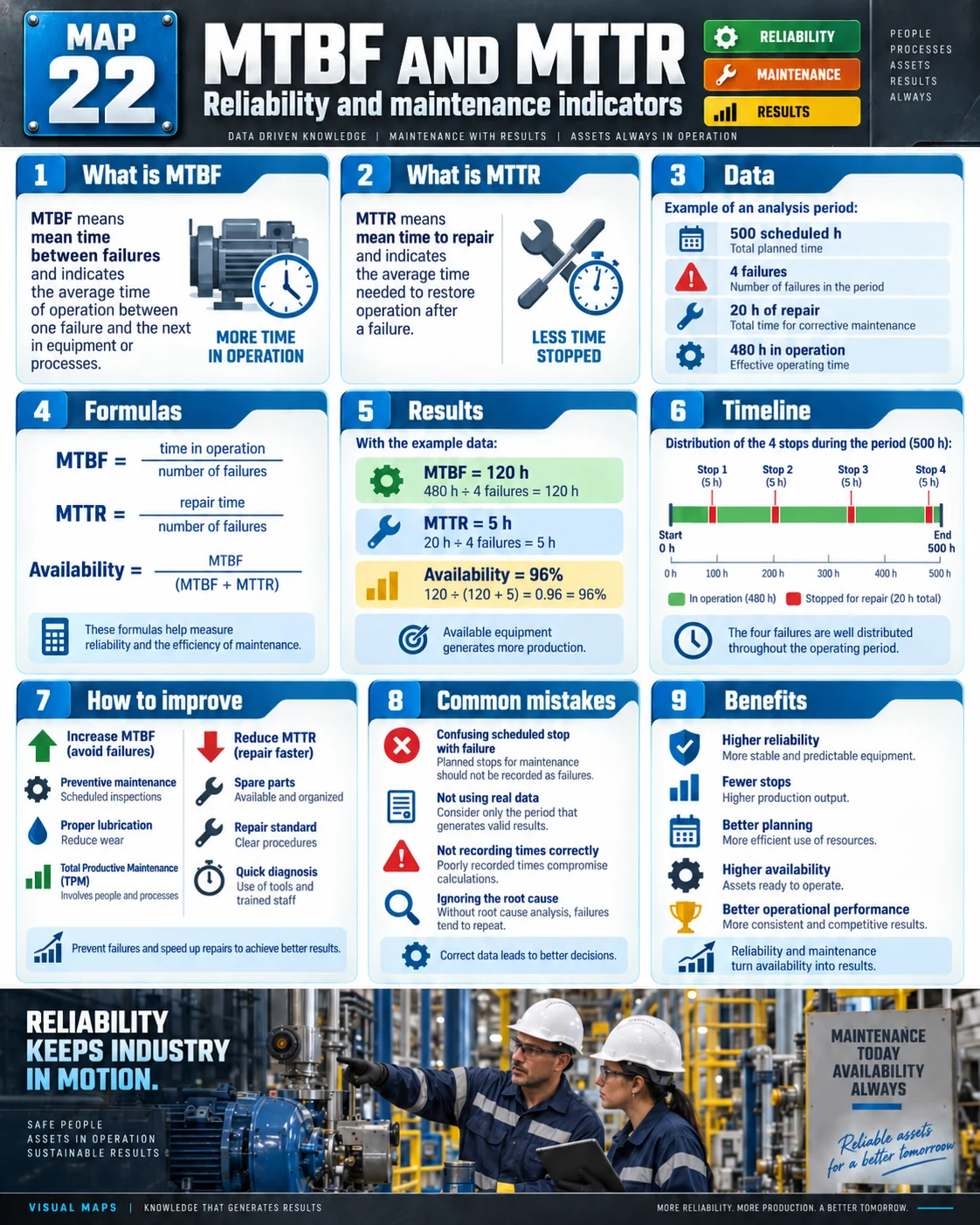
The map shows the example data, the formulas, the results, a timeline of the four stops and how to improve each metric.
Formulas
MTBF = operating time ÷ number of failures
MTTR = total repair time ÷ number of failures
Availability = MTBF ÷ (MTBF + MTTR)
Worked example
| Monthly data | Value |
|---|---|
| Scheduled time | 500 h |
| Number of failures | 4 |
| Total repair time | 20 h |
| Operating time | 480 h |
- MTBF = 480 ÷ 4 = 120 h.
- MTTR = 20 ÷ 4 = 5 h.
- Availability = 120 ÷ (120 + 5) = 96%, the same as 480 ÷ 500.
On average the machine runs 120 hours, breaks down and stays down for 5 hours. There are two ways to raise availability: fail less often (higher MTBF) or repair faster (lower MTTR).
How to read them
| Metric | Direction | What it shows |
|---|---|---|
| MTBF | Higher is better | More reliable equipment, fewer failures |
| MTTR | Lower is better | Faster repairs, less downtime |
Compare the same machine over time, or similar machines. A high MTBF with a high MTTR can hide a few very long breakdowns, and the reverse also happens.
MTBF, MTTF and planned stops
- MTTF (mean time to failure) applies to items that are replaced rather than repaired, such as lamps or bearings.
- Planned stops like preventive maintenance and changeovers are not failures and stay out of the calculation.
- This is maintenance availability. In OEE, availability also includes changeovers and other stops.
How to improve
| Increase MTBF (fail less) | Reduce MTTR (repair faster) |
|---|---|
| Preventive maintenance and scheduled inspections | Spare parts available and organized |
| Proper lubrication to reduce wear | Repair standards and clear procedures |
| TPM with autonomous maintenance | Quick diagnosis with the right tools and trained staff |
| Root cause analysis with the 5 Whys and FMEA | Quick changeover techniques (SMED) applied to repairs |
Common mistakes
- Not recording every failure, including small ones.
- Counting planned stops as failures.
- Recording times incorrectly.
- Skipping root cause analysis, so failures repeat.
- Tracking the metrics without an action plan.
Frequently asked questions
What is MTBF?
Mean time between failures: operating time divided by the number of failures in the period.
What is MTTR?
Mean time to repair: total repair time divided by the number of failures.
How do you calculate availability from MTBF and MTTR?
Availability = MTBF ÷ (MTBF + MTTR). In the example, 120 ÷ 125 = 96%.
What is the difference between MTBF and MTTF?
MTBF is for repairable equipment; MTTF is for items that are replaced after they fail.
Do preventive maintenance stops count in MTBF?
No. Planned stops are not failures and should stay out of the calculation.
Sources
- SMITH, D. J. Reliability, Maintainability and Risk. Oxford: Butterworth-Heinemann.
- MOUBRAY, J. Reliability-Centered Maintenance. New York: Industrial Press.
- IEC 60050-192. International Electrotechnical Vocabulary: Dependability. Geneva: IEC.
Want fewer breakdowns and more uptime?
Download the free metrics e-book and track your maintenance losses.
Download the e-book
About the author
Lean Manufacturing & Behavioral Management Specialist
Over 20 years in the automotive and metalworking industries (GM and Dana), Lean Manufacturing practitioner since 2006. SENAI instructor and mentor in Brazil’s Brasil Mais Produtivo program, delivering consulting, training and audits for 50+ companies, combining quality, productivity and people development.