What FMEA is
FMEA (failure mode and effects analysis) is a method for identifying, before they happen, the ways a product or process can fail, understanding their effects and causes, and prioritizing preventive actions.
It is a team tool: production, engineering, quality and maintenance walk through each step and ask what could go wrong. The output is a ranked list of risks and an action plan.
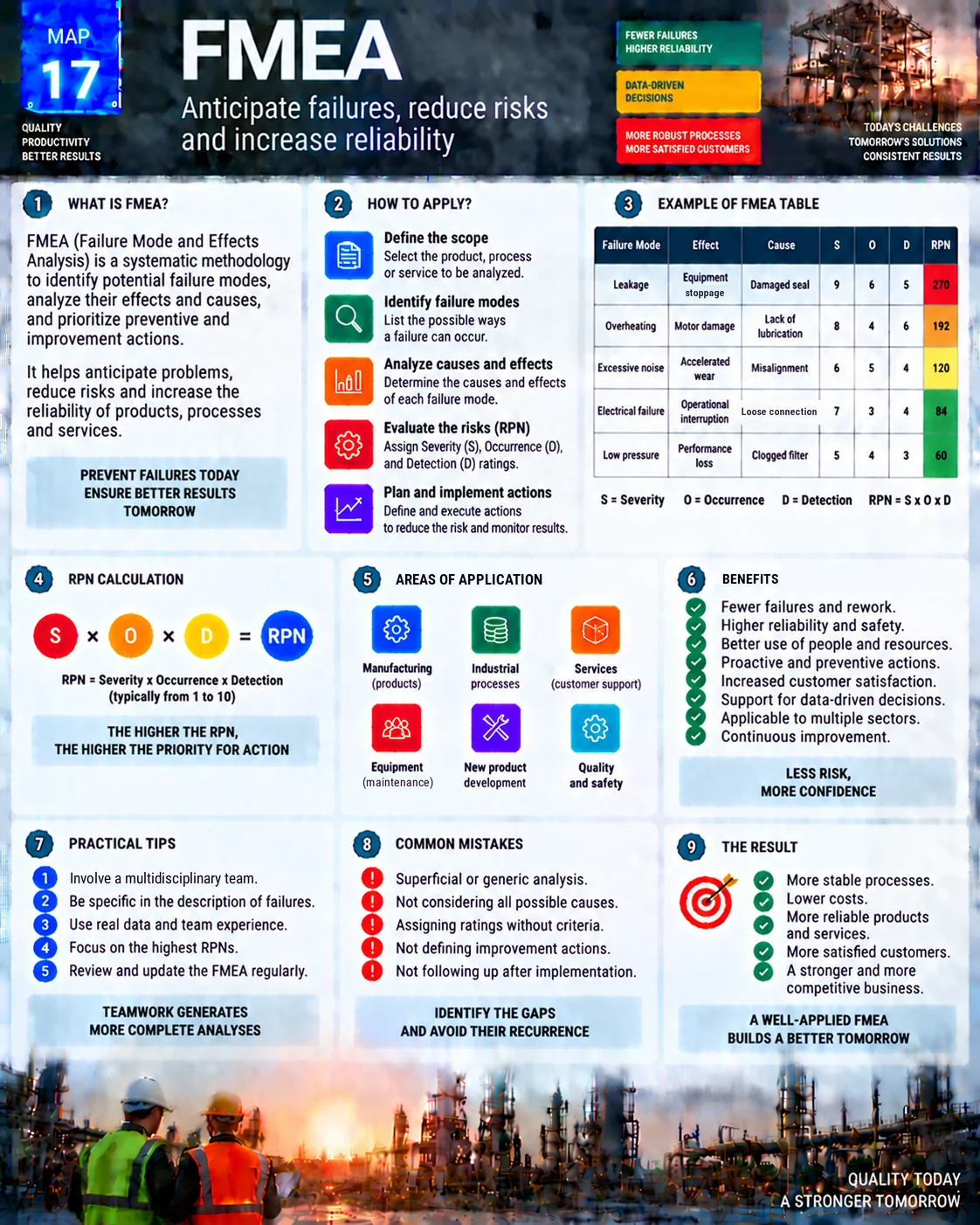
FMEA visual map
The map shows the steps, an example table with five failure modes, the RPN calculation and the areas of application.
Origins and types
FMEA started in the U.S. military in the late 1940s, was used by NASA in the space programs and reached the automotive industry in the 1970s. Today there is a joint AIAG and VDA handbook, published in 2019.
| Type | Focus |
|---|---|
| DFMEA | Product design: design-related failures |
| PFMEA | Manufacturing or assembly process |
| Machinery and system FMEA | Equipment, maintenance and systems |
Severity, occurrence and detection
| Rating | Question | Scale |
|---|---|---|
| Severity (S) | How serious is the effect for the customer or for safety? | 1 (no effect) to 10 (safety risk) |
| Occurrence (O) | How often does the cause happen? | 1 (remote) to 10 (very high) |
| Detection (D) | How likely are current controls to catch it before the customer? | 1 (certain detection) to 10 (no detection) |
RPN = S × O × D (from 1 to 1,000)
The risk priority number ranks the risks: the higher it is, the higher the priority for action.
Example FMEA table
| Failure mode | Effect | Cause | S | O | D | RPN |
|---|---|---|---|---|---|---|
| Leakage | Equipment stoppage | Damaged seal | 9 | 6 | 5 | 270 |
| Overheating | Motor damage | Lack of lubrication | 8 | 4 | 6 | 192 |
| Excessive noise | Accelerated wear | Misalignment | 6 | 5 | 4 | 120 |
| Electrical failure | Operational interruption | Loose connection | 7 | 3 | 4 | 84 |
| Low pressure | Performance loss | Clogged filter | 5 | 4 | 3 | 60 |
Leakage is the priority. One possible action is preventive seal replacement in the TPM plan plus a check on the daily route: if occurrence falls to 2 and detection stays at 3, the RPN becomes 9 × 2 × 3 = 54. Severity only changes with a design change.
How to do an FMEA
- Define the scope: product, process or equipment to analyze.
- Build the team with the people who design, run, maintain and inspect.
- Identify the failure modes of each function or step.
- Analyze effects and causes; the 5 Whys help reach the cause.
- Rate the risks with S, O and D and calculate the RPN.
- Plan actions with an owner and a due date, then recalculate after implementation.
Beyond RPN: AIAG-VDA action priority
RPN has a weakness: different combinations can give the same number. A 10 × 2 × 5 and a 5 × 4 × 5 both equal 100, but the first involves a safety risk. That is why the 2019 AIAG-VDA handbook replaced RPN with an action priority (AP) table, which rates every combination as high, medium or low priority and gives severity more weight. Whatever the method, effects with severity 9 or 10 always require action.
Typical actions by rating
- Lower occurrence: poka-yoke, preventive maintenance, standardization.
- Improve detection: sensors, automatic inspection, SPC.
- Lower severity: only through design change, redundancy or protection.
Common mistakes and tips
- Superficial or generic analysis copied from another FMEA.
- Not considering all possible causes.
- Assigning ratings without written criteria.
- Not defining actions or not reviewing after them.
- Treating the FMEA as an audit document instead of a living tool.
- Multidisciplinary team.
- Written S, O and D scales.
- Real failure and complaint data.
- Actions with owners and due dates.
- FMEA reviewed at every product or process change.
Frequently asked questions
What is FMEA?
Failure mode and effects analysis: a team method to anticipate failures, rate their risk and prioritize preventive actions.
How do you calculate RPN?
Multiply severity, occurrence and detection, each rated from 1 to 10. Example: 9 × 6 × 5 = 270.
What is a good RPN threshold?
There is no universal threshold; rank by RPN and always act on effects with severity 9 or 10.
What is the difference between DFMEA and PFMEA?
DFMEA analyzes product design failures; PFMEA analyzes failures in the manufacturing process.
Is RPN still used?
Yes, but the 2019 AIAG-VDA handbook recommends action priority (AP), which gives severity more weight.
Sources
- AIAG; VDA. FMEA Handbook. Southfield: AIAG, 2019.
- IEC 60812:2018. Failure modes and effects analysis (FMEA and FMECA). Geneva: IEC.
- STAMATIS, D. H. Failure Mode and Effect Analysis: FMEA from Theory to Execution. Milwaukee: ASQ Quality Press.
Want to prevent failures at the root?
Download the free "Problem Solving Kit" e-book, with PDCA, A3, 5 Whys and Ishikawa.
Download the e-book
About the author
Lean Manufacturing & Behavioral Management Specialist
Over 20 years in the automotive and metalworking industries (GM and Dana), Lean Manufacturing practitioner since 2006. SENAI instructor and mentor in Brazil’s Brasil Mais Produtivo program, delivering consulting, training and audits for 50+ companies, combining quality, productivity and people development.