
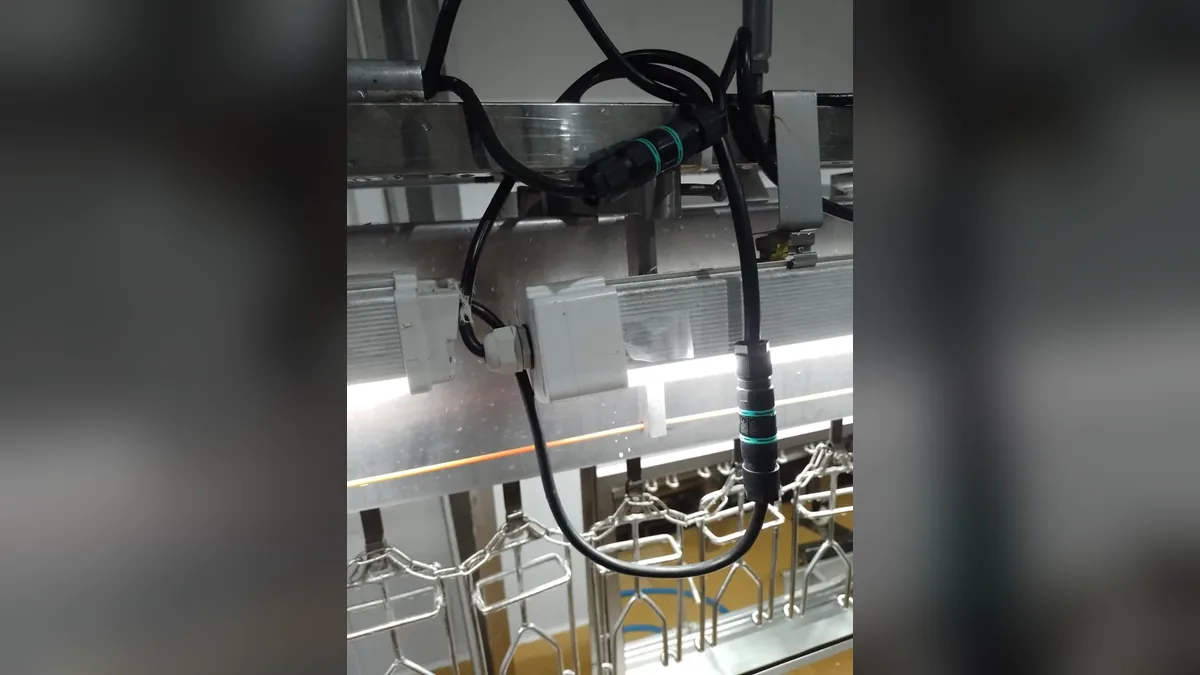
- A stopwatch next to the splice
- The Lean wastes seen through a connection
- Poka-yoke: when the component prevents the error
- Quality at the source: the test moves from the site to the factory
- Standardised work applies to electrical design too
- Standardising components without straitjacketing
- A one-machine kaizen
- Frequently asked questions
A large share of a plant's waste is decided on the specification sheet, long before it reaches the shop floor. A cable splice made in the field shows this well. Timed as in a process analysis, it involves stripping, splicing, insulating, applying tape, applying compound or resin, waiting for it to cure, testing and closing the box. Little of that adds value. And each manual step is also a failure mode: if the splice gives way in six months, the time comes back, with the downtime on top.
Lean is usually remembered for changes to layout and lines, but specifying a component is a process decision like any other. The Lean Enterprise Institute defines Lean as a way of thinking and acting aimed at creating the necessary value with fewer resources and less waste (lean.org). Applying that idea to electrical connections is good training for the eye, because they are on every machine and almost nobody sees them.
A stopwatch next to the splice
In the method Techno do Brasil presented at Mundo SENAI (described in the series guide), three themes recur: installation error, number of components and circuit weak points. This is electrical engineering vocabulary and, term by term, Lean vocabulary. An installation error is a defect; an extra component is overprocessing; a weak point is a step that can fail.
A poorly chosen connection does not show up in value stream mapping (VSM). It shows up later, as a symptom: the unplanned stoppage, the scrap with no cause, the technician who disappears for two hours to find a poor contact. The map records the effect. The cause stayed far back, on the specification sheet.
The Lean wastes seen through a connection
Of the eight classic wastes (the full list is at the Lean Enterprise Institute), six appear clearly when you look at an electrical connection.
| Waste | How it appears in the connection | Design decision that prevents it |
|---|---|---|
| Defects | A sensor or scale with an unstable reading due to moisture generates scrap and rework | Degree of protection and anti-condensation protection suited to the environment |
| Waiting | Line stopped waiting for diagnosis of an intermittent fault or for a spare part | Re-inspectable connections and standardised spares in stock |
| Motion | Technician opens boxes, disconnects terminals and redoes connections in the field | Plug and socket and pre-wired versions |
| Overprocessing | Improvised splices with tape, compound or resin, in several layers | A splice designed for the environment, with few components |
| Inventory | Dozens of spare-part models for the same function | Standardisation by function and by environment |
| Unused talent | Skilled technician spending the shift redoing a poorly executed connection | Simple installation that depends less on individual skill |
Notice that the right-hand column does not talk about products, it talks about decisions. The waste is not in the connector; it is in choosing a connector that does not match the place where it will work. That is why the first article in this series treats connections as the weak point of production, and the second shows how to choose industrial electrical connectors with sound criteria.
Poka-yoke: when the component prevents the error
Poka-yoke starts from a simple premise: people make mistakes, and the process must be designed so that the error does not happen or is noticed immediately. Asking for attention is not a solution. In Techno's presentation and catalogue, four elements relate directly to this principle.
Fewer parts to assemble
The co-moulded seal was presented as a “new technology”: plastic and rubber injected together, with chemical-mechanical adhesion between the two. Techno lists three effects: quick installation with few components, fewer installation errors thanks to the anti-leak joints, and greater strength, which results in greater reliability. In a DFMEA, each separate part and each assembly step is a failure mode with its own occurrence: the ring fitted upside down, left on the workbench or dropped inside the box. Co-moulding eliminates the interface and the step, and reduces occurrence by design, not by training. That is the strongest poka-yoke there is, the one that removes the opportunity for error.
Variants that cannot be mixed up
For some series, the catalogue mentions versions with different mechanical keys and colours for power and signalling circuits. This is poka-yoke in its purest form: the signal connector physically will not go into the power one.
A lock that shows whether the connection is complete
Push-pull, rotary or bayonet locks give tactile and visual feedback. The operator knows it has engaged. A “half-mated” connection is one of the most treacherous defects, because it works in the test and fails under vibration: the loose contact undergoes micromotion, fretting corrosion (fretting) and oxidation, contact resistance rises and the point heats up. And the seal, without the intended compression, no longer seals.
One connector per cable
In one of the cases presented, machine panels with rectangular multipole connectors were redesigned with circular panel connectors, each sized for its own cable: 12 cores, 8 cores, 3 cores. With different connectors for each function, plugging the wrong cable into the wrong place becomes much more difficult. The full case is in Electrical connection cases in harsh environments.
Quality at the source: the test moves from the site to the factory
Jidoka proposes building quality into the process instead of inspecting it at the end. For connections, this means shifting as much assembly and testing as possible from the field, where conditions are poor and variation is high, to the factory, where the process is controlled.
The Techno catalogue describes pre-wired solutions, with the cable injection-moulded into a single piece, and states that the team carries out electrical and mechanical tests on every production run. For the xDRY anti-condensation line, the presentation showed the “100% tested” badge. And the materials come with tests that answer in advance to typical causes of degradation: ozone ageing (ISO 1431-1), salt spray (EN 60068-2-11), 1,000 hours of UV (EN 60079-0), UL 746C f1 classification for outdoor use and a chemical resistance table that includes lubricating oils, petrol, ammonia, fertilisers and seawater.
There is a technical distinction behind this. The IP rating is a type test: short, under controlled conditions, with the assembly new and correctly fitted. Ageing, UV, ozone, salt spray, chemicals and thermal cycling lie outside it. Qualifying the material for these agents is building quality for the service life, not just for the day of the test. It is the same reasoning as the 1-10-100 rule of thumb: what costs 1 to prevent at the design stage costs 10 to correct during installation and 100 when it fails in operation.
For the buyer, this changes the question. Instead of “who will inspect the splice once it is done?”, it becomes “how much of the splice can I receive ready-made?”. According to the catalogue, cable length and terminal finish can be specified to order, and it is worth making that definition at the purchasing stage, not on site.
Standardised work applies to electrical design too
Standardised work is the basis of any improvement: without a standard, there is nothing to improve. Techno's presentation brought something that does not always come up when the subject is connectors: a three-step method for a correct and durable installation, which works as a design standard.
- Analyse the external environment. Humidity, water, chemicals, pressure, heat, temperature variation and condensation.
- Select and harmonise the cables. Outer diameter, number of poles, cross-section of each pole and technical specification. The presentation compared, for example, EPR (ethylene-propylene rubber, flexible and performing well in damp locations and underground networks) with polyether-based PU, immune to hydrolysis and resistant to salt water, sewage, fungi, mineral oils and greases. The video shown in the presentation covers this step. Harmonising matters for two physical reasons: the cable gland seal only compresses correctly when the diameter is within the range (outside it, the rubber either does not seal or suffers compression set sooner), and in stranded cables water can wick by capillary action between the strands and reach the connector from the inside, with the sheath intact.
- Eliminate all weak points. Circuit floor plan, distances in metres between components, identification and counting of every cable interruption (straight splice, T, Y, H or multiple branch), changes of conductor size and distances between interruptions.
The third step is a process analysis applied to the circuit, with a quantitative basis. Cable interruptions act as elements in series: Rsystem = R1 × R2 × … × Rn. With illustrative numbers, 20 connections with 99% annual reliability each give 0.9920 ≈ 0.82, about an 18% chance of at least one failure in the year. The levers are the same as in a production process: eliminate unnecessary steps and make the remaining ones robust.
In my assessment, this is where the differentiator of Techno's approach lies. The company treats the connection as a system (environment, cable, interruptions, connection, validation), not as a catalogue item; it designs to reduce interfaces and assembly errors; with xDRY it covers condensation, a failure mode that the IP test does not reproduce; and it qualifies the material for time in service. This is a differentiator because it attacks waste at the phase in which it is cheapest to avoid.
Even conduit got a visual standard in the presentation: yellow corrugated PVC for walls, orange PVC for slabs and floors, black HDPE with UV protection for outdoor areas. Colour by application is visual management, the same logic as 5S.
Standardising components without straitjacketing
The Techno general catalogue is broad, with thousands of codes covering splices, branch connectors, disconnectables, panel connectors, boxes and cable glands. For design, this variety is an advantage. For maintenance, without a rule, it turns into dead stock and replacement errors. A practical way to strike the balance:
- List the functions that exist in the plant: splice, branch, plug and socket, panel, cable gland.
- For each combination of function and environment (dry, damp, washdown, buried, outdoor), choose a reference family.
- Record the exceptions and the reason for each one.
- Review the standard when failures or the environment change, at the pace of continuous improvement.
The gain in inventory and replacement time ties in with the management of spare parts and MRO and, on the maintenance side, with TPM applied to connections.
A one-machine kaizen
None of this requires a corporate programme. A small-scale kaizen, on a single machine, already shows the way:
- Choose the machine with the most electrical failure history in the past year. A Pareto chart of corrective work orders helps.
- Map the connections as in the third step of the method: every cable interruption, its type and its environment.
- Classify the wastes using the table in this article.
- Test a change at one critical point and record the installation time and the subsequent failures.
- Standardise if there is a gain, and take the rule to similar machines.
To measure the effect on availability, use TEEP and OEE; to put a monetary value on the result, the total cost of industrial connections shows how to do the calculation. And if you want to learn about the company whose material served as the basis for the examples, the guide to Techno do Brasil gives the overview.
Back to the timed splice from the beginning: Lean asks which steps add value. In a field connection, the best answer is rarely to do the same steps faster. It is to specify a component that makes half of them unnecessary, and with them the failure modes they brought along.
Frequently asked questions
Is choosing a better component a Lean action?
Yes, when the choice prevents defects, waiting, motion or rework at the source. Lean does not require new technology, it requires understanding where waste originates, and it often originates in the specification.
How does poka-yoke apply to electrical connectors?
Through fewer loose components during assembly, as with the co-moulded seal; versions with different mechanical keys or colours per function; locks that show whether mating is complete; and a connector sized for each cable.
Which Lean wastes does a poorly chosen connection cause?
Mainly defects, waiting, motion, overprocessing, inventory and unused talent. All of them show up as stoppages, rework or technician time spent on repairs that could have been avoided.
Doesn't standardising connectors limit correct specification?
It does if the standard is too rigid. The way out is to standardise by function and by environment, keep a clear rule for exceptions and review the standard when failures show that something has changed.
Does this reasoning apply to small plants?
It does, and it usually pays back quickly. The gain comes from eliminating repeat failures and reducing repair time, and the pilot can start on a single machine.
In this series
- Techno do Brasil: electrical connection technology (series guide)
- Industrial electrical connections and productivity
- How to choose industrial electrical connectors
- IP66, IP68 and IP69K: what they mean
- Condensation and water ingress in connections
- Industrial connections and TPM: reliability
- Lean and waste in component selection
- Connection cases in harsh environments
- Total cost of industrial connections (TCO)
Sources
- Techno do Brasil. Presentation “Complicated and Hostile Applications” (Portuguese original), given by Mário Adinolfi at the Techno do Brasil Installation Certification Course, Mundo SENAI, Marechal Cândido Rondon (PR), November 6, 2026.
- Techno General Catalogue (CATGENIT102024), Portuguese edition.
- Video on cable selection and harmonisation, shown in the presentation (YouTube).
- Lean Enterprise Institute: What is Lean?
- Lean Enterprise Institute: The Eight Wastes of Lean
- Techno do Brasil: official website.
Bookmark this address: Manufatura Enxuta is your lean manufacturing school. Come back whenever you need to study, with complete articles, a visual map and reliable sources. Follow one of the study tracks or check the A–Z glossary.
Explore the technology at the source
This series explains the technology behind connections and its effect on waste. For the technical data of each item, consult the catalogue and data sheets on the official Techno do Brasil website.
Visit the official website
About the author
Vagner Soares
Specialist in Lean Manufacturing and Behavioural Management
More than 20 years in the automotive and metalworking industries (GM and Dana), and a Lean Manufacturing specialist since 2006. SENAI instructor and mentor in the Brasil Mais Produtivo programme, with consulting, training and audits in more than 50 companies, bringing together quality, productivity and people development.


