The question is badly framed
Anyone asking which is better, ISO 9001 or Lean, is comparing things of different natures. ISO 9001 is a requirements standard for a quality management system, auditable by third parties. Lean Manufacturing is a philosophy and a set of practices for delivering value with minimum waste. See the basics in what Lean Manufacturing is.
One requires you to define and prove how you work. The other asks whether that way of working consumes more than it needs to. A factory can be certified and still have processes full of waiting and inventory. It can also have a lean shop floor and no document control that would convince a demanding customer.
For another frequent comparison between approaches, read Lean vs Six Sigma. Here the focus is different: a management system versus a method for eliminating losses.
What each approach delivers
ISO 9001 delivers predictability. It creates a system in which responsibilities, controls, records, auditing, and corrective action are routine. Its risk is turning into bureaucracy, when the document comes to matter more than the result.
Lean delivers flow and loss reduction. It targets the seven wastes, lead time, and the participation of people in improvement. Its risk is becoming dependent on individuals and leaders, with no record to sustain the gain when they change.
The meeting point is the standard. Lean's standardized work is the base on which improvement happens, and ISO requires the work method to be defined and controlled. It is the same gesture with different vocabulary.
Comparison table
| Criterion | ISO 9001 | Lean Manufacturing |
|---|---|---|
| Nature | Requirements standard for a management system | Philosophy and set of practices |
| Central question | Is the process defined, controlled, and consistent? | Does the process add value or create loss? |
| Main focus | Conformity, customer confidence, control | Flow, lead time, waste |
| Verification | Internal and third-party audit | Gemba, indicators, leadership routine |
| How change happens | Corrective action and continual improvement | Kaizen, improvement events, problem solving |
| Visible result | Certificate and confidence in contracts | Less inventory, waiting, and rework |
| Risk if poorly applied | Bureaucracy and unused paperwork | Gains with no support and no record |
How to combine the two
The combination works best when each side covers the other's weakness. A practical order of work:
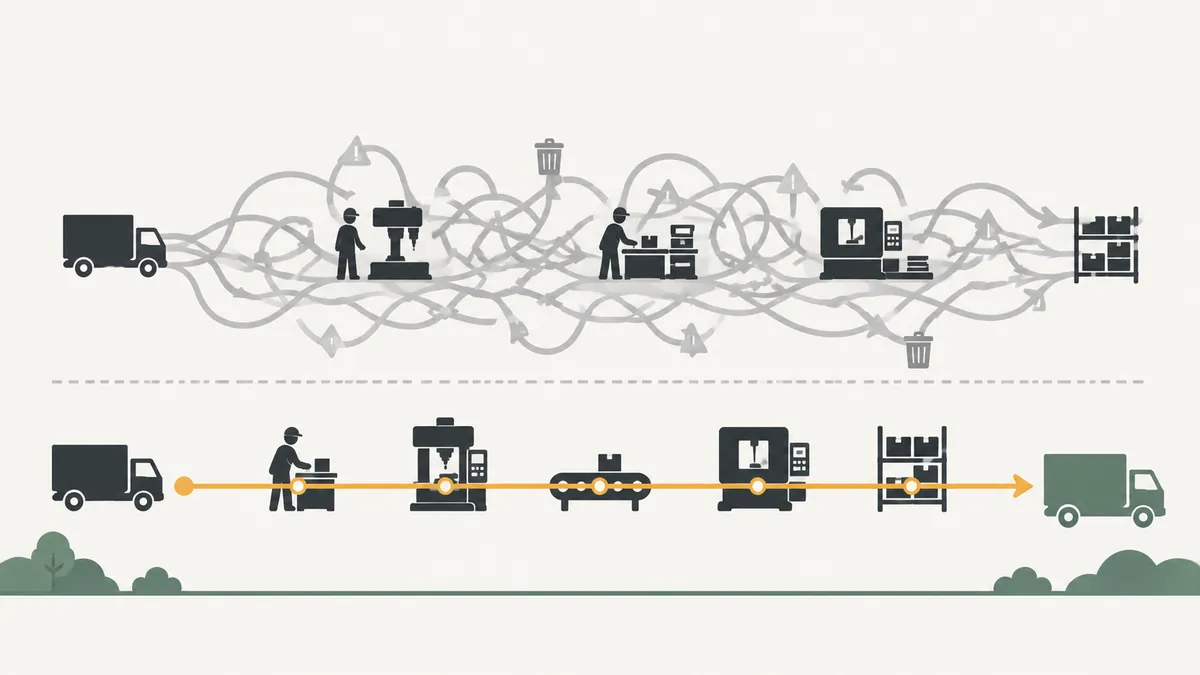
- Map the real flow. Use value stream mapping to see where the product waits and where work is repeated. This also meets the requirement to understand the processes and their interactions.
- Eliminate losses before documenting. There is no point in writing a procedure for a step that should cease to exist.
- Standardize what is left. Short, visual instructions satisfy the documented information required by the standard.
- Use the audit as a gemba. The internal audit can be the routine of checking whether the standard is followed and whether it still makes sense.
- Handle deviations with a method. The corrective action required by the standard benefits from PDCA and the 5 Whys.
- Measure with few indicators. The same numbers serve management review and the shop floor board.
When to prioritize each one
There is no universal answer, but there are signs.
Start with ISO 9001 when
- Customers or public tenders require a certificate in order to contract.
- The process depends on the memory of a few people and there is no record of what is done.
- Complaints repeat because nobody treats the cause.
Start with Lean when
- Delivery lead time is long and work-in-process inventory is high.
- Rework, waiting, and movement are visible to the naked eye.
- The documentation system already exists, but the shop floor ignores it.
In many companies the answer is to do both in short sequence, with the same process team. Those who do not yet master the basics can start from the Toyota Production System to understand where lean thinking comes from.
Mistakes that block integration
- Creating two parallel systems. One for the audit and another for day to day. The auditor notices, and so does the team.
- Documenting the waste. Standardizing a step without value only perpetuates it.
- Delegating everything to quality. Both the standard and Lean depend on production leadership.
- Measuring too much. Dozens of indicators dilute focus. Prefer a few, well understood.
- Treating certification as the end. The certificate attests to a system, not a replacement for daily improvement.
Illustrative scenario
Imagine a fictional metalworking company that makes brackets and needs the certificate to serve a large customer. The diagnosis shows that each batch spends more time waiting in a queue than on a machine. If the team only documents the procedures, the certificate is issued, but the queue remains.
If, before writing, the team maps the flow, reduces batches, and standardizes what is left, the procedures are shorter and reflect the real work. The auditor finds clear evidence and the customer receives faster. The example is illustrative, without numbers, to show the order of decisions: first simplify, then standardize, and finally audit.
Next step
Choose a product and ask two people: first, which document controls your process? Then, where does the product wait the most? If the first answer is vague, start with control. If the second is obvious, start with flow. Whichever starting point you choose, return to the other side within a quarter, so that neither becomes an island.
For the standard's implementation roadmap, see how to implement ISO 9001.
Frequently asked questions
Are ISO 9001 and Lean competitors?
No. ISO 9001 structures and controls the management system. Lean reduces waste and speeds up flow. They work better together.
Can I have Lean without ISO 9001?
Yes. Lean does not require certification. Without records and controls, however, the gains can become dependent on specific people.
Does ISO 9001 get in the way of Lean?
Only when it turns into bureaucracy. With short instructions and standards that reflect the real work, the standard reinforces the standardization that Lean needs in order to improve.
Which should a small factory start with?
With whichever hurts most today. If the problem is a customer requirement, ISO 9001. If it is lead time and inventory, Lean. In both cases, plan the other for soon after.
Keep studying
Sources
- WOMACK, J.; JONES, D. A Mentalidade Enxuta nas Empresas. Rio de Janeiro: Elsevier.
- ABNT NBR ISO 9001:2015. Sistemas de gestão da qualidade: requisitos. Rio de Janeiro: ABNT.
- Lean Enterprise Institute. Standardized Work. https://www.lean.org/lexicon-terms/standardized-work/
Keep studying: trusted sources and links
- Lean Enterprise Institute: What is Lean?
- ISO: ISO 9001 and related standards, Quality management
- Wikipedia: Lean manufacturing
- Wikipedia: ISO 9000 family
Save this address: Manufatura Enxuta is your school for lean manufacturing. Come back whenever you need to study, with a complete article, a visual map and trusted sources. Follow one of the learning paths or check the A–Z glossary.
Want a quick reference guide?
Download the free Lean pocket guide e-book, with the concepts and tools on one page each.
Download the e-book
About the author
Lean Manufacturing & Behavioral Management Specialist
Over 20 years in the automotive and metalworking industries (GM and Dana), Lean Manufacturing practitioner since 2006. SENAI instructor and mentor in Brazil’s Brasil Mais Produtivo program, delivering consulting, training and audits for 50+ companies, combining quality, productivity and people development.