
What manufacturing productivity is
Manufacturing productivity is the ratio of what the plant produces (output) to what it consumes to produce it (input): labor, machines, material, energy. To calculate it, divide the quantity produced by the resource used, for example units per labor hour.
A single figure says little. It only matters against the previous period, a target or another line, so productivity works best as a trend indicator.
Productivity visual map
The map gathers the productivity, efficiency and effectiveness formulas and the numeric example used in this article.
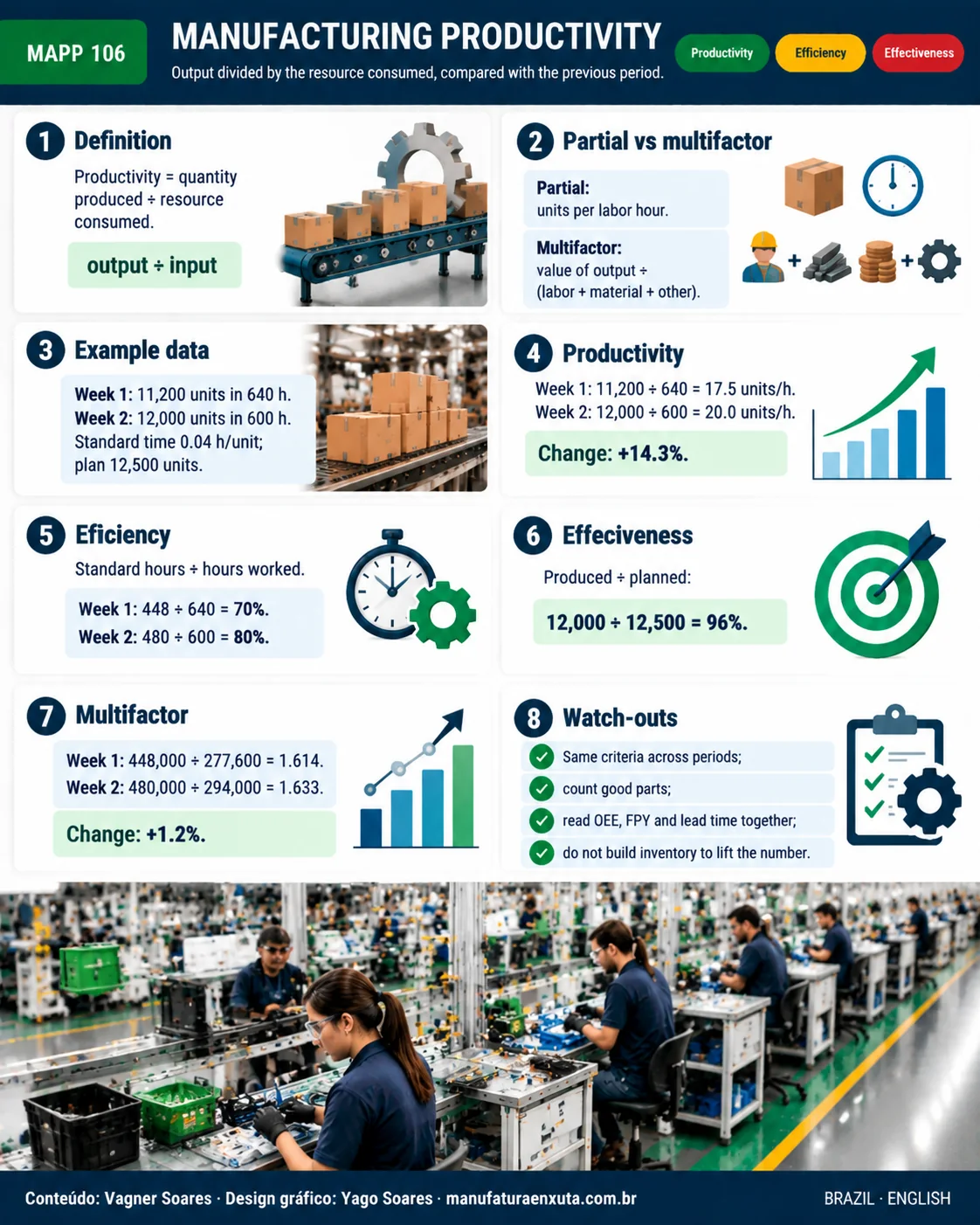
Productivity formulas
Productivity = quantity produced ÷ resource consumed
- Partial (single factor): units per labor hour, units per machine hour, kg per kWh. The most common measure on the shop floor.
- Multifactor (total): value of output ÷ cost of all inputs. It shows whether a labor gain was paid for with more material or energy.
Multifactor productivity = value of output ÷ (labor + material + other costs)
Keep the same unit and counting rules from period to period. Count good parts when scrap is significant: a scrapped part consumes input and produces no output.
Worked example: two weeks on an assembly line
Fictional example. The line has a standard time of 2.4 minutes per unit (0.04 h) and a plan of 12,500 units in week 2. Selling price is $40 per unit, labor $30/h, material $22 per unit and $12,000 of other costs per week.
| Data | Week 1 | Week 2 |
|---|---|---|
| Units produced | 11,200 | 12,000 |
| Hours worked | 640 | 600 |
| Productivity (units/h) | 11,200 ÷ 640 = 17.5 | 12,000 ÷ 600 = 20.0 |
| Standard hours earned | 11,200 × 0.04 = 448 | 12,000 × 0.04 = 480 |
| Efficiency (std hours ÷ hours worked) | 448 ÷ 640 = 70% | 480 ÷ 600 = 80% |
| Value of output ($) | 448,000 | 480,000 |
| Total input cost ($) | 19,200 + 246,400 + 12,000 = 277,600 | 18,000 + 264,000 + 12,000 = 294,000 |
| Multifactor productivity | 1.614 | 1.633 |
Labor productivity rose from 17.5 to 20 units/h: (20 ÷ 17.5) − 1 = +14.3%. Multifactor productivity rose only 1.2% because material grew along with volume. The real gain is in labor hours, not in material cost.
Productivity, efficiency and effectiveness
The three terms get mixed up on the floor, but they measure different things.
| Metric | Question it answers | Calculation in the example (week 2) |
|---|---|---|
| Productivity | How much do I produce per resource? | 12,000 ÷ 600 h = 20 units/h |
| Efficiency | Do I use the resource within the expected time? | 480 std h ÷ 600 h = 80% |
| Effectiveness | Do I deliver what was planned? | 12,000 ÷ 12,500 = 96% |
A line can be effective (meets the plan) and inefficient (burns more hours than standard). The standard time comes from a time study; if it is wrong, efficiency will be wrong too.
Which indicators to use alongside
Productivity alone hides problems. Combine it with:
- OEE: shows where equipment loses time (availability, performance, quality).
- Production capacity: compares what was produced with what was possible.
- Takt time: the pace demanded by the customer, to check whether producing more is even needed.
- FPY and RTY: make sure higher volume did not come with more rework.
- Lead time: high productivity with growing inventory is not a gain.
To pick the right set for your area, see the guide to lean manufacturing KPIs.
How to improve productivity
- Measure by workstation and by shift. The plant average hides the line dragging results down.
- Attack time losses (stoppages, waiting, changeovers) before buying a new machine.
- Work on the bottleneck. Gains outside the constraint do not raise output; see the theory of constraints.
- Standardize the method. Standardized work reduces variation between operators.
- Cut setup time with SMED to free productive hours.
- Review results weekly with data on display and one action per deviation.
The cost of the gain matters too: see how productivity feeds into the unit cost of production.
Common mistakes
- Comparing periods with different criteria: the mix, standard time or hour counting changed and the figure is no longer comparable.
- Counting output without quality: scrapped parts inflate the numerator.
- Measuring labor only: the gain may have shifted to material, energy or overtime.
- Producing for the metric: building inventory beyond demand raises productivity and hurts cash.
- Confusing productivity with work intensity: asking for more effort is not improving the method.
- Averaging across different products: convert everything to standard hours before adding.
Frequently asked questions
How do you calculate manufacturing productivity?
Divide the quantity produced by the resource consumed. Example: 12,000 units ÷ 600 hours worked = 20 units per hour.
What is the difference between productivity and efficiency?
Productivity is output per resource. Efficiency compares the standard time of the parts produced with the time actually spent: 480 h ÷ 600 h = 80% in the example.
How do you calculate the percentage change in productivity?
(Current productivity ÷ previous productivity) − 1. In the example, 20 ÷ 17.5 − 1 = 14.3%.
What is multifactor productivity?
The value of output divided by the cost of all inputs (labor, material, energy). It avoids crediting labor with a gain that came from another input.
What is the best productivity metric for the shop floor?
Units per labor hour by workstation and shift, tracked together with efficiency against standard time and a quality indicator.
Does producing more always mean higher productivity?
No. If volume grows in proportion to hours or inputs, productivity does not change. And producing above demand only builds inventory.
Sources
- SLACK, N.; BRANDON-JONES, A.; JOHNSTON, R. Operations Management. Pearson.
- STEVENSON, W. J. Operations Management. McGraw-Hill.
- HEIZER, J.; RENDER, B. Operations Management. Pearson.
- SINK, D. S.; TUTTLE, T. C. Planning and Measurement in Your Organization of the Future. Norcross: Industrial Engineering and Management Press, 1989.
Want to measure what really matters?
Download the free e-book on performance indicators and track the losses in your operation.
Download the e-book
About the author
Lean Manufacturing & Behavioral Management Specialist
Over 20 years in the automotive and metalworking industries (GM and Dana), Lean Manufacturing practitioner since 2006. SENAI instructor and mentor in Brazil’s Brasil Mais Produtivo program, delivering consulting, training and audits for 50+ companies, combining quality, productivity and people development.