
What a time study is
A time study uses a stopwatch to measure an operation and set a reliable standard time: the time a trained operator, working at a normal pace with the defined method, needs to complete the task, including necessary breaks.
Standard time is the basis for line balancing, capacity calculations, product costing and fair targets.
Time study visual map
The map summarizes the steps, the formulas, the 5-reading example and the check on the number of cycles.
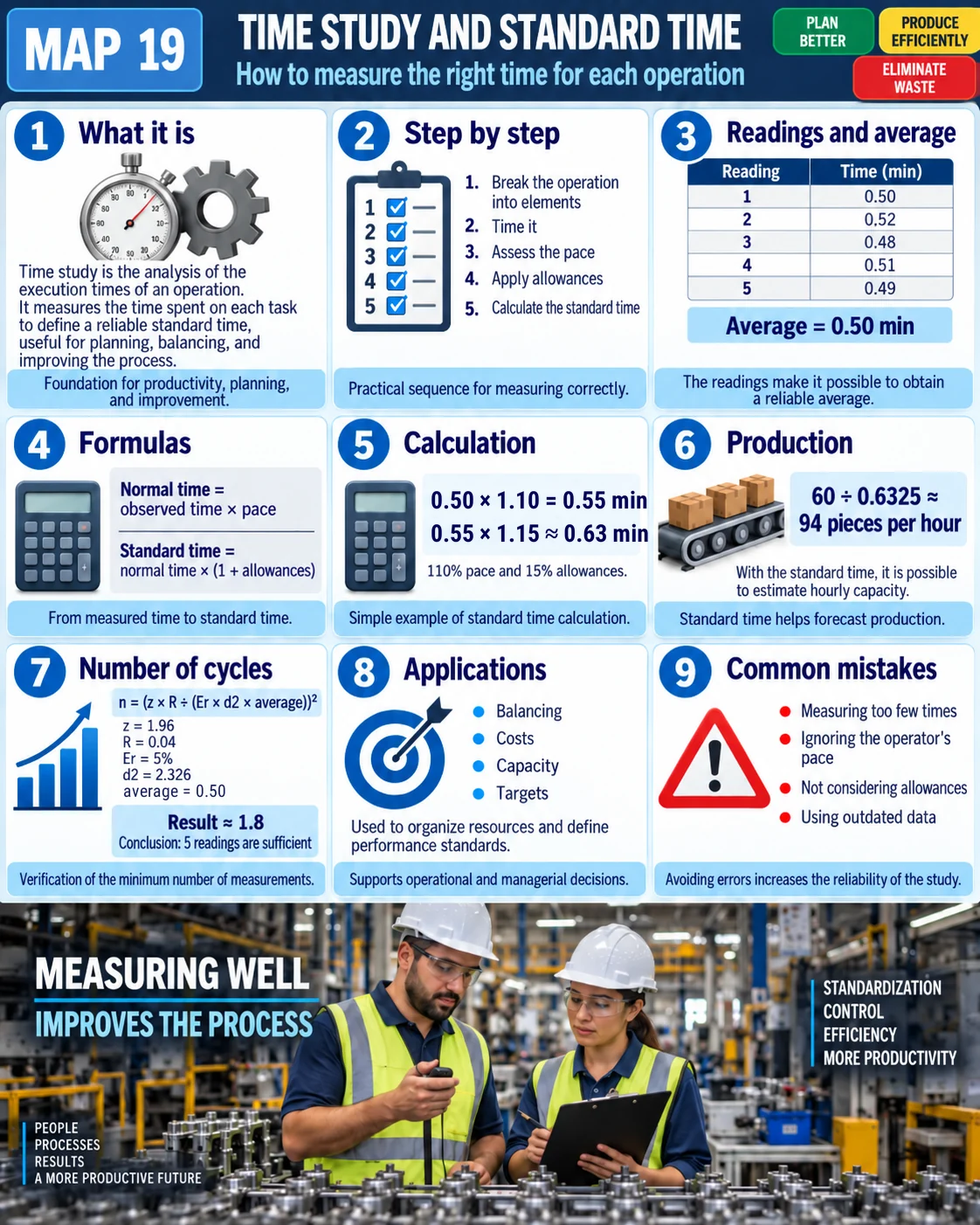
Step by step
- Break the operation into elements with clear start and end points.
- Time several cycles with the standard method in place.
- Rate the operator's pace against normal pace.
- Apply allowances for fatigue and personal needs.
- Calculate the standard time.
Standardize before you time: measuring a messy method just freezes the waste. Standardized work comes first.
Formulas
Normal time = average observed time × performance rating
Standard time = normal time × (1 + allowances)
Some companies apply allowances as 1 ÷ (1 − p), where p is the share of the shift reserved for breaks. Both conventions are used; just write down which one you follow.
Worked example
| Reading | Time (min) |
|---|---|
| 1 | 0.50 |
| 2 | 0.52 |
| 3 | 0.48 |
| 4 | 0.51 |
| 5 | 0.49 |
| Average | 0.50 |
- Pace rated at 110%: normal time = 0.50 × 1.10 = 0.55 min.
- Allowances of 15%: standard time = 0.55 × 1.15 = 0.6325 ≈ 0.63 min.
- Expected output: 60 ÷ 0.6325 ≈ 94 pieces per hour.
How many readings are enough?
n = (z × R ÷ (Er × d2 × average))²
At 95% confidence (z = 1.96), range R = 0.04 min, relative error Er = 5%, d2 = 2.326 (sample of 5) and an average of 0.50, n ≈ 1.8. Five readings are more than two, so the sample is enough. More variable operations need more cycles.
Where standard time is used
- Line balancing: comparing each station's load with takt, as in assembly line balancing.
- Capacity: how many pieces per hour each station delivers.
- Costing: direct labor per piece.
- Targets: expected output per shift.
Common mistakes
- Taking too few readings or timing only one operator.
- Ignoring the operator's pace.
- Leaving out allowances.
- Timing before standardizing the method.
- Using outdated times after improvements.
Frequently asked questions
What is a time study?
A stopwatch measurement of an operation used to set its standard time.
How do you calculate standard time?
Multiply the average observed time by the performance rating to get normal time, then by the allowance factor. In the example, 0.50 × 1.10 × 1.15 ≈ 0.63 min.
What is the difference between normal time and standard time?
Normal time adjusts for the operator's pace; standard time adds allowances for fatigue and personal needs.
How many cycles should I time?
Use the sample size formula; in the example about 2 would do, so 5 readings leave a margin.
What is standard time used for?
Line balancing, capacity planning, product costing and production targets.
Sources
- NIEBEL, B.; FREIVALDS, A. Niebel's Methods, Standards, and Work Design. New York: McGraw-Hill.
- BARNES, R. M. Motion and Time Study: Design and Measurement of Work. New York: Wiley.
- ILO. Introduction to Work Study. Geneva: International Labour Office.
Standardize before you measure.
Download the free "Lean Pocket Guide" e-book with standardized work and the core tools.
Download the e-book
About the author
Lean Manufacturing & Behavioral Management Specialist
Over 20 years in the automotive and metalworking industries (GM and Dana), Lean Manufacturing practitioner since 2006. SENAI instructor and mentor in Brazil’s Brasil Mais Produtivo program, delivering consulting, training and audits for 50+ companies, combining quality, productivity and people development.