What Industry 4.0 is
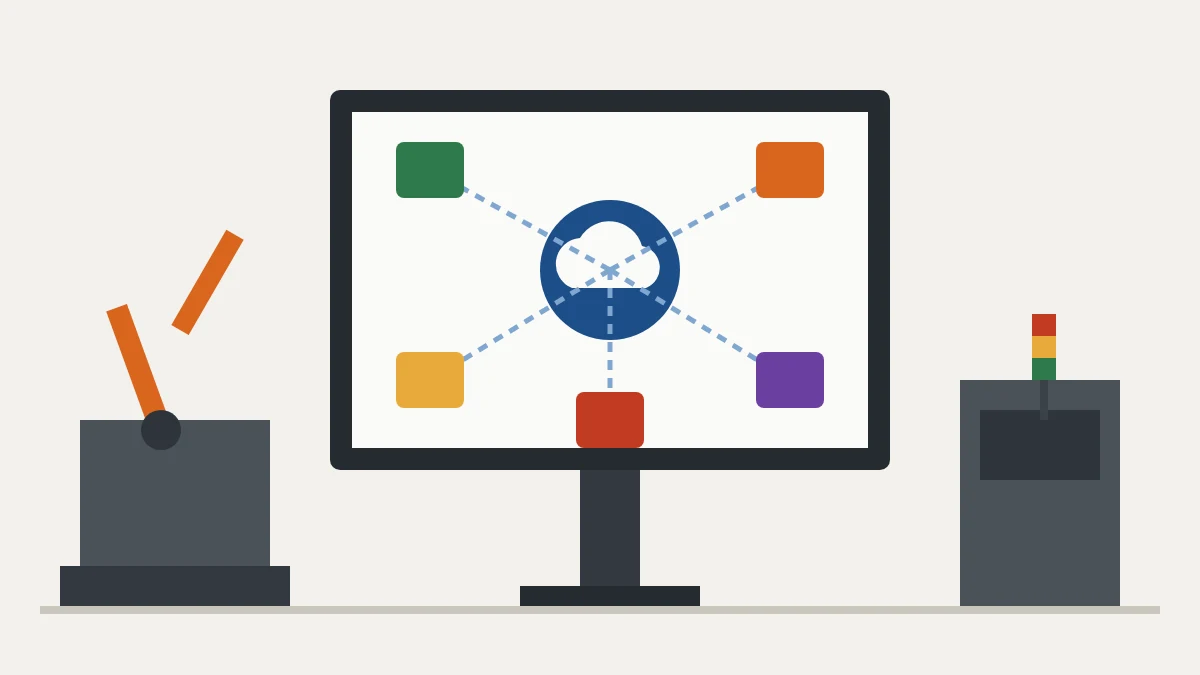
Industry 4.0 is the name given to the fourth industrial revolution: integrating digital technologies into production, connecting machines, data and people to make manufacturing smarter, more flexible and more efficient.
In practice it means machines report their own status, data reaches decision makers in real time, and processes can be simulated and adjusted before anyone touches the line.
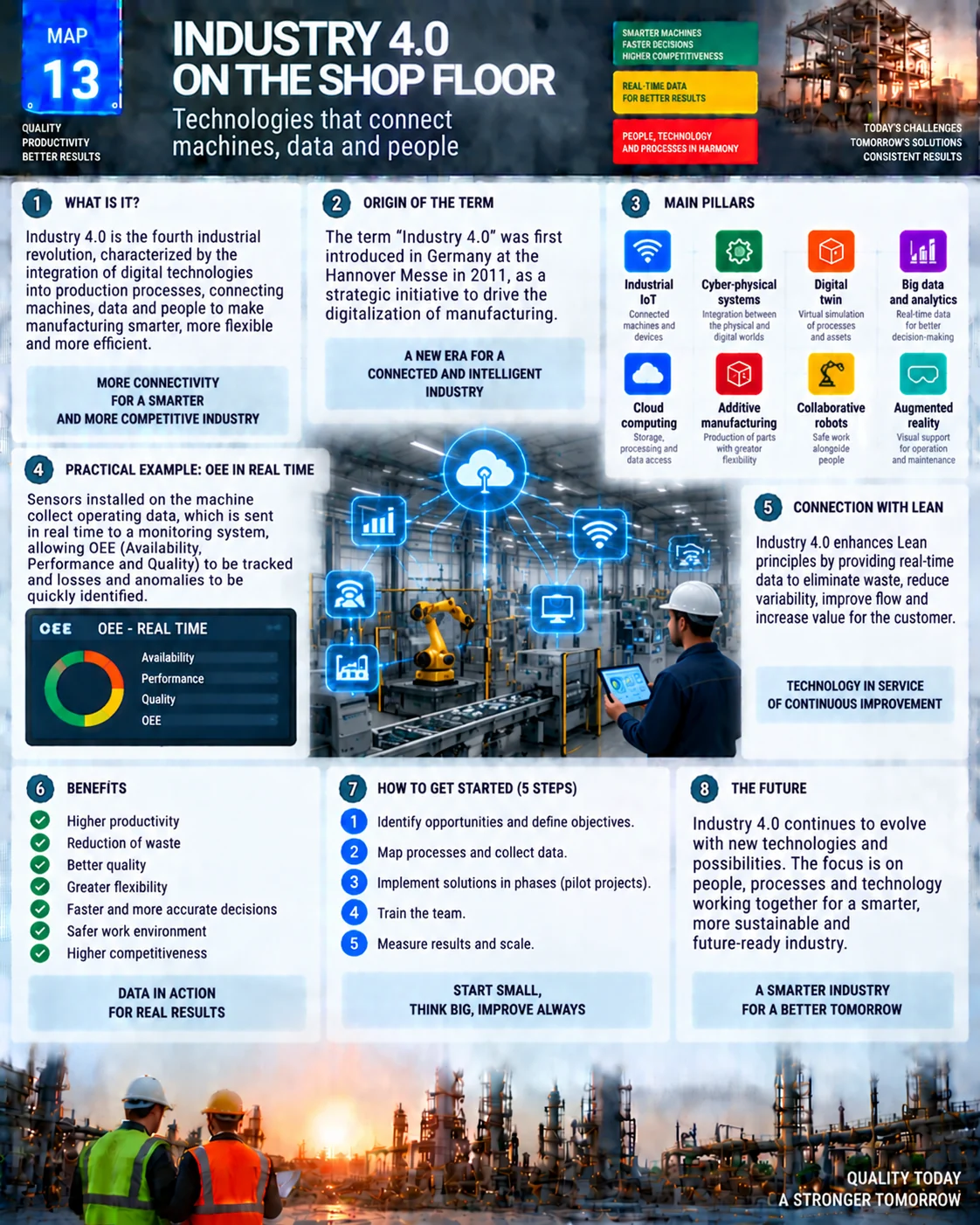
Industry 4.0 visual map
The map sums up the origin of the term, the eight pillars, a real-time OEE example, the link with Lean and the first steps.
Origin of the term
The term Industrie 4.0 was introduced at the Hannover Messe in Germany in 2011 as a strategic initiative to digitize manufacturing. In 2013 the German Academy of Science and Engineering (acatech) published the recommendations that shaped the concept. The three earlier revolutions were steam-powered mechanization, mass production with electricity, and automation with electronics and computers.
The technology pillars
| Technology | What it does on the shop floor |
|---|---|
| Industrial IoT | Connected sensors and machines sending data |
| Cyber-physical systems | Integration between the physical and the digital world |
| Digital twin | Virtual model of processes and assets to simulate before changing |
| Big data and analytics | Real-time data for better decisions |
| Cloud computing | Data storage and processing without local infrastructure |
| Additive manufacturing | 3D printing of parts, prototypes and tooling |
| Collaborative robots | Robots that work safely alongside people |
| Augmented reality | Visual support for operation and maintenance |
Practical example: OEE in real time
Sensors on the machine record whether it is running, stopped or in changeover, count good parts and rejects, and send everything to a dashboard. OEE (availability × performance × quality) stops being a month-end spreadsheet exercise and becomes visible during the shift, with the reason for every stop. The team reacts on the spot, and the daily meeting discusses facts instead of memories.
Connection with Lean
Industry 4.0 amplifies Lean; it does not replace it. Automating a wasteful process only produces waste faster. The order that works is to stabilize and simplify with Lean first, then digitize. Many 4.0 technologies are digital versions of Lean ideas: andon becomes a phone alert, visual management becomes a real-time dashboard, and jidoka gains sensors that stop the machine when a defect is detected.
Benefits
- Higher productivity and less waste.
- Better quality through earlier detection.
- More flexibility for small lots and customized products.
- Faster, more accurate decisions.
- A safer work environment.
- Predictive maintenance that reduces breakdowns, supporting TPM.
How to get started in 5 steps
- Identify opportunities and set objectives tied to real problems: downtime, scrap, lead time.
- Map processes and collect data, even manually at first.
- Implement in phases, with pilot projects on one machine or line.
- Train the team to use and maintain the new tools.
- Measure results and scale what worked. Use NPV and IRR to evaluate the investment.
The future: people at the center
The conversation is moving toward what the European Commission called Industry 5.0: technology serving people, sustainability and resilience. The focus remains that of good industrial engineering: processes, technology and people working together.
Frequently asked questions
What is Industry 4.0?
The fourth industrial revolution, defined by integrating digital technologies such as IoT, data analytics and robotics into production.
When did the term Industry 4.0 appear?
It was introduced at the Hannover Messe in Germany in 2011.
What are the Industry 4.0 technologies?
Industrial IoT, cyber-physical systems, digital twins, big data, cloud, additive manufacturing, collaborative robots and augmented reality.
Does Industry 4.0 replace Lean?
No. It amplifies Lean; digitizing a wasteful process only speeds up the waste.
Where should a plant start?
With a real, measurable problem and a small pilot project, measuring results before scaling up.
Sources
- KAGERMANN, H.; WAHLSTER, W.; HELBIG, J. Recommendations for implementing the strategic initiative INDUSTRIE 4.0. Frankfurt: acatech, 2013.
- EUROPEAN COMMISSION. Industry 5.0: Towards a sustainable, human-centric and resilient European industry. Brussels, 2021.
- SCHWAB, K. The Fourth Industrial Revolution. Geneva: World Economic Forum.
Lean first, then digital.
Download the free "Lean for Leaders" e-book and get your plant ready for digital transformation.
Download the e-book
About the author
Lean Manufacturing & Behavioral Management Specialist
Over 20 years in the automotive and metalworking industries (GM and Dana), Lean Manufacturing practitioner since 2006. SENAI instructor and mentor in Brazil’s Brasil Mais Produtivo program, delivering consulting, training and audits for 50+ companies, combining quality, productivity and people development.