
What job sequencing is
Job sequencing sets the order in which jobs are processed on a resource. With the same jobs and the same capacity, changing only the sequence changes average lead time, work in process and how many orders are late.
It is the most detailed step of production planning and control: after deciding what and how much to make, you decide in which order.
Job sequencing visual map
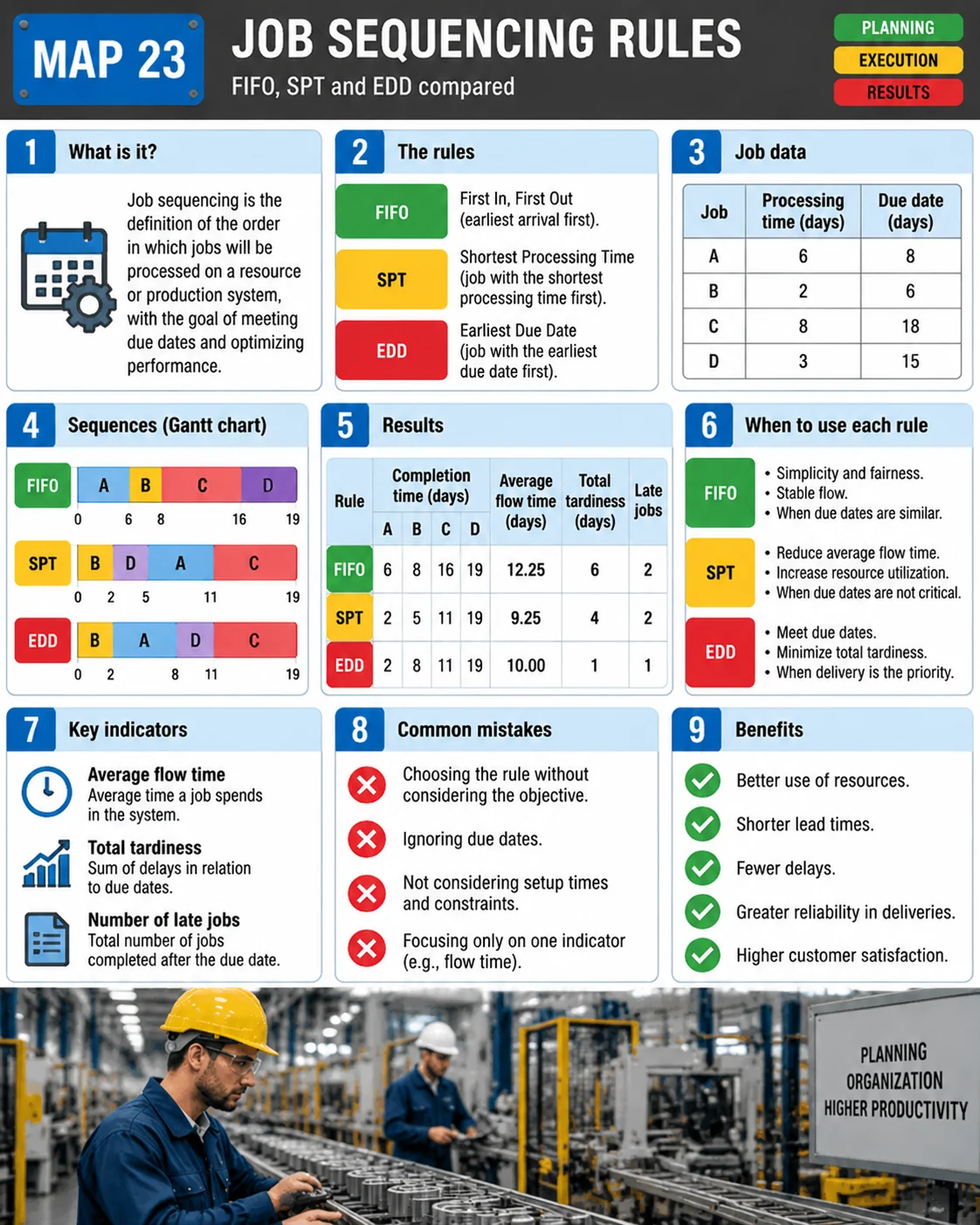
The map compares the three rules on the same set of jobs, with Gantt charts and a results table.
The three rules
| Rule | Criterion | What it favors |
|---|---|---|
| FIFO | First in, first out | Order of arrival |
| SPT | Shortest processing time first | Fast flow, less work in process |
| EDD | Earliest due date first | Meeting due dates |
Example: 4 jobs on one machine
| Job | Processing time (days) | Due date (day) |
|---|---|---|
| A | 6 | 8 |
| B | 2 | 6 |
| C | 8 | 18 |
| D | 3 | 15 |
| Rule | Sequence | Completion | Average flow time | Total tardiness | Late jobs |
|---|---|---|---|---|---|
| FIFO | A, B, C, D | 6, 8, 16, 19 | 12.25 days | 6 | 2 (B and D) |
| SPT | B, D, A, C | 2, 5, 11, 19 | 9.25 days | 4 | 2 (A and C) |
| EDD | B, A, D, C | 2, 8, 11, 19 | 10.00 days | 1 | 1 (C) |
Every sequence ends on day 19 because the total work is the same. What changes is the path: SPT gives the lowest average flow time and EDD the lowest tardiness.
How to calculate the metrics
- Completion time: cumulative sum of processing times in the sequence.
- Average flow time: mean of the completion times (all jobs available at day 0). For FIFO, (6 + 8 + 16 + 19) ÷ 4 = 12.25.
- Tardiness: completion minus due date, when positive. In FIFO, B is 2 days late (8 − 6) and D is 4 days late (19 − 15): 6 in total.
When to use each rule
| Rule | Use it when |
|---|---|
| FIFO | Due dates are similar, flow is stable and fairness to customers matters |
| SPT | The goal is to cut average flow time and work in process, and due dates are not critical |
| EDD | Meeting due dates is the priority |
On a single machine, SPT minimizes average flow time and EDD minimizes maximum lateness, classic results of scheduling theory. In practice, pure SPT can leave long jobs waiting indefinitely, so combine rules or cap waiting times.
Setups, families and the bottleneck
When setup time depends on the sequence, grouping jobs of the same family can matter more than any simple rule. Sequence the bottleneck with care, since it sets the plant's output, and use SMED to make sequencing more flexible.
Common mistakes
- Choosing a rule without considering the objective.
- Ignoring due dates.
- Not considering setup times and constraints.
- Focusing on a single indicator, such as flow time.
- Reshuffling the sequence constantly with no rule.
Frequently asked questions
What is job sequencing?
Setting the order in which jobs are processed on a resource.
What is the difference between FIFO, SPT and EDD?
FIFO follows arrival order; SPT runs the shortest job first; EDD runs the job with the earliest due date first.
Which rule minimizes average flow time?
SPT. In the example, average flow time drops from 12.25 days (FIFO) to 9.25 days.
Which rule reduces tardiness?
EDD. In the example, total tardiness drops to 1 day with only one late job.
How do you calculate average flow time?
Add the completion times of all jobs and divide by the number of jobs.
Sources
- PINEDO, M. L. Scheduling: Theory, Algorithms, and Systems. New York: Springer.
- JACKSON, J. R. Scheduling a production line to minimize maximum tardiness. Los Angeles: UCLA, 1955.
- STEVENSON, W. J. Operations Management. New York: McGraw-Hill.
Want a schedule that keeps promises?
Download the free pull production e-book, with kanban, supermarkets and leveling.
Download the e-book
About the author
Lean Manufacturing & Behavioral Management Specialist
Over 20 years in the automotive and metalworking industries (GM and Dana), Lean Manufacturing practitioner since 2006. SENAI instructor and mentor in Brazil’s Brasil Mais Produtivo program, delivering consulting, training and audits for 50+ companies, combining quality, productivity and people development.