
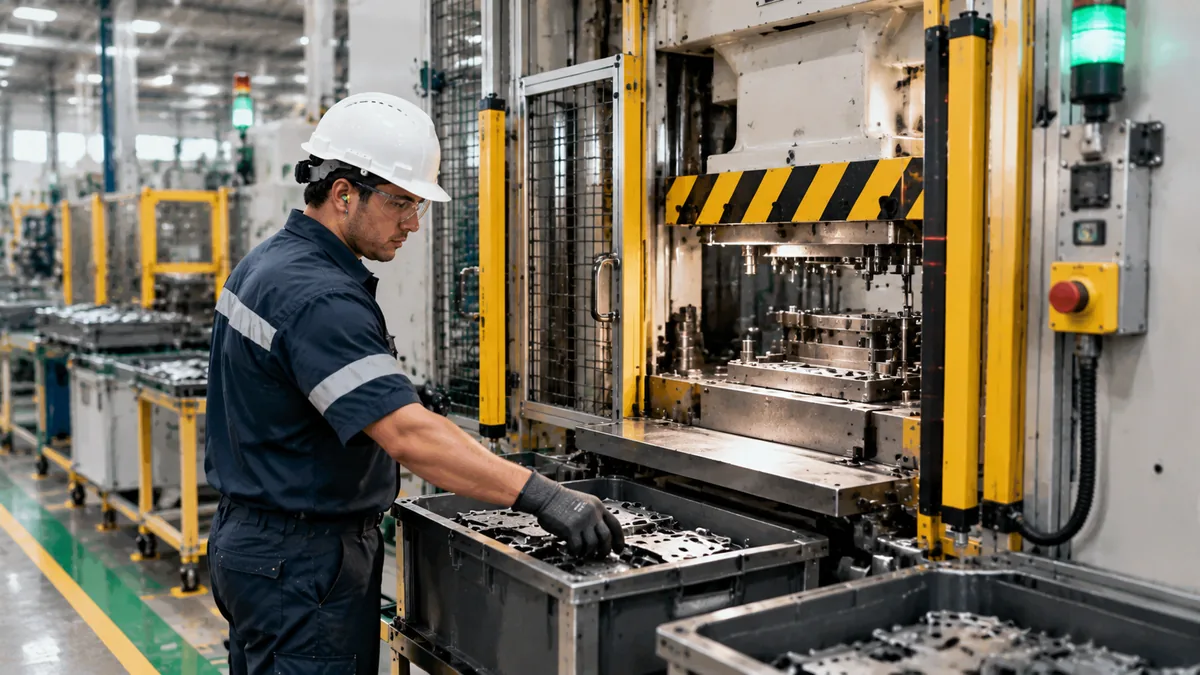
Machine safety and lean: where they meet
Machine safety standards set out how to protect people from hazards on machines: guards, interlocks, emergency stops and safe procedures. Lean aims to remove waste while respecting people. When guarding is well designed, it does not slow the flow: an operator who has no reason to defeat the machine runs with fewer stops and lower risk.
The conflict starts when guarding is an afterthought. A panel that needs a wrench to open at every cleaning gets left off. This article shows how to design protection that protects and also saves time. It does not replace the standards themselves or a qualified safety professional. The Brazilian rule (NR-12) is covered in the Portuguese version; the logic below applies to ISO, EU and OSHA-style requirements.
Visual map of machine safety
The map summarizes guards, interlocks, the safety distance calculation and the daily check routine.

Guards, interlocks and emergency stops
The general order of risk reduction, as in ISO 12100, is: design the hazard out, guard against access to the danger zone, and only then warn and train. Common shop floor measures:
- Fixed guard: for points not needed in daily work. Removable only with a tool.
- Interlocked movable guard: for points reached often (loading, cleaning, clearing a jam). Opening it stops the hazardous motion.
- Presence-sensing device: light curtain, area scanner or pressure mat that stops the machine when someone enters.
- Two-hand control: keeps both hands out of the danger zone during the cycle.
- Emergency stop: visible, within reach, with no automatic restart.
The circuits that perform these functions are the safety-related parts of the control system, assessed under ISO 13849-1 (performance level). In the United States, machine guarding falls under OSHA 29 CFR 1910 Subpart O, with lockout/tagout in 1910.147. The required level comes from a risk assessment, not from preference.
Lean helps with one question per access point: how often does the operator go in, and for how long? If the answer is “several times a shift”, a fixed guard is a design error. An interlocked guard that opens in seconds is the answer. The same thinking applies to poka-yoke: the safe way should be the easy way.
Safety distance for a light curtain
A presence-sensing device protects only if it sits far enough from the hazard for the machine to stop before a hand arrives. ISO 13855 covers the positioning of safeguards by approach speed. The general form is:
S = K × T + C
- S: minimum distance from the curtain to the danger zone (mm).
- K: approach speed of the body or hand (2000 mm/s is the usual value for distances up to 500 mm).
- T: total stopping time in seconds: curtain response (t1) plus machine stopping time (t2).
- C: added reach before detection. For curtains with resolution d up to 40 mm, C = 8 × (d − 14).
Example: a curtain with 30 mm resolution, t1 = 0.03 s and t2 = 0.12 s.
| Item | Calculation | Result |
|---|---|---|
| T | 0.03 + 0.12 | 0.15 s |
| K × T | 2000 × 0.15 | 300 mm |
| C | 8 × (30 − 14) | 128 mm |
| S | 300 + 128 | 428 mm |
The curtain must be at least 428 mm from the danger zone. If the brake wears and the stopping time rises to T = 0.27 s, then S = 2000 × 0.27 + 128 = 668 mm; because that exceeds 500 mm, the standard allows recalculating with K = 1600 mm/s, which gives 1600 × 0.27 + 128 = 560 mm (500 mm minimum). This is why stopping time must be measured, not estimated, and re-measured periodically.
Example: the guard nobody put back
A fictional case to illustrate the numbers. A press has a fixed side guard held by bolts. The operator must open it three times per shift to clear chips and remove a stuck part. With tools, each opening takes 10 minutes, and by the end of the shift the guard is left off.
| Situation | Time per opening | Per shift (3 openings) | Per month (2 shifts, 22 days) |
|---|---|---|---|
| Fixed guard with bolts | 10 min | 30 min | 22.0 h |
| Interlocked movable guard | 1 min | 3 min | 2.2 h |
| Gain | 9 min | 27 min | 19.8 h |
The math: 27 min × 2 shifts × 22 days = 1,188 min, or 19.8 hours a month. The time saved is real, but the bigger gain is that the operator no longer has a reason to defeat the guard. Safety and productivity point to the same change.
Daily check routine on the shop floor
An installed guard is not a guaranteed guard. Interlocks drift, cables break, labels peel. Use a short checklist at the start of each shift, as part of autonomous maintenance:
- Fixed guards in place with all fasteners.
- Interlock: open the guard during a cycle and confirm the hazardous motion stops.
- Emergency stop: press it and confirm the stop and no automatic restart.
- Light curtain: test with the test rod at the stated resolution.
- Signs and lighting visible.
- No sign of defeat: tape, magnets, wedges or a jumper across an interlock switch.
With 12 machines and 6 items of half a minute each, the routine takes 36 minutes per shift, spread across the operators of each machine. Record results on a simple board in the style of visual management: green for OK, red for an abnormality that requires a stop.
Maintenance, adjustment and cleaning tasks that need access require lockout and tagout of energy. Changeovers well planned with SMED can be done with the machine locked out and with less downtime. A tidy workstation from 5S also cuts the risk of tripping, objects in the motion zone and a blocked path to the emergency stop. For the posture side of the workstation, see ergonomics on the assembly line.
Common mistakes
- Treating the standard as a stamp: making the machine compliant on paper without fixing why people defeat it.
- Guards that get in the way of work: if it disrupts the cycle, it will be removed. Involve the operator in the design.
- Measuring stopping time once: brakes age and the safety distance stops being valid.
- Relying only on training and signs: they are the last layer, not the first.
- Modifying a safety circuit without competence: changes to interlocks need a qualified person and revalidation.
- Ignoring older machines: existing equipment also needs a risk assessment.
Frequently asked questions
Are machine safety and lean compatible?
Yes. Well-designed guarding reduces stops, rework and workarounds. The conflict exists only when guarding is poorly thought out.
What is the difference between a fixed guard and an interlocked guard?
A fixed guard opens only with a tool and suits rarely accessed points. An interlocked guard opens without a tool and stops the hazardous motion when opened, so it suits frequent access.
How do you calculate the safety distance of a light curtain?
With S = K × T + C, per ISO 13855. In the example, K = 2000 mm/s, T = 0.15 s and C = 128 mm give 428 mm.
How often should safety devices be checked?
Simple checks by the operator at the start of each shift. More complete tests follow the maintenance plan and what the manufacturer and risk assessment require.
Can I bypass an interlock to save time?
No. Defeating a safety device exposes people and the company. If the guard gets in the way, fix the design instead of disabling the device.
Where does lockout/tagout fit in?
It covers work where energy could start or release unexpectedly, such as repair, adjustment and jam clearing. It complements guards and does not replace them.
Sources
- ISO 12100: Safety of machinery — General principles for design — Risk assessment and risk reduction.
- ISO 13849-1: Safety of machinery — Safety-related parts of control systems.
- ISO 13855: Safety of machinery — Positioning of safeguards with respect to the approach speeds of parts of the human body.
- OSHA. 29 CFR 1910 Subpart O: Machinery and Machine Guarding; 29 CFR 1910.147: The control of hazardous energy (lockout/tagout).
Know where the waste is hiding?
The next step is organizing the workstation. Download the free "5S in Practice" e-book.
Download the 5S e-book
About the author
Lean Manufacturing & Behavioral Management Specialist
Over 20 years in the automotive and metalworking industries (GM and Dana), Lean Manufacturing practitioner since 2006. SENAI instructor and mentor in Brazil’s Brasil Mais Produtivo program, delivering consulting, training and audits for 50+ companies, combining quality, productivity and people development.