- What autonomous maintenance is
- Who does what: operator and maintenance
- The 7 steps of autonomous maintenance
- The steps in practice
- Example: the step 3 standard and the time it takes
- Tags and managing abnormalities
- How to tell whether it is working
- Autonomous, preventive and corrective maintenance
- Common mistakes
- Next step
- Frequently asked questions
What autonomous maintenance is
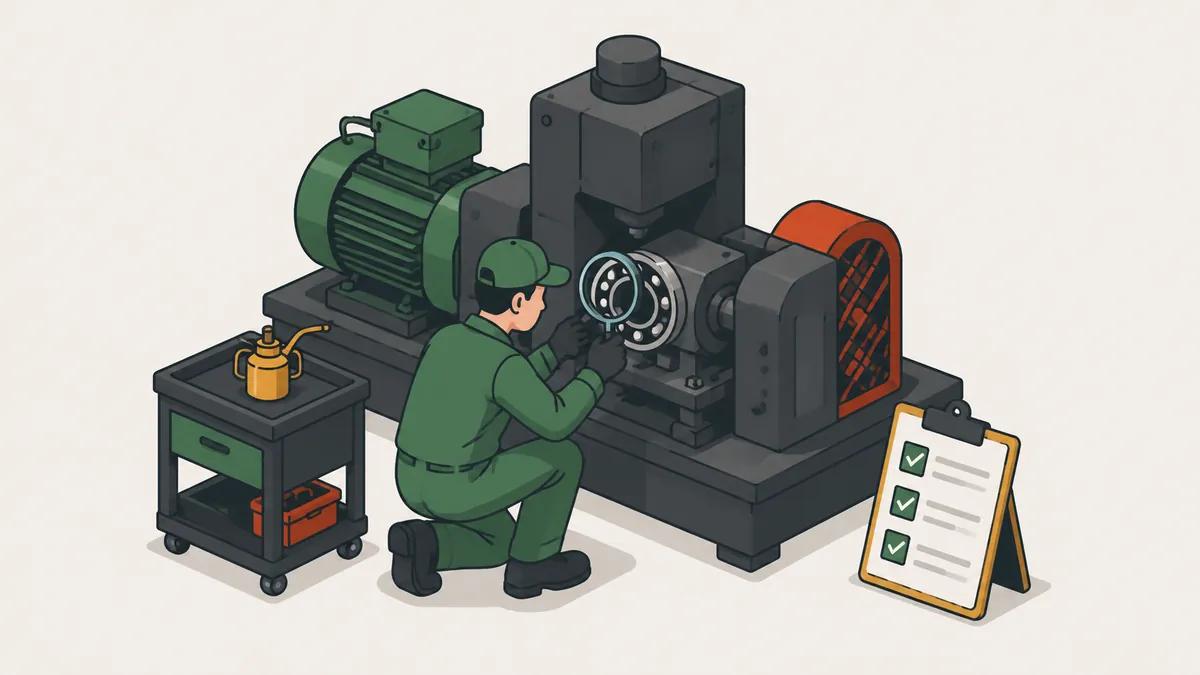
Autonomous maintenance (jishu hozen in Japanese) is the TPM pillar that hands operators the basic care of their equipment: cleaning, inspecting, lubricating and tightening. It is not dumping work on production. It recognizes that the person running the machine all shift is the first to notice that something changed: a new noise, a vibration, a fresh leak.
The seven-step program is described in the TPM literature associated with Seiichi Nakajima and the Japan Institute of Plant Maintenance (JIPM). Some authors group or name the steps a little differently, so what matters is the logic: start with cleaning, learn from what it reveals, write a standard and only then widen the team's responsibility.
The expected gains are practical: failures caught early, cleaner and better-lubricated equipment, fewer minor stops and a team that knows its machine. Maintenance gains time for planned work and for root cause analysis of failures. Operations gains a safer, more predictable workstation. The program works best on a base of 5S, because cleanliness and order are the starting point.
Who does what: operator and maintenance
| Responsibility | Operator | Maintenance |
|---|---|---|
| Daily cleaning | Yes | Supports at the start |
| Basic inspection and lubrication | Yes | Sets the standard |
| Detecting and logging abnormalities | Yes | Analyzes and prioritizes |
| Specialized repairs and adjustments | No | Yes |
| Design improvements | Suggests | Carries out |
An autonomous operator does not replace the mechanic. The operator frees the mechanic for work that needs real expertise. Leadership plays a decisive role: it must set aside time in the shift for cleaning and inspection. If the production target fills every minute, the program dies within weeks.
The culture shift is the biggest challenge. Many operators see cleaning as a minor chore, and many mechanics fear losing ground. It helps to talk about the gain for each side, to show in practice that an operator notices in minutes what maintenance might take hours to find, and to recognize good observations in public. Safety comes with it: operators must know how to lock out and tag out equipment energy and clean moving parts only with the machine stopped.
The 7 steps of autonomous maintenance
| Step | What to do | Expected result |
|---|---|---|
| 1. Initial cleaning and inspection | Clean the equipment thoroughly and tag everything you find | Abnormalities identified and restored |
| 2. Sources of contamination and hard-to-reach areas | Attack the source of dirt and make access easier | Less dirt and faster cleaning |
| 3. Provisional standards | Write the cleaning, inspection and lubrication standard | One-page standard that fits the shift |
| 4. General inspection | Train the operator on technical items | Operator recognizes more defects |
| 5. Autonomous inspection | Revise the standards and run them in the routine | Inspection done and verified by the operator |
| 6. Workplace organization and order | Standardize tools, materials, waste and records | The whole area standardized |
| 7. Autonomous management | The team takes ownership of goals, metrics and improvement | Continuous improvement at the station |
Steps 1 to 3 build the basic condition of the equipment. Steps 4 and 5 build the ability to inspect. Steps 6 and 7 move the team toward self-management. That grouping is a practical way to organize the steps, not a single fixed rule. Each step advances only after a leader audit.
The steps in practice
Step 1. Clean with attention, looking into every corner. While cleaning, operators find leaks, play, loose bolts and odd noises. Each finding gets a tag. Cleaning is inspecting: the rag touches the whole machine and reveals what the dirt was hiding.
Step 2. Go after the source. Cleaning the same spot every day without treating the cause is waste. Illustrative example: if oil always drips from the same point, a drip tray or a new seal solves it for good, and that daily cleaning drops out of the standard.
Step 3. With what the team has learned, it writes a simple standard. It has to fit in the time the operator actually has. See the example below.
Step 4. Maintenance trains operators on drives, hydraulics, pneumatics and electrical basics. More abnormalities show up and get fixed. Training should be hands-on, with the machine open, and end with a simple check that the operator can recognize the defect.
Steps 5 to 7. The standards are revised with what was learned and the operator runs them. Then the station's organization extends to the whole area, along the lines of 5S, and the team takes ownership of its goals and improvements, supported by standardized work.
Example: the step 3 standard and the time it takes
Illustrative example for a pilot machine. The time set aside is 15 minutes per shift. The real checkpoints come from the tags in step 1.
| Checkpoint | Activity | Frequency | Time |
|---|---|---|---|
| Spindle guides | Clean and lubricate | Daily | 3 min |
| Air filter | Inspect and drain | Daily | 2 min |
| Oil level and leaks | Check | Daily | 2 min |
| Machine area | General cleaning | Daily | 3 min |
| Motor mount | Check tightness | Weekly | 5 min |
Time check: the daily tasks add up to 3 + 2 + 2 + 3 = 10 minutes. On the day of the weekly task, 10 + 5 = 15 minutes, exactly the time set aside. In a month with 22 shifts and 4 weeks, that is 10 × 22 = 220 minutes plus 5 × 4 = 20 minutes, or 240 minutes (4 hours) per machine. Twenty-two 8-hour shifts are 176 hours, or 10,560 minutes. So the program uses 240 ÷ 10,560 = 2.3% of shift time.
Golden rules: color-coded lubricants, checkpoints marked on the machine and a total time that fits inside the shift. Photos of the correct condition and visual cues, such as an oil level mark, a rotation arrow and the green band on a gauge, replace long explanations and make a deviation obvious to anyone walking by.
Tags and managing abnormalities
Use two kinds of tag: one for abnormalities the operator fixes and one for those that need maintenance. Each tag goes on a board with a date, an owner and a due date. A tag that hangs for months destroys the program's credibility. Pair the board with the area's visual management.
A good habit is a quick weekly review of ten minutes, standing at the board. The leader asks what is open, what is late and what needs help. That ritual shows the team that the program has an owner and that the time spent cleaning pays back.
How to tell whether it is working
Track a few metrics: abnormalities opened and closed, response time, adherence to the standard and minor stops. For the effect on maintenance, use MTBF and MTTR. For the overall effect, use OEE, where minor stops usually fall under the performance loss.
Illustrative example of minor stops on the pilot machine. Planned time for the week is 5 shifts of 8 hours, or 2,400 minutes. Before the program, 10 stops of 6 minutes added up to 60 minutes, or 2.5% of the time (60 ÷ 2,400). Afterward, 4 stops of 6 minutes add up to 24 minutes, or 1.0%. The gain is 60 − 24 = 36 minutes per week, or 1.5 percentage points of planned time. The numbers are illustrative: the real value comes from your own before-and-after record.
Autonomous, preventive and corrective maintenance
| Aspect | Autonomous | Preventive | Corrective |
|---|---|---|---|
| Who does it | Operator | Maintenance | Maintenance |
| What they do | Clean, inspect, lubricate, tighten | Planned interventions by time or usage | Repair after the failure |
| Goal | Catch deviations early and keep basic conditions | Prevent failures with scheduled replacement and overhaul | Restore operation |
One does not replace the others. Autonomous maintenance reduces the number of failures that reach the corrective stage and gives preventive maintenance better information about the real condition of the equipment.
Common mistakes
- Not setting aside time in the shift. The production target eats the cleaning and the program ends.
- Leaving tags open for months, with no owner or due date.
- Skipping steps without an audit. Each step must be consolidated before the next.
- Writing standards that are too long for anyone to follow.
- Handing over the task without training. Step 4 exists so the operator knows what to look for.
- Starting on every machine at once instead of one pilot machine.
Another risk is rushing to show results. Autonomous maintenance takes time to mature. If people are measured on the number of steps completed rather than the quality of what was learned, the team goes through the ritual and misses the learning.
Next step
Pick one pilot machine and schedule an initial cleaning day with the operator and a mechanic together. Log every abnormality on a tag. In two weeks you will have the material to write the step 3 standard. Move on only when the previous step is consolidated, with a leader audit, and track minor stops from day one so you have a before and an after.
After the first machine, use what you learned as a model. The standard, the tag board and the weekly review routine can be replicated on the next machines, with adjustments for each piece of equipment.
Frequently asked questions
What is autonomous maintenance in TPM?
It is the TPM pillar in which the operator takes care of the equipment's basic conditions: cleaning, inspection, lubrication and tightening. It is also called jishu hozen.
What are the 7 steps of autonomous maintenance?
Initial cleaning and inspection, eliminating sources of contamination and hard-to-reach areas, provisional standards, general inspection, autonomous inspection, workplace organization and order, and autonomous management.
Does the operator take over the mechanic's job?
No. The operator handles basic conditions and spots abnormalities. Specialized repairs and adjustments stay with maintenance.
How much time per shift does autonomous maintenance take?
It depends on the equipment. A practical starting point is 10 to 15 minutes per shift, adjusted as the standards get leaner.
How long does it take to complete the 7 steps?
It depends on the number of machines and on discipline. It usually takes many months per area, and each step advances only after an audit.
What is the difference between autonomous maintenance and 5S?
5S organizes and cleans the workstation. Autonomous maintenance builds on that base and adds inspection, lubrication and equipment-focused standards.
How do I start without stopping production?
On a pilot machine, with an agreed time for the initial cleaning and maintenance present.
Which metrics show whether it works?
Abnormalities opened and closed, adherence to the standard, minor stops, MTBF, MTTR and OEE.
Sources
- NAKAJIMA, S. Introduction to TPM: Total Productive Maintenance. Portland: Productivity Press.
- Lean Enterprise Institute. Total Productive Maintenance. Lean Lexicon. https://www.lean.org/lexicon-terms/total-productive-maintenance/
- Lean Enterprise Institute. Standardized Work. Lean Lexicon. https://www.lean.org/lexicon-terms/standardized-work/
- LIKER, J. The Toyota Way: 14 Management Principles from the World's Greatest Manufacturer. McGraw-Hill.
Want to start with the foundation of TPM?
Download the free 5S in Practice e-book and build the cleaning and order standard that autonomous maintenance depends on.
Download the e-book
About the author
Lean Manufacturing & Behavioral Management Specialist
Over 20 years in the automotive and metalworking industries (GM and Dana), Lean Manufacturing practitioner since 2006. SENAI instructor and mentor in Brazil’s Brasil Mais Produtivo program, delivering consulting, training and audits for 50+ companies, combining quality, productivity and people development.