What MSA is
MSA (measurement system analysis) evaluates the whole measurement system: gauge, method, operator and environment. Before using data for SPC or Cp and Cpk, you need to know how much variation comes from the measurement itself.
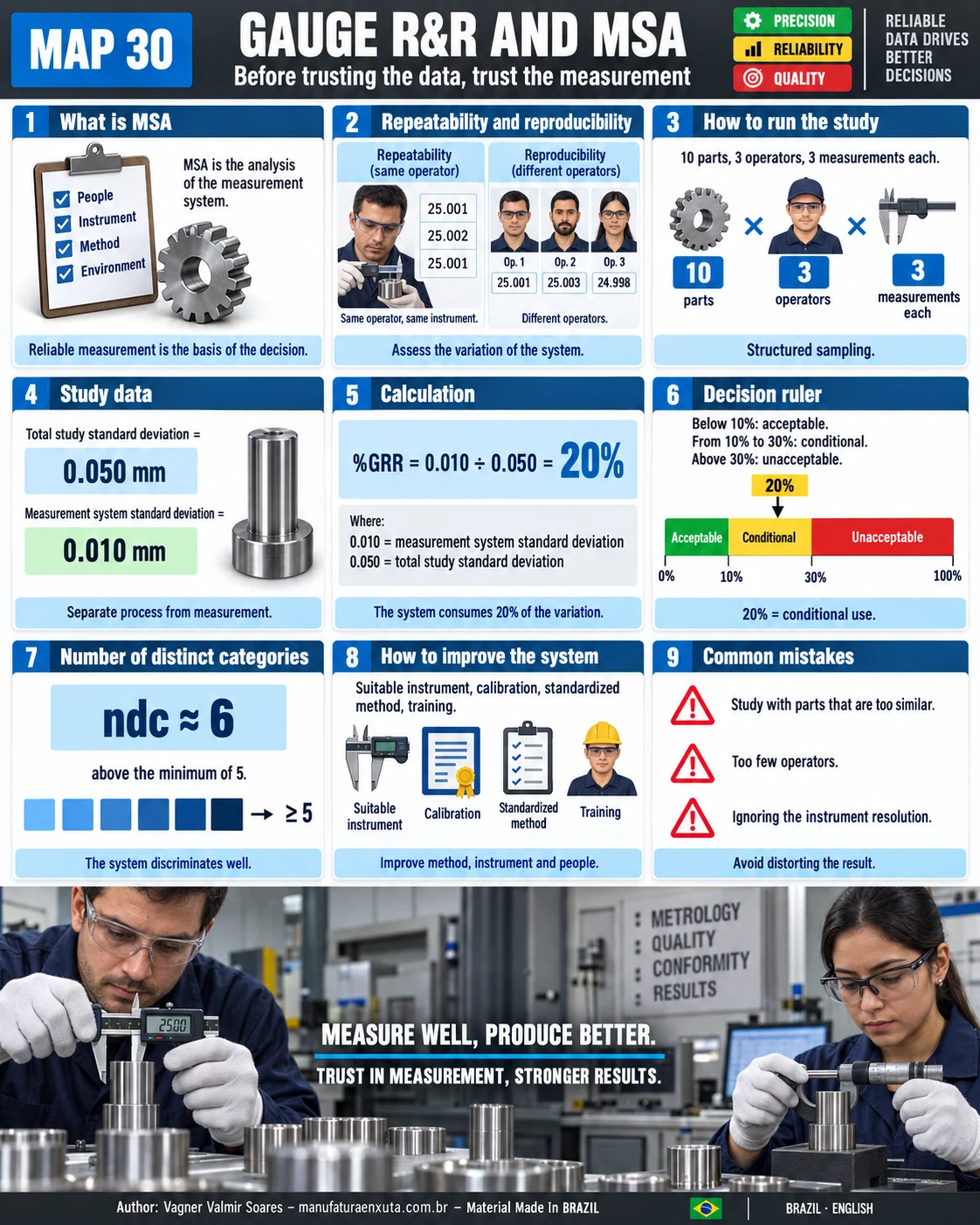
Gauge R&R and MSA visual map
The map shows the study plan, the %GRR calculation and the decision rule.
Repeatability and reproducibility
| Component | What it measures | Indicates |
|---|---|---|
| Repeatability | Same operator, same gauge, same part | Equipment variation |
| Reproducibility | Different operators measuring the same parts | Variation between operators and method |
Gauge R&R combines both: it is the total variation of the measurement system.
How to run the study
- Choose 10 parts that represent the real process variation.
- Select 3 operators who measure in daily work.
- Each operator measures each part 3 times, in random order and without seeing earlier results: 90 measurements.
- Analyze with the average and range method or ANOVA.
Example and decision rule
Total study variation = 0.050 mm; measurement system variation (GRR) = 0.010 mm.
%GRR = 0.010 ÷ 0.050 = 20%
| %GRR | Decision (AIAG guideline) |
|---|---|
| Below 10% | Acceptable |
| 10% to 30% | Conditional: may be accepted depending on the application and cost |
| Above 30% | Unacceptable: improve the measurement system |
Part variation: √(0.050² − 0.010²) ≈ 0.049. Number of distinct categories: ndc = 1.41 × 0.049 ÷ 0.010 ≈ 6.9, truncated to 6, above the minimum of 5.
How to improve the measurement system
- Poor repeatability: unsuitable gauge, wear, low resolution, part fixturing.
- Poor reproducibility: non-standard method, lack of training, different reading habits.
- Up-to-date calibration and a controlled environment.
Common mistakes
- Using parts that are too similar.
- Operators knowing which part they are measuring.
- Ignoring gauge resolution (the 1/10 of tolerance rule).
- Trusting data without ever running the study.
Frequently asked questions
What is Gauge R&R?
A repeatability and reproducibility study that measures the variation of the measurement system.
What %GRR is acceptable?
Below 10% is acceptable; 10% to 30% is conditional; above 30% is unacceptable.
How many parts and operators are used?
A typical study uses 10 parts, 3 operators and 3 measurements per part.
What is ndc?
The number of distinct categories the system can separate; it should be at least 5.
What is the difference between repeatability and reproducibility?
Repeatability is variation for the same operator; reproducibility is variation between operators.
Sources
- AIAG. Measurement Systems Analysis: Reference Manual. 4th ed. Southfield: AIAG, 2010.
- MONTGOMERY, D. C. Introduction to Statistical Quality Control. Hoboken: Wiley.
- WHEELER, D. J. EMP III: Evaluating the Measurement Process. Knoxville: SPC Press.
Want the tools ready to use?
Download the free "Problem Solving Kit" e-book, with PDCA, A3, 5 Whys and Ishikawa.
Download the e-book
About the author
Lean Manufacturing & Behavioral Management Specialist
Over 20 years in the automotive and metalworking industries (GM and Dana), Lean Manufacturing practitioner since 2006. SENAI instructor and mentor in Brazil’s Brasil Mais Produtivo program, delivering consulting, training and audits for 50+ companies, combining quality, productivity and people development.