- What CPM and PERT are
- CPM and PERT visual map
- Origins: Polaris and DuPont
- Network elements
- Worked example: a 14-day critical path
- How to calculate ES, EF, LS, LF and float
- Uncertain durations: PERT's three-point estimate
- How to shorten the schedule
- Common applications
- Watch-outs and checklist
- Frequently asked questions
What CPM and PERT are
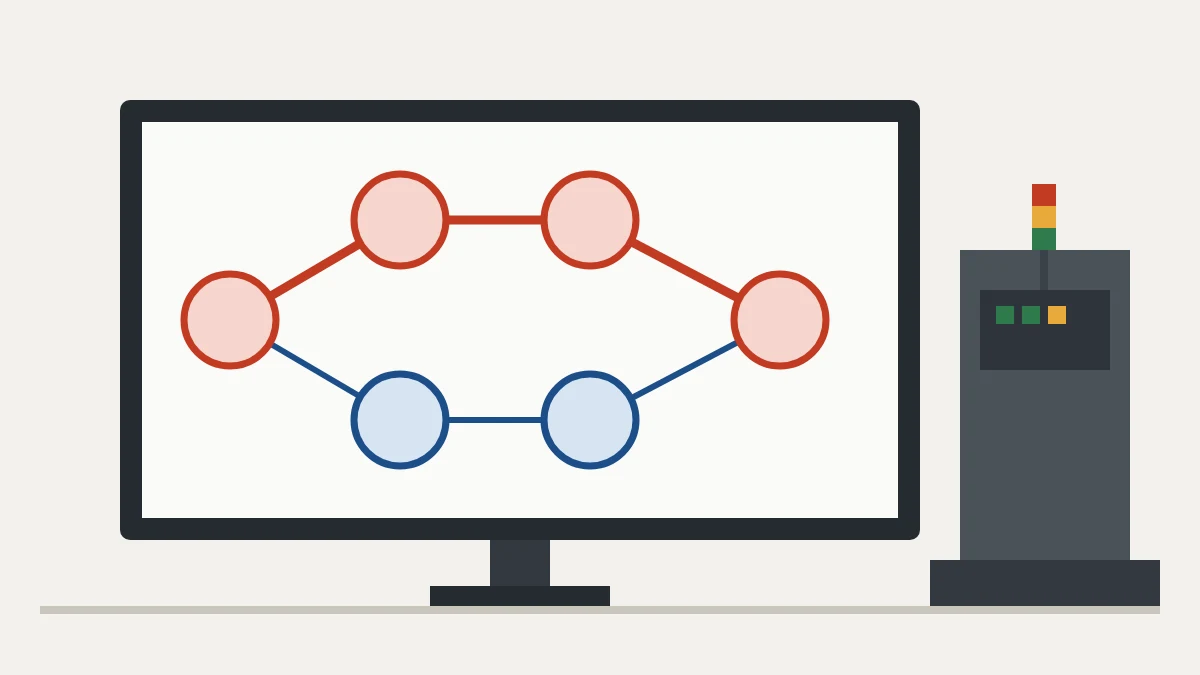
The critical path method (CPM) and PERT are techniques for planning and controlling projects by drawing the activities as a network with their dependencies and durations. The goal is to find the shortest possible project duration and the activities that cannot slip: the critical path.
They apply to setting up a line, installing a machine, renovating an area, launching a product or organizing a maintenance shutdown. Whenever tasks depend on one another, the network shows where a delay is expensive and where there is slack.
CPM and PERT visual map
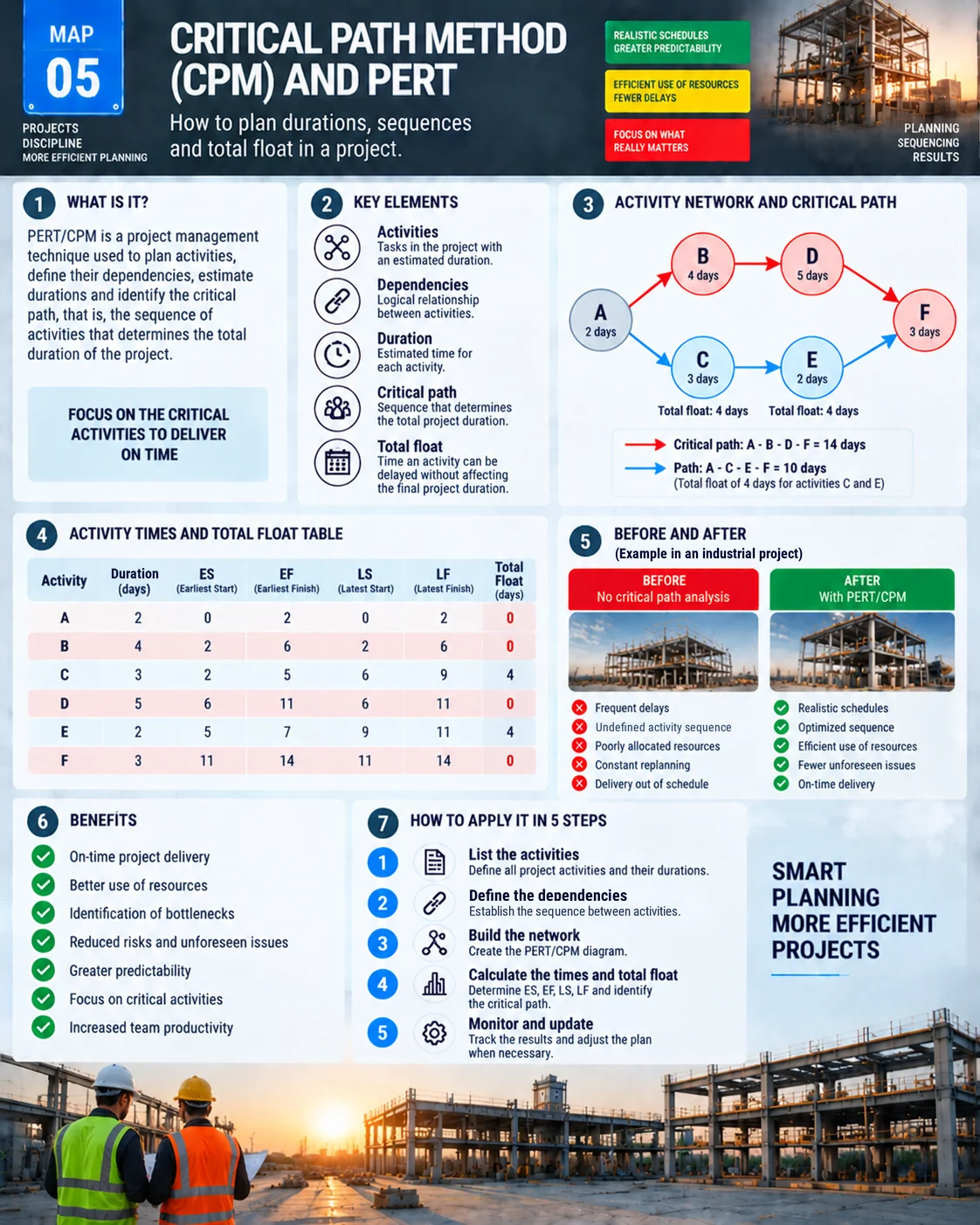
The map shows the example network, the 14-day critical path, the table of early and late times with total float, and the steps.
Origins: Polaris and DuPont
Both techniques appeared in the late 1950s. CPM was developed by James Kelley and Morgan Walker for DuPont, with known durations and a focus on cost. PERT (Program Evaluation and Review Technique) was created for the U.S. Navy's Polaris missile program to handle uncertain durations. Today any project software combines the two.
Network elements
| Element | Meaning |
|---|---|
| Activity | A task that takes time and resources |
| Predecessor | What must finish before an activity can start |
| Duration | Estimated time of each activity |
| ES and EF | Early start and early finish |
| LS and LF | Late start and late finish |
| Total float | How long an activity can slip without delaying the project |
Worked example: a 14-day critical path
A project has six activities: A (2 days); B (4 days, after A); C (3 days, after A); D (5 days, after B); E (2 days, after C); F (3 days, after D and E). There are two paths:
- A, B, D, F: 2 + 4 + 5 + 3 = 14 days (critical path).
- A, C, E, F: 2 + 3 + 2 + 3 = 10 days.
| Activity | Duration | Predecessor | ES | EF | LS | LF | Float |
|---|---|---|---|---|---|---|---|
| A | 2 | - | 0 | 2 | 0 | 2 | 0 |
| B | 4 | A | 2 | 6 | 2 | 6 | 0 |
| C | 3 | A | 2 | 5 | 6 | 9 | 4 |
| D | 5 | B | 6 | 11 | 6 | 11 | 0 |
| E | 2 | C | 5 | 7 | 9 | 11 | 4 |
| F | 3 | D, E | 11 | 14 | 11 | 14 | 0 |
The project finishes in 14 days. A, B, D and F have zero float: any delay in them delays the whole project. C and E have 4 days of float.
How to calculate ES, EF, LS, LF and float
Forward pass: an activity's ES is the largest EF of its predecessors; EF = ES + duration. F starts on day 11 because it waits for D (EF 11), even though E finishes on day 7.
Backward pass: from the end, an activity's LF is the smallest LS of its successors; LS = LF − duration. E must finish by day 11 (LS of F), so it can start as late as day 9.
Total float = LS − ES = LF − EF
For E: 9 − 5 = 4 days. Activities with zero float form the critical path.
Uncertain durations: PERT's three-point estimate
When a duration is uncertain, PERT uses three estimates: optimistic (o), most likely (m) and pessimistic (p).
Expected duration = (o + 4m + p) ÷ 6 | Standard deviation = (p − o) ÷ 6
If activity D has o = 3, m = 5 and p = 7 days, its expected duration is (3 + 20 + 7) ÷ 6 = 5 days, with a standard deviation of about 0.67 days. Adding up the variances of the critical activities gives a sense of the chance of meeting the deadline.
How to shorten the schedule
- Crashing: add resources to critical activities, starting with the cheapest ones to speed up.
- Fast tracking: overlap critical activities that were sequential, accepting more risk.
- Watch out: shortening the critical path can make another path critical. In the example, A, C, E, F only becomes critical if the main path drops below 10 days.
For maintenance shutdowns, CPM usually works together with TPM and SMED to cut machine downtime.
Common applications
- Construction and infrastructure projects.
- Plant setup and equipment installation.
- Product development and R&D.
- IT projects and system rollouts.
- Events and planned maintenance shutdowns.
Watch-outs and checklist
- Overly optimistic duration estimates.
- A network that is not updated after scope changes.
- The network alone ignores resource limits: two activities may need the same crew.
- Non-critical activities still need follow-up.
- All activities listed.
- Dependencies validated with the people doing the work.
- Durations estimated from data or three points.
- ES, EF, LS, LF and float calculated.
- Critical path highlighted and reviewed every week.
Frequently asked questions
What is the critical path?
The sequence of activities with zero float; it sets the shortest project duration, and any delay on it delays delivery.
How do you calculate total float?
Total float = LS − ES (or LF − EF). In the example, activity E has 9 − 5 = 4 days of float.
What is the difference between PERT and CPM?
CPM works with known durations and focuses on time and cost; PERT uses three estimates to handle uncertain durations.
How is the PERT expected duration calculated?
With (optimistic + 4 × most likely + pessimistic) ÷ 6.
Can the critical path change?
Yes. If critical activities are sped up or others slip, a different path may become the longest.
Sources
- KELLEY, J. E.; WALKER, M. R. Critical-path planning and scheduling. Proceedings of the Eastern Joint Computer Conference, 1959.
- PROJECT MANAGEMENT INSTITUTE. A Guide to the Project Management Body of Knowledge (PMBOK Guide). Newtown Square: PMI.
- SLACK, N.; BRANDON-JONES, A.; JOHNSTON, R. Operations Management. Harlow: Pearson.
Project running late? Find the root cause.
Download the free "Problem Solving Kit" e-book, with PDCA, A3, 5 Whys and Ishikawa.
Download the e-book
About the author
Lean Manufacturing & Behavioral Management Specialist
Over 20 years in the automotive and metalworking industries (GM and Dana), Lean Manufacturing practitioner since 2006. SENAI instructor and mentor in Brazil’s Brasil Mais Produtivo program, delivering consulting, training and audits for 50+ companies, combining quality, productivity and people development.