How to read this list
There is no single, official list of Industry 4.0 characteristics. Authors and institutions group the elements in different ways. The seven below are a practical organization, designed for people who need to recognize a connected plant in day-to-day work and decide where to start.
Use the list as a mirror, not as a target. Walk the plant with it in hand, mark what already exists in partial form, and note the gaps that weigh most on daily operations. The order of the characteristics also matters: connectivity and data come before decentralized decision-making, because you cannot decentralize what you cannot yet see.
For the general concept, the technologies, and the first step, read Industry 4.0 on the shop floor. Here the focus is on recognizing each trait and understanding what it demands of the process.
1. Connectivity of machines and systems
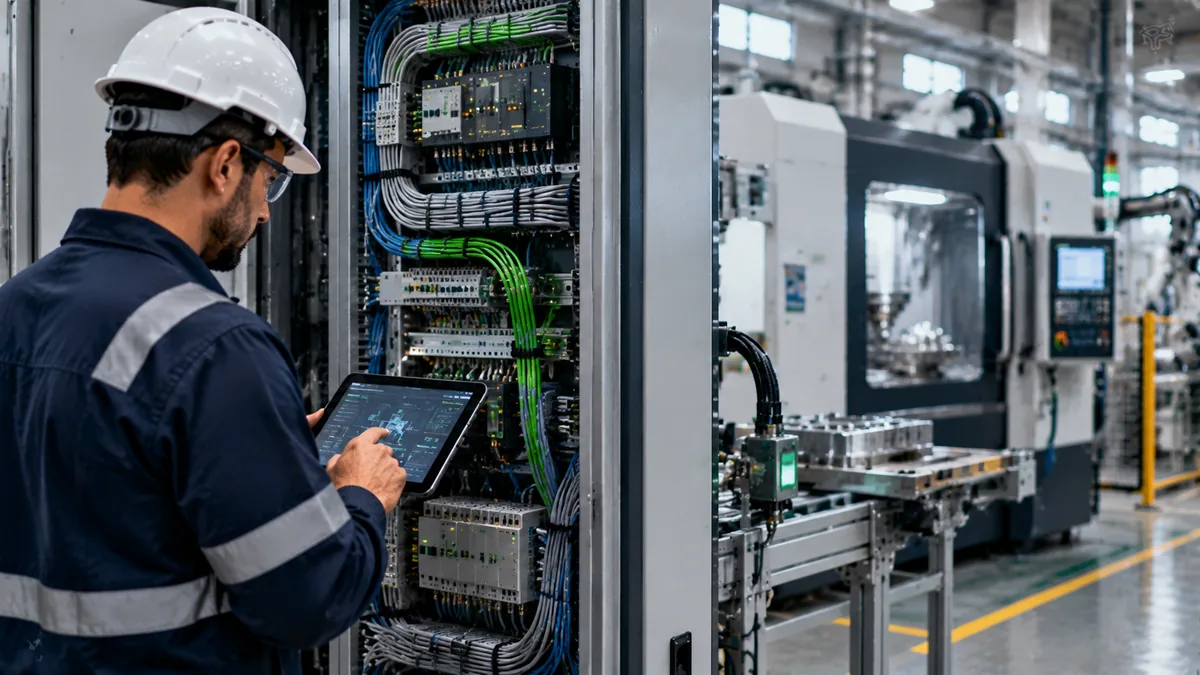
Equipment, tools, and systems exchange information with each other through networks and sensors. A press alerts the production system when it stops. A conveyor reports its occupancy to planning. Without connection, the data stays trapped in each machine.
Practical requirement: standardize how equipment communicates events, even the oldest machines, by retrofitting sensors.
2. Near real-time data
Data is no longer collected on a clipboard at the end of the shift but recorded at the moment the event occurs. This makes it possible to see stops, scrap, and pace while there is still time to act.
Illustrative scenario: a machine stops 6 times per shift, and each stop lasts 5 minutes. That is 6 × 5 = 30 minutes of downtime per shift. In a 480-minute shift, this represents 30 ÷ 480 = 0.0625, or 6.25% of the time. Without automatic recording, these short stops tend to go unnoticed, and that is exactly where near real-time data shows its value.
Practical requirement: define a few relevant indicators, such as OEE, before collecting everything that can be collected.
3. Automation and robotics
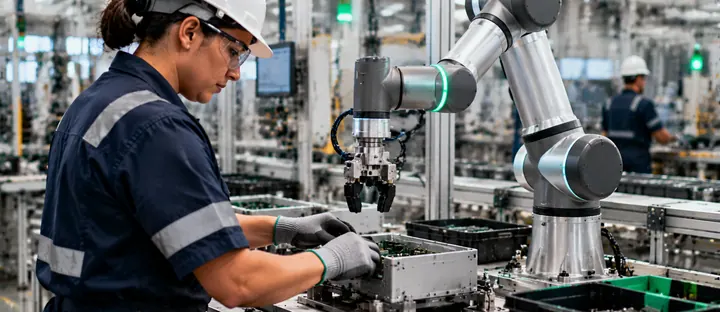
Repetitive, heavy, or high-precision tasks are performed by programmable machines, from industrial robots to automated transport systems. Automation is part of the picture, but it does not define it alone: an isolated automated cell is not, by itself, an Industry 4.0 plant.
Practical requirement: a standardized, stable process before automation.
4. Flexibility and customization
The line adapts to product variations with few changeovers and little lost time. Production schedules change more easily, and the configuration of each order reaches the machine digitally.
Practical requirement: reduce setup time. The quick changeover technique (SMED) is a prerequisite, not a luxury.
5. Traceability
Each lot, part, or order can be tracked from raw material to shipping, with a record of parameters, operator, and equipment. When a defect appears, it is possible to isolate exactly what was affected.
Practical requirement: unique material identification and discipline in recording at the workstation.
6. Vertical and horizontal integration
Vertical integration links the shop floor to management and planning systems. Horizontal integration links the plant to suppliers and customers along the chain. The result is planning that reacts to reality rather than to an outdated master record. See how this affects production planning and control (PCP).
Practical requirement: correct master data for routings, structures, and times. Bad data that is connected is still bad data, only faster.
7. Decentralized decision-making and advanced analytics
Systems and people on site make simple decisions without waiting for the hierarchy: rescheduling an order, stopping a machine that shows a failure trend, requesting maintenance. Data analysis supports predictions and alerts.
Practical requirement: clear rules about who decides what, and training to interpret the alerts.
Summary of the seven characteristics
| No. | Characteristic | What you see on the plant floor | Prerequisite |
|---|---|---|---|
| 1 | Connectivity | Machines send events to a system | Communication standard |
| 2 | Near real-time data | Stops and scrap visible immediately | Defined indicators |
| 3 | Automation and robotics | Repetitive tasks done by machines | Stable process |
| 4 | Flexibility | Quick changeovers and an adaptable schedule | SMED applied |
| 5 | Traceability | Lot tracked end to end | Unique identification |
| 6 | Integration | Shop floor and management speaking the same language | Correct master data |
| 7 | Decentralized decision-making | Alerts and actions at the workstation itself | Rules of autonomy |
What the list does not tell you
A common mistake is to measure progress by the number of characteristics present. A plant with five of them well integrated into daily work is worth more than one with all seven installed and ignored by the team. The final test is use: a characteristic exists when someone makes a better decision because of it.
Having all seven characteristics does not make a plant good. They describe capability, not results. An operation with a lot of waste will keep wasting, just with more charts. The final criteria remain customer value, quality, and cost. That is why the comparison with Lean, made in Industry 4.0 vs lean manufacturing, is essential reading.
Next step
Print the table and rate one production line from 0 to 2 on each characteristic: 0 for absent, 1 for partial, 2 for established. Flag the zero scores that are prerequisites for others, such as the communication standard and indicators. Define one action per quarter to raise one of them, and prioritize the one that removes a problem the team already feels today. For the complete adoption sequence, see the 5 steps of digital transformation.
Frequently asked questions
Is there an official list of Industry 4.0 characteristics?
No. Each author groups them differently. The list in this article is a practical organization to make recognition and diagnosis easier.
Is automation the same as Industry 4.0?
No. Automation is one of the characteristics. Industry 4.0 also involves connectivity, data, integration, and decisions supported by information.
Do I need all seven characteristics?
No. They serve as a map. What matters is choosing the ones that solve the operation's real problems.
Can older machines be part of this model?
They can, with retrofitted sensors and communication modules, as long as the process is stable and the data has value.
Which characteristic should I start with?
In general, near real-time data on a few indicators, because they show where the losses are and guide the others.
Keep studying
Sources
- Lean Enterprise Institute. Visual management (Lean glossary). https://www.lean.org/lexicon-terms/visual-management/
- Lean Enterprise Institute. Toyota Production System (Lean glossary). https://www.lean.org/lexicon-terms/toyota-production-system/
- OHNO, T. O Sistema Toyota de Produção: além da produção em larga escala. Porto Alegre: Bookman.
- MONDEN, Y. Toyota Production System: An Integrated Approach to Just-in-Time. CRC Press.
Keep studying: trusted sources and links
- Plattform Industrie 4.0
- SENAI: educação profissional e tecnológica para a indústria (in Portuguese)
- Wikipedia: Fourth Industrial Revolution
Save this address: Manufatura Enxuta is your school for lean manufacturing. Come back whenever you need to study, with a complete article, a visual map and trusted sources. Follow one of the learning paths or check the A–Z glossary.
Want to measure what really matters?
Download the free e-book on performance indicators and track the losses in your operation.
Download the e-book
About the author
Lean Manufacturing & Behavioral Management Specialist
Over 20 years in the automotive and metalworking industries (GM and Dana), Lean Manufacturing practitioner since 2006. SENAI instructor and mentor in Brazil’s Brasil Mais Produtivo program, delivering consulting, training and audits for 50+ companies, combining quality, productivity and people development.